Free Microsoft PL-600 Practice Test Questions MCQs
Stop wondering if you're ready. Our Microsoft PL-600 practice test is designed to identify your exact knowledge gaps. Validate your skills with Microsoft Power Platform Solution Architect questions that mirror the real exam's format and difficulty. Build a personalized study plan based on your free PL-600 exam questions mcqs performance, focusing your effort where it matters most.
Targeted practice like this helps candidates feel significantly more prepared for Microsoft Power Platform Solution Architect exam day.
21920+ already prepared
Updated On : 12-Oct-2026192 Questions
Microsoft Power Platform Solution Architect
4.9/5.0
Topic 1: First Up Consulting
Case study
This is a case study. Case studies are not timed separately. You can use as much exam time as you would like to complete each case. However, there may be additional case studies and sections on this exam. You must manage your time to ensure that you are able to complete all questions included on this exam in the time provided.
To answer the questions included in a case study, you will need to reference information that is provided in the case study. Case studies might contain exhibits and other resources that provide more information about the scenario that is described in the case study. Each question is independent of the other questions in this case study. At the end of this case study, a review screen will appear. This screen allows you to review your answers and to make changes before you move to the next section of the exam. After you begin a new section, you cannot return to this section.
To start the case study
To display the first question in this case study, click the Next button. Use the buttons in the left pane to explore the content of the case study before you answer the questions. Clicking these buttons displays information such as business requirements, existing environment, and problem statements. If the case study has an All Information tab, note that the information displayed is identical to the information displayed on the subsequent tabs. When you are ready to answer a question, click the Question button to return to the question.
Background
First Up Consulting recruits information technology (IT) workers for temporary or
permanent positions at client companies. The company operates offices in multiple countries/regions.
First Up has both full-time and part-time employees. The company has a team or worker support agents that respond to inquiries from current and prospective workers. Some of the worker support agents are multilingual.
The company does not have a standardized tool used for reporting purposes. The organization engages you to implement a new Power Platform solution. Workers are managed by a dedicated team that includes one primary recruiter and a contract assistant. Many client companies live in areas that do not allow for mobile data connections.
Current environment:
Existing systems and processes
First Up uses an on-premises system to manage current and historical patient data including medications and medical visits. The company plans to reference historical data in the existing system. The records held in these systems will not be migrated to the new solution except for medication information.
Employee authentication with the existing system is provided by an on-premises
Active Directory instance that is linked to Azure Active Directory. An appointment record is created for each visit with a worker. The record includes
worker contact information, preferred language, the date and time of the
appointment, and other relevant data. This information is reviewed by the worker’s primary recruiter.
First Up has no current capabilities for forecasting future worker needs based on the data held.
Client company visits
Before First Up signs a contract to place workers at a client company, a member of the audit team visits the company and interviews company management. Audit members use different types of devices including Android and iOS devices. First Up has no plans to require the use of a single type of device. Audit team members currently record information about workers on paper forms. Team members enter information from paper forms into the
system when they return to the office.
First Up audits client companies at least once each year but may schedule additional visits based on feedback from workers that they place at a client company.
Requirements
General
There is no standardized communication tool across the company, and this causes communication issues between different teams. First up employees must be able to contact each other by using a secure system to ask and answer questions about medical cases. Workers must be able to communicate in near real-time with worker support agents
.
Client company visits
Audit team records must be locked after they have been reviewed by a First Up
manager. No further edits to the record can be carried out. This must be
implemented using standard available system functionality. Audit teams must be able to enter records of their visits to the companies where they have or may place workers. Audit teams must be able to update any necessary records with the latest information. The solution must support tracking of security clearance information for a worker including the date, status, and certifying agency.
When a worker makes an appointment, the appointments must appear in the
timeline for the worker’s contact record.
Job history information
The solution must provide a worker appointment booking system that can access worker historical job placement data. The solution must allow employees to associate a primary recruiter with each worker. The solution must also allow multiple secondary recruiters to be associated with each worker.
Every worker assessment performed must be validated and countersigned by the primary recruiter for a worker.
Job posting data from previous work engagements must be accessible by the
Power Platform solution to ensure that new job postings are accurate.
First Up staff members must be able to view and update worker records. They
must be able to see current and historical job placement data on the same form in the new solution.
Worker access
The solution must support workers that speak different languages. The solution
must provide automatic translation capabilities.
The solution must support near real-time communications between workers and
recruiters.
Workers must be able to view their records online. Workers must be able to enter
any additional information that is required by or may be helpful to recruiters.
The solution must provide workers a way to search for general information about
available positions.
Workers must be able to request copies of their records by using a chatbot.
Workers must be able to provide information to a recruiter as needed.
Data platform
Audit teams must have the ability to view worker information on their mobile
devices.
Audit teams must be able to record data during visits to locations where workers
are placed.
The solution must support the ability for a corporate governance auditing team to
periodically audit the organization’s records, policies, and procedures.
Reporting and analytics
The reporting and analytics team must be able to create reports that include data
from all facilities and all workers.
Management reports must present an overview of the entire organization. Other
reports may be limited to specific offices.
You must create dashboards that show the status across all groups of workers.
The dashboards must be embedded into the Power Platform apps. Updates to
data must be displayed in near real time.
Security
Authentication for all user types must be managed by a single platform. IT teams
must use PowerShell to apply security permissions for users.
Worker records must only be viewed by the recruiting office that the worker visits.
Worker still records must be archived after ten years and are then removed from the main system. Worker information must not be deleted from the system while
skill and job placement history records for the worker exist in the system.
User security roles must be customized to ensure that users are able to interact
only with the specific data in which they need access.
Workers must be able to sign into a portal by using their own email address.
Workers must be required to use a secure method of authentication to be able to
view their data.
Alerts regarding the number of recruited and placed at client companies must be
updated as background processes.
Issues
The organization reports the following issues:
Recruiters report that they cannot see historical job placement data for workers.
API usage reports show that the number of API calls made exceeds limits. This
causes delays saving data.
Users cannot view Power BI reports within the Power Platform apps.
Some security clearance information for workers not visible from within the Power
Platform solution.
Audit teams report that they cannot view or edit worker data when the device on
which they access the solution does not have network connectivity.
The testing ream reports that one of the canvas apps is not working as expected.
An error message displays as specific pages load.
You need to configure Microsoft Dataverse to retrieve external data for the sales and
construction departments.
Which connection methods should you use?
To answer, move the appropriate connection methods to the correct requirements. You
may use each connection method once, more than once, or not at all. You may need to
move the split bar between panes or scroll to view content.
NOTE: Each correct selection is worth one point.
Explanation:
The question is a drag-and-drop scenario in the PL-600 exam (often question 65 in practice sets) for a home builder company with sales, construction, and warranty departments. The task requires configuring Microsoft Dataverse to retrieve external data only for sales and construction (warranty is not mentioned for external data retrieval). Connection methods typically include options like virtual tables (for real-time external access without data duplication) and dataflows or connectors (for importing/copying data). The correct mapping uses virtual tables for scenarios needing live external querying, often for sales (CRM-like external sources) and construction (operational systems), while warranty might use a different or no method.
Correct Option:
Sales → Virtual tables
Virtual tables (formerly virtual entities) in Dataverse allow real-time read/write access to external data sources (e.g., via OData, SQL, or custom connectors) without copying data into Dataverse. This is ideal for sales department data that often comes from external CRM/ERP systems requiring live querying, low latency, and no duplication — especially when data volume is high or changes frequently.
Construction → Virtual tables
Similar to sales, construction data (e.g., project management, supply chain, or on-site systems) benefits from virtual tables for seamless integration with external databases or APIs. It enables model-driven apps and Power Automate to work with external records as if native, supporting real-time updates without ETL overhead or storage costs in Dataverse.
Incorrect Option:
Warranty → (any connection method or none)
The question specifies retrieving external data "for the sales and construction departments" only. Warranty is listed but excluded from the external data requirement in this specific drag-drop. Assigning a method here (e.g., virtual tables, data import, or dataflows) would be incorrect as it does not match the stated need. Warranty data may be handled internally or differently per case study.
Reference:
Microsoft Learn: Create and edit virtual tables (Dataverse) - https://learn.microsoft.com/en-us/power-apps/maker/data-platform/create-edit-virtual-tables
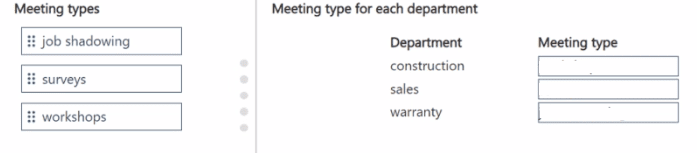
You need to conduct discovery meetings to gather information for each job role.
Which type of meeting should you use for each department?
To answer, move the appropriate meeting types to the correct departments. You may use
each meeting type once, more than once, or not at all. You may need to move the split bar
between panes or scroll to view content.
NOTE: Each correct selection is worth one point.
Explanation:
This is a drag-and-drop question from the PL-600 exam (commonly in the First Up Consulting or home builder case study). As a solution architect, you conduct discovery meetings to understand job roles and processes in sales, construction, and warranty departments. Meeting types must align with department characteristics: construction involves hands-on, demonstrable work; sales staff are mobile and dispersed; warranty requires collaborative, in-person discussion of roles and processes. The goal is effective requirements gathering without disrupting operations.
Correct Option:
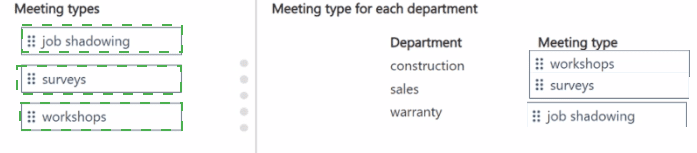
Construction → job shadowing
Job shadowing is best for construction because team members perform physical, hands-on tasks (e.g., building homes, site operations) that are difficult to describe verbally or in writing. Shadowing allows the architect to observe processes firsthand, understand workflows, pain points, and real-world context directly, leading to more accurate requirements.
Sales → surveys
Sales personnel are often remote, traveling, or working flexible hours across locations. Surveys enable asynchronous, self-paced input without scheduling conflicts, allowing many people to provide feedback conveniently on their processes, tools, and needs while minimizing disruption to revenue-generating activities.
Warranty → workshops
Warranty staff typically work in a more centralized or office-based setting with shared responsibilities. Workshops facilitate interactive, in-person (or live virtual) sessions for group discussion, brainstorming, clarification of complex processes, and collaborative mapping of job roles and requirements.
Incorrect Option:
There are no truly "incorrect" assignments here since all types are used once, but misplacements would be incorrect (e.g., assigning workshops to sales would be inefficient due to scheduling issues; surveys to construction would miss observing physical processes; job shadowing to warranty might be unnecessary overhead if processes are discussion-based rather than observable actions).
Reference:
ExamTopics discussion (PL-600 Topic 1 Question 64): https://www.examtopics.com/discussions/microsoft/view/149445-exam-pl-600-topic-1-question-64-discussion
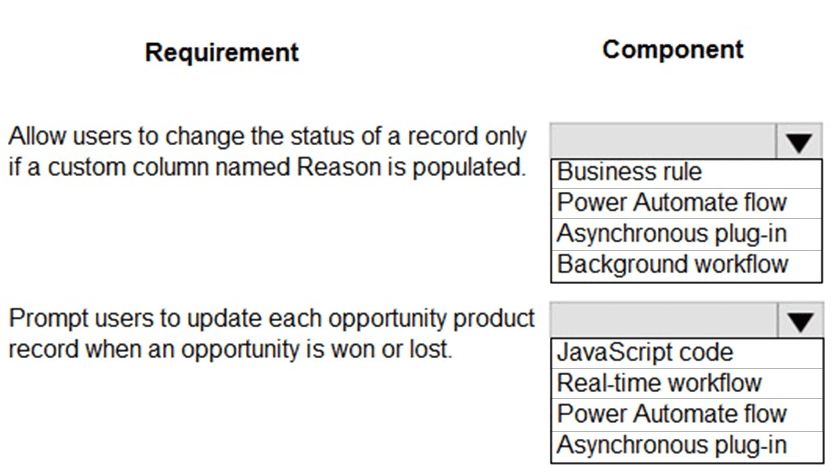
You are designing a Microsoft Power Platform solution for a company.
Which components should you recommend? To answer, select the appropriate options in
the answer area.
NOTE: Each correct selection is worth one point.
Explanation:
This PL-600 question tests your ability to recommend the most appropriate low-code/no-code components for two common requirements in a Power Platform solution: enforcing conditional validation before status changes (e.g., on Opportunity or Case records) and prompting users interactively during key business events like closing an Opportunity. Business rules provide client-side, real-time enforcement without code, while real-time (synchronous) workflows can trigger UI prompts or actions during form events like status updates. The focus is on user experience, performance, and avoiding unnecessary custom code or async processing.
Correct Option:
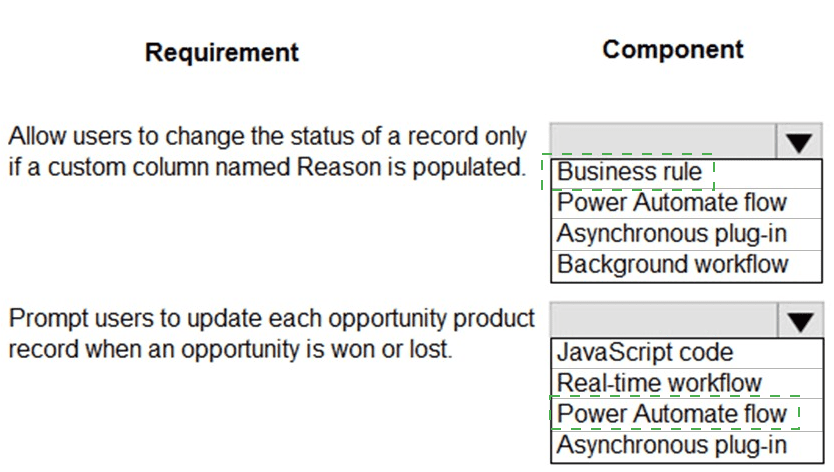
Allow users to change the status of a record only if a custom column named Reason is populated → Business rule
Business rules in Dataverse execute client-side on the form in real time. They can check if the Reason field has a value (not null/empty) and lock or hide the status field (or show an error message) if it's blank, preventing the status change until populated. This is declarative, efficient, and aligns with Microsoft’s preference for low-code enforcement of simple field-level conditions without plugins or flows.
Prompt users to update each opportunity product record when an opportunity is won or lost → Real-time workflow
A real-time (synchronous) workflow triggers immediately on the Opportunity close (Won/Lost) event. It can check child Opportunity Product records, and if updates are needed (e.g., missing data), stop the process with a user-friendly error message prompting the user to edit the related products before completing the close action. This ensures interactive prompting in the UI without async delays.
Incorrect Option:
Allow users to change the status... → Power Automate flow
Power Automate flows (cloud flows) run server-side and asynchronously; they cannot prevent a status change in real time on the form. A user could save the status change before the flow runs, making it unsuitable for blocking/preventing invalid updates. Flows are better for post-event automation, not conditional enforcement.
Allow users to change the status... → Asynchronous plug-in / Background workflow
These execute server-side after the record is saved (async), so they cannot block or prevent the status update in the user interface before it happens. They are for background processing, not real-time validation or user blocking.
Prompt users to update each opportunity product... → JavaScript code
While JavaScript on the form (onChange/onSave) could achieve prompting, PL-600 emphasizes low-code/no-code solutions where possible. Real-time workflows provide a no-code alternative for event-based prompting on Opportunity close, reducing custom code maintenance.
Prompt users to update each opportunity product... → Power Automate flow / Asynchronous plug-in
Power Automate flows and async plugins run after the save/commit, so they cannot interrupt the close process to prompt the user interactively in real time. The user would complete the Won/Lost action before any prompt appears (e.g., via email or notification), defeating the interactive requirement.
Reference:
Microsoft Learn: Create and edit business rules - https://learn.microsoft.com/en-us/power-apps/maker/data-platform/data-platform-create-business-rule
You are designing a Microsoft Power Platform solution for a financial services company.
Data from existing financial systems will be imported into Microsoft Dataverse and
displayed to users as part of the app deployment.
The company has the following issues with data:
• Phone numbers in records can contain letters in the record.
• Security has not been applied to financial total values held in each record.
• Users and managers can see all records.
You need to apply data quality standards to the solution.
What should you recommend? To answer, drag the appropriate solutions to the correct
data quality items. Each solution may be used once, more than once, or not at all. You may
need to drag the split bar between panes or scroll to view content
NOTE: Each correct selection is worth one point.


Explanation:
The question presents three distinct data quality and security issues that need resolution in a financial services solution. Each issue requires a specific Dataverse capability designed to address data integrity or access control concerns. Proper matching ensures phone number format validation, financial data protection, and appropriate record visibility based on organizational hierarchy.
Correct Option Matching:
Phone numbers must contain only numbers → Masking rules
Masking rules in Dataverse enforce specific data formats by applying input patterns that restrict what users can enter. For phone numbers requiring only digits, masking rules can be configured to accept only numeric characters, preventing letters from being entered and ensuring consistent data quality at the point of entry.
Account financial totals are secured for only authorized users to access → Field-level security
Field-level security provides granular control over specific fields within a record, allowing administrators to restrict access to sensitive data like financial totals while permitting access to other fields. This ensures only users with explicit permissions can view or edit financial information, regardless of their broader record access.
Users must be able to view their records and managers must be able to view records for their team → Hierarchical security
Hierarchical security extends the security model to support organizational reporting structures. It enables managers to access records owned by their direct and indirect reports while maintaining proper data isolation for non-reporting relationships. This fulfills the requirement for team-based record visibility without granting blanket access.
Incorrect Options (if misapplied):
Masking rules for financial totals would be incorrect because masking rules format input but do not control access permissions. They cannot prevent unauthorized users from viewing sensitive data once entered.
Field-level security for phone number format would be incorrect because field-level security controls read/write access, not data format validation. It cannot enforce that phone numbers contain only numbers.
Hierarchical security for phone numbers would be incorrect because hierarchical security manages record visibility based on reporting relationships, not data format enforcement or field-level access control.
Reference:
Microsoft Dataverse security documentation covering field-level security profiles and hierarchical security configuration. Data quality management features including column validation and masking rules.
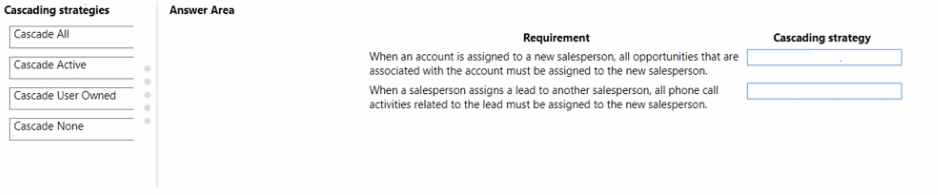
You are designing a data model for a Microsoft Power Platform solution.
The data model must meet the following requirements:
• When an account is assigned to a new salesperson, all opportunities that ate associated
with the account must be assigned to the new salesperson.
• When a salesperson assigns a lead to another salesperson, all phone call activities
related to the lead must be assigned to the new salesperson.
You need to recommend cascading strategies for the data model.
Which cascading strategy should you recommend? To answer, drag the appropriate
cascading strategies to the correct requirements. Each cascading strategy may be used
once, more than once, or not at all. You may need to drag the split bar between panes or
scroll to view content
NOTE: Each correct selection is worthone point.
Explanation:
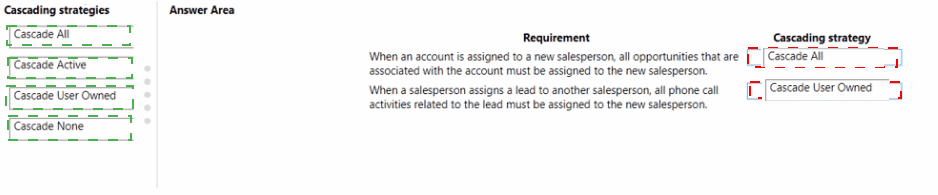
The question requires selecting appropriate cascading strategies for relationship behavior in Dataverse. Cascading rules determine how actions performed on a parent record affect related child records. Account-Opportunity and Lead-Phone Call relationships need different strategies based on business requirements for record reassignment. Proper selection ensures data integrity and automation of ownership changes.
Correct Option Matching:
When an account is assigned to a new salesperson, all opportunities associated with the account must be assigned → Cascade All
Cascade All ensures that when the parent account is reassigned, all related opportunity records are automatically reassigned to the same new owner. This maintains consistency between accounts and their associated opportunities, ensuring the new salesperson has complete visibility into all related business development activities.
When a lead is assigned to another salesperson, all phone call activities related to the lead must be assigned → Cascade User Owned
Cascade User Owned reassigns only those related records owned by the same user as the parent. This ensures phone call activities created by the original salesperson transfer with the lead, but activities owned by other users (like customer service calls) remain with their respective owners, preserving appropriate ownership boundaries.
Incorrect Strategies:
Cascade Active would be incorrect for both requirements because it only reassigns active records while leaving inactive records with the original owner. The requirements specify all associated records must transfer regardless of status.
Cascade None would be incorrect as it would leave child records orphaned with the original owner, failing both requirements for automatic reassignment during ownership changes.
Reference:
Microsoft Dataverse relationship behavior documentation covering cascading rules for parental relationships. Entity relationship configuration options including Cascade All, Cascade Active, Cascade User Owned, and Cascade None.
| Page 1 out of 20 Pages |
Microsoft Power Platform Solution Architect Practice Exam Questions
PL-600 - Microsoft Power Platform Solution Architect Official Exam Blueprint and Weight:
1. Perform Solution Envisioning and Requirement Analysis
Official Exam Weight: 30-35%
Subtopics: Gather business requirements, identify existing systems and integrations, perform fit-gap analysis, identify functional and non-functional requirements, recommend Microsoft Power Platform components, design solution strategy, identify licensing requirements, recommend security and compliance solutions, identify data sources and integration requirements, assess organizational readiness, identify risks and dependencies, facilitate workshops and requirement sessions, validate business objectives, define success criteria and KPIs, document architecture decisions, plan application lifecycle management (ALM) strategy.
2. Architect a Solution
Official Exam Weight: 40-45%
Subtopics: Design data models using Microsoft Dataverse, design integrations with external systems, recommend automation solutions using Power Automate, design user experiences using model-driven and canvas apps, design Power Pages solutions, design AI Builder and Copilot capabilities, design security models and role-based access control, define environment strategy, implement governance and compliance controls, design business process automation, recommend reporting and analytics solutions using Power BI, architect high availability and scalability solutions, design disaster recovery strategy, define authentication and authorization methods, optimize solution performance, recommend extensibility options using plugins custom connectors and Azure services.
3. Implement the Solution
Official Exam Weight: 15-20%
Subtopics: Configure Microsoft Dataverse, create tables columns and relationships, configure business rules and workflows, implement Power Automate cloud flows, configure integrations and connectors, deploy managed and unmanaged solutions, configure application lifecycle management processes, manage environments and solutions, configure security roles and teams, validate solution functionality, implement monitoring and diagnostics, configure Power Platform pipelines, manage data migrations, troubleshoot implementation issues, optimize deployments and releases.
4. Manage the Solution Lifecycle
Official Exam Weight: 10-15%
Subtopics: Monitor solution health and performance, manage updates and releases, implement governance policies, maintain documentation, manage support and issue resolution processes, monitor adoption and usage analytics, implement backup and recovery strategies, manage change requests, evaluate enhancement opportunities, optimize operational processes, ensure compliance with organizational standards, review security posture and access management.
| Domain | Title | Exam Weight |
|---|---|---|
| 1 | Perform Solution Envisioning and Requirement Analysis | 30-35% |
| 2 | Architect a Solution | 40-45% |
| 3 | Implement the Solution | 15-20% |
| 4 | Manage the Solution Lifecycle | 10-15% |
PL-600: What This Exam Is Really Testing
The PL-600 Microsoft Power Platform Solution Architect exam focuses on designing end-to-end solutions—not just building apps. You will be judged on how well you translate business needs into a secure, scalable architecture using the Power Platform and Microsoft ecosystem.
What You Need to Be Comfortable With
Discovery & requirements: stakeholders, use cases, constraints, success metrics
Architecture choices: when to use Power Apps, Power Automate, Power Pages, copilots, and when not to
Data & integration: Dataverse design, security roles, data modeling, connectors, integration patterns
ALM & governance: environments, solutions, deployment strategy, guardrails, CoE concepts
Security & compliance: least privilege, DLP policies, identity approach, auditing
Performance & reliability: scale, limits, monitoring, resiliency planning
A Study Approach That Matches the Exam
Think in decision frameworks, not features. For every scenario, practice answering:
What’s the business outcome?
What’s the data source and security model?
What’s the simplest architecture that meets requirements?
How will it be deployed and governed?
Mistakes That Cost Marks
Designing an app without a clear Dataverse/data model plan
Ignoring environment strategy and ALM (solutions, pipelines, versioning)
Overusing custom code when configuration meets the need
Treating DLP and security as an afterthought
Practice That Helps You Pass
PL-600 practice questions are scenario-heavy and written like real projects. Microsoft Power Platform Solution Architect practice tests on msmcqs.com can help you improve requirement-reading, eliminate “almost right” options, and spot gaps in governance and ALM thinking.
Customer Love
Solution architecture concepts were easier to grasp with MSmcqs.com practice exam for Microsoft Certified: Power Platform Solution Architect Expert. The scenario-based PL-600 questions prepared me well for the real exam.
Miguel Torres | Spain