Free Microsoft MB-920 Practice Test Questions MCQs
Stop wondering if you're ready. Our Microsoft MB-920 practice test is designed to identify your exact knowledge gaps. Validate your skills with Microsoft Dynamics 365 Fundamentals (ERP) questions that mirror the real exam's format and difficulty. Build a personalized study plan based on your free MB-920 exam questions mcqs performance, focusing your effort where it matters most.
Targeted practice like this helps candidates feel significantly more prepared for Microsoft Dynamics 365 Fundamentals (ERP) exam day.
21490+ already prepared
Updated On : 17-Jul-2026149 Questions
Microsoft Dynamics 365 Fundamentals (ERP)
4.9/5.0
A company plans to implement Dynamics 365 Finance. The company wants to be able to perform the following actions:
Calculate aged balances by customer.
Create customer invoices that are not related to sales orders.
You need to explore accounting solutions for these business requirements.
What should you recommend? To answer, select the appropriate options in the answer area.
NOTE: Each correct selection is worth one point.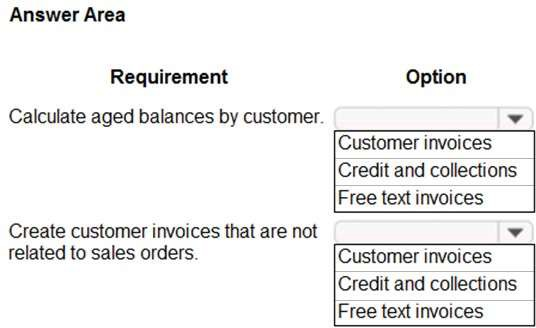
Explanation:
Dynamics 365 Finance provides specialized tools to manage accounts receivable and monitor customer payment health. For organizations that need to bill for services or miscellaneous items without the overhead of a formal inventory-based sales order, the system offers flexible invoicing alternatives. Simultaneously, the platform includes a robust credit management engine that analyzes historical transaction data to provide a clear view of outstanding debt. These capabilities allow financial teams to streamline their billing processes while maintaining tight control over their cash flow and collections efforts.
Correct Option:
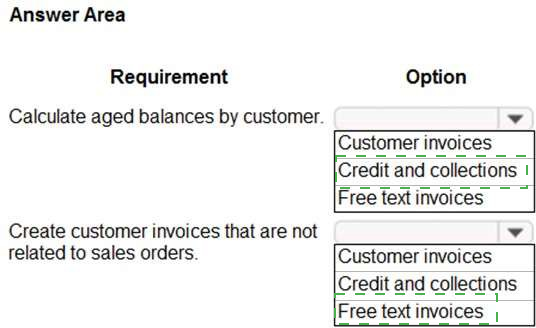
Calculate aged balances by customer: Credit and collections
The Credit and collections module is specifically designed to manage the collections process and track customer debt. It provides the aging reports and snapshots necessary to view overdue balances across different time buckets (e.g., 30, 60, or 90 days) for individual customers or groups.
Create customer invoices that are not related to sales orders: Free text invoices
A Free text invoice is used for sales that do not require a sales order, packing slip, or inventory item. It allows a user to enter an invoice line that includes a ledger account, sales tax, and a description, making it ideal for billing services or miscellaneous charges.
Incorrect Option:
Customer invoices:
In Dynamics 365, "Customer invoices" typically refers to the final documents generated from formal Sales orders. While they reflect debt, they are the result of a logistics process rather than a tool for calculating aged balances or billing for non-order-related items.
Credit and collections (for invoicing):
While this module manages the results of invoicing (the debt), it does not contain the transactional entry screens used to actually generate and post a new invoice document to a customer.
Reference:
Microsoft Learn: Create a free text invoice
Microsoft Learn: Collections and credit in Accounts receivable
A company manufactures and sells chairs. The company uses Dynamics 365 Finance and
Dynamics 365 Supply Chain Management for finance and manufacturing operations.
You need to determine which module to use for each operational need.
Which module should you use? To answer, drag the appropriate modules to the correct
scenarios. Each module may be used once, more than once, or not at all. You may need to
drag the split bar between panes or scroll to view content.
NOTE: Each correct selection is worth one point.

Explanation:
Dynamics 365 Supply Chain Management and Finance are designed to work in tandem to manage the complexity of discrete manufacturing. In a chair manufacturing environment, the system must handle everything from the procurement of raw materials and the assembly of finished goods to the analysis of historical sales data for future planning. By utilizing specific modules for production control and demand forecasting, companies can reduce waste, optimize inventory levels, and ensure that manufacturing capacity aligns with customer demand.
Correct Option:
Scenario:
Create orders for the bill of material items to manufacture chairs.
Module:
Production control
Explanation:
The Production control module is used to manage the manufacturing lifecycle of products that use a Bill of Materials (BOM). It allows you to create production orders, schedule work on the shop floor, and track the consumption of materials and labor required to build each chair.
Scenario:
Determine the number of chairs sold last month to predict future demand.
Module:
Master planning
Explanation:
The Master planning module includes demand forecasting capabilities that analyze historical transaction data, such as sales from the previous month, to generate predictions for future requirements. This helps the company plan production and purchasing activities effectively.
Incorrect Option:
IoT Intelligence:
While this can monitor machine health on the production line, it is not used for creating BOM-based production orders or calculating demand forecasts based on sales history.
Accounts payable / Accounts receivable:
These modules handle the financial aspects of buying raw materials and billing customers, respectively, but they do not manage the physical manufacturing process or demand planning.
Credit and collections:
This module is used to manage customer credit limits and recover overdue payments, which is unrelated to the manufacturing of goods or demand prediction.
Reference:
Microsoft Learn: Production control overview
Microsoft Learn: Demand forecasting overview
A company plans to implement Dynamics 365 Supply Chain Management.
Instructions: For each of the following statements, select Yes if the statement is true.
Otherwise, select No.
NOTE: Each correct selection is worth one point.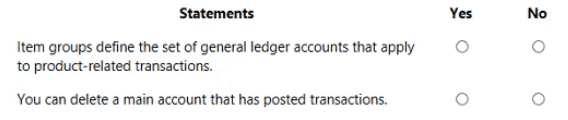
Explanation:
Dynamics 365 Supply Chain Management and Finance apps utilize integrated frameworks to manage complex business data, financial governance, and project lifecycles. Item groups are a fundamental setup in Supply Chain Management that link physical product transactions to the General Ledger, ensuring that every inventory movement is correctly reflected in the company's financial accounts. For project-based work, Project Operations coordinates the transition from sales quotes to delivery, using Stages to provide governance and reporting oversight throughout the engagement.
Correct Option (image_bdf598.png):
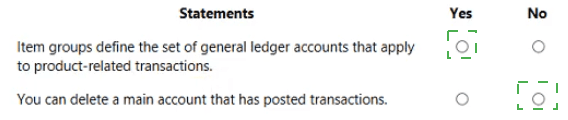
Item groups define the set of general ledger accounts that apply to product-related transactions: Yes.
Item groups are used to categorize products and, more importantly, to define the posting profiles for inventory, sales, and purchase transactions to specific ledger accounts.
You can delete a main account that has posted transactions: No.
To maintain financial integrity and audit trails, the system prevents the deletion of any main account once it contains posted transaction data.
Incorrect Option:
The statement regarding deleting a main account with transactions is false because it would break historical financial records and the integrity of the trial balance.
Reference:
Microsoft Learn: Item groups overview
Microsoft Learn: Main accounts and the chart of accounts
Exam MB-920 Study Guide: Describe Dynamics 365 Supply Chain Management core capabilities
A company plans to implement Dynamics 365 Project Operations. You need to recommend
a capability that meets each requirement.
Which capability should you recommend? To answer, select the appropriate option in the
answer area.
NOTE: Each correct selection is worth one point.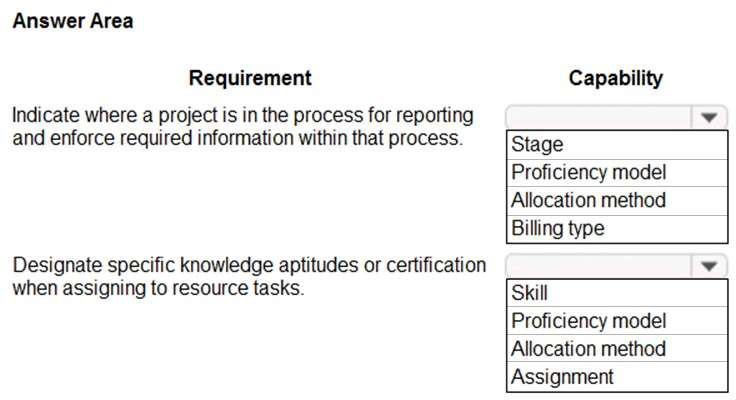
Explanation:
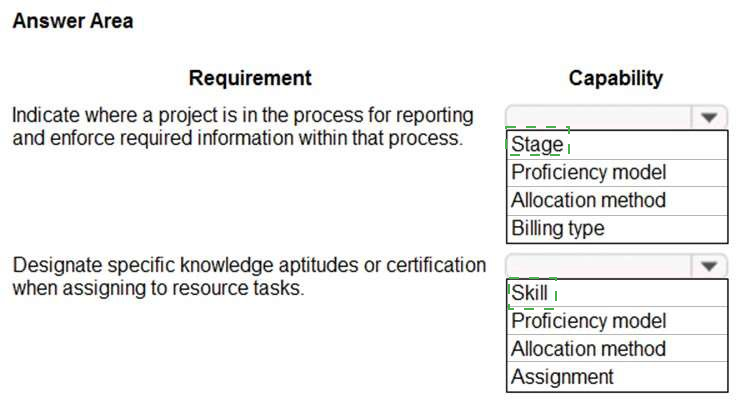
Dynamics 365 Project Operations is a unified business application designed to manage the end-to-end lifecycle of project-based services. To maintain operational consistency, the system uses Stages to track a project’s lifecycle (e.g., from New to In Process to Completed), acting as a governance tool that can enforce data entry requirements before a project can advance. For resource management, the system utilizes a Skill database to categorize the knowledge, aptitudes, and certifications of staff. This allows project managers to precisely match the right talent to specific tasks based on technical requirements or professional credentials.
Correct Options (image_be4c2d.png):
Requirement: Indicate where a project is in the process for reporting and enforce required information within that process.
Capability: Stage
Explanation: Project stages (or phases) define the status of a project. They are essential for high-level reporting and can be configured to prevent a project from moving forward until specific documentation or financial data is provided.
Requirement: Designate specific knowledge aptitudes or certification when assigning to resource tasks.
Capability: Skill
Explanation: Skills are used to define the specific competencies, such as software expertise or industry certifications, required for a project task. This allows for automated or manual resource matching to ensure the most qualified staff are assigned.
Incorrect Options (image_be4c2d.png):
Proficiency model: While related to skills, a proficiency model defines the level of a skill (e.g., beginner vs. expert) rather than the aptitude itself.
Allocation method: This refers to how a resource's time is spread across a project (e.g., full capacity vs. remaining capacity) rather than tracking project progress or knowledge.
Billing type: This categorizes whether a task is chargeable, non-chargeable, or complimentary for financial purposes.
Assignment: This is the final action of booking a resource to a task, not the designation of knowledge or certifications required for that task.
Reference:
Microsoft Learn: Project lifecycle and stages overview
Microsoft Learn: Resource management and skills overview
A company plans to implement Dynamics 365 Project Operations.
Instructions: For each of the following statements, select Yes if the statement is true.
Otherwise, select No.
NOTE: Each correct selection is worth one point.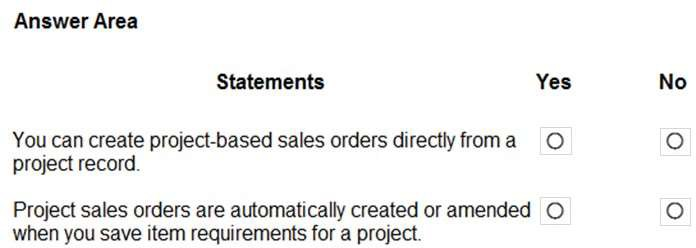
Explanation:
Dynamics 365 Project Operations provides a unified platform to manage the entire project lifecycle, from sales and resource management to project accounting. Within this ecosystem, project-based sales orders and item requirements are closely linked to the core project record to ensure that materials and services are correctly allocated and billed. Additionally, the platform integrates with broader Dynamics 365 Finance features, such as automated OCR for expense management and complex fixed asset depreciation, to provide a complete end-to-end business solution.
Correct Options:
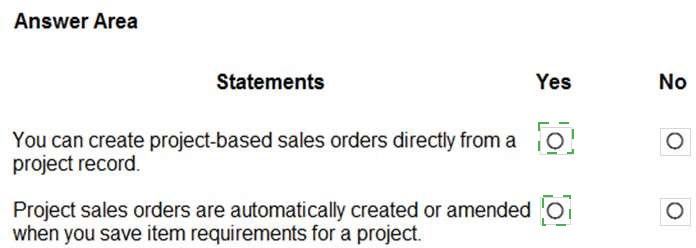
Project Operations Statements (image_be53ef.png)
You can create project-based sales orders directly from a project record: Yes.
Project managers can initiate sales orders directly from the project to handle the sale of items or services associated with that specific engagement.
Project sales orders are automatically created or amended when you save item requirements for a project: Yes.
In the project management and accounting module, saving an item requirement typically triggers the creation of a corresponding sales order line to manage the logistics and eventual billing of that item.
Project Contracts (image_bfc737.png)
Used to manage billing details: Yes.
Generated from an approved lead record: No.
Contracts are typically generated from a won Quote, not directly from a lead.
Contain details about agreed-upon product and project items: Yes.
Incorrect Options:
Project Operations (image_be53ef.png)
There are no "No" selections for this specific set of statements as they describe standard integration behavior between project records and sales/item logistics.
Financial Capabilities (image_03e10e.png & image_be6ad1.png)
Scheduled generation of financial statements: Yes.
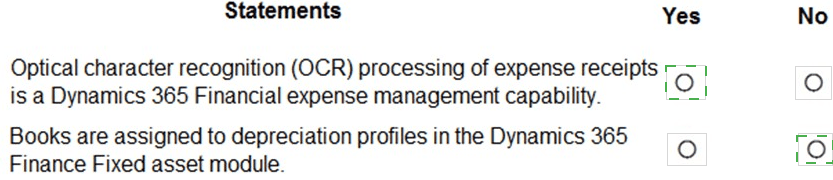
OCR for expense receipts: Yes.
Books assigned to depreciation profiles: Yes.
Reference:
Microsoft Learn: Project management and accounting overview
Microsoft Learn: Create and manage project sales orders
Microsoft Learn: Item requirements in projects
A retailer plans to award its customers based on the amount of money they spend. The retailer has not previously offered a customer reward program.
You need to recommend a method for tracking customer spending.
What should you recommend? To answer, select the appropriate options in the answer area.
NOTE: Each correct selection is worth one point.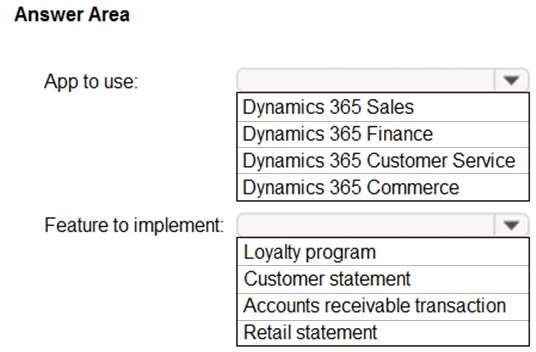
Explanation:
Dynamics 365 Commerce provides comprehensive tools to manage and enhance customer relationships through integrated loyalty programs. These programs allow retailers to define specific rules for how customers earn and redeem points based on their spending behavior across different channels. By centralizing this data, the system can automatically track purchases and apply rewards, enabling a personalized shopping experience that encourages repeat business and provides valuable insights into customer lifetime value.
Correct Option:
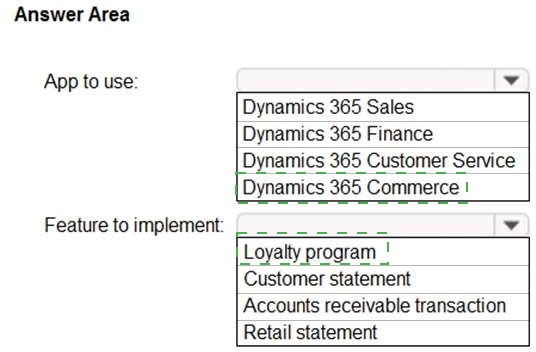
App to use: Dynamics 365 Commerce
This application is specifically designed for retail environments and includes native modules for managing omnichannel customer interactions, including point-of-sale (POS), e-commerce, and back-office retail operations.
Feature to implement: Loyalty program
The loyalty program feature allows the retailer to establish loyalty tiers, earning rules (e.g., 1 point per $1 spent), and redemption schemes. It is the standard mechanism within the Dynamics 365 ecosystem for rewarding customers based on their spending history.
Incorrect Option:
App to use (Sales, Finance, Customer Service):
While these apps have customer-related features, they do not contain the specialized retail loyalty engines found in the Commerce app. Finance handles core accounting, while Sales and Customer Service focus on CRM and support ticketing.
Feature to implement (Customer statement, Accounts receivable transaction, Retail statement):
Customer statement/Accounts receivable transaction:
These are financial documents and records used for billing and debt collection, not for tracking reward points.
Retail statement:
This is a back-office process used to reconcile daily transactions from stores, not a customer-facing reward feature.
Reference:
Microsoft Learn: Loyalty overview in Dynamics 365 Commerce
Microsoft Learn: Set up loyalty programs
For each of the following statements, select Yes if the statement is true. Otherwise, select
No.
NOTE: Each correct selection is worth one point.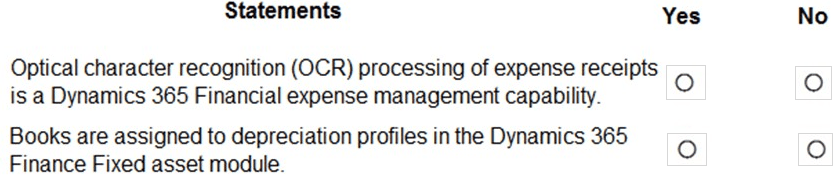
Explanation:
Dynamics 365 Finance and Operations apps utilize a robust framework of internal controls, automated workflows, and advanced data processing to manage complex business requirements. Key features include Separation of Duties, which prevents fraud by ensuring no single user has total control over a high-risk process, and Workflow automation, which triggers notifications or approvals based on specific financial thresholds. Additionally, the system leverages automated Financial Reporting tools that can be scheduled to generate periodic statements, ensuring stakeholders have consistent access to updated financial data.
Correct Option (image_03e10e.png):
Configure separation of duties for tasks that must be performed by different users: Yes.
This is a core security feature used to mitigate risk by ensuring that conflicting responsibilities (like creating a vendor and paying that same vendor) are assigned to separate individuals.
Automatic notification for approval when an invoice created is higher than $10,000: Yes.
Dynamics 365 uses a flexible workflow engine where conditional rules can be set to require management approval only when transactions exceed defined monetary limits.
Scheduled generation of financial statements: Yes.
The Financial Reporting component allows users to schedule report groups to generate at specific intervals (daily, weekly, etc.) and store them in the report library.
Incorrect Option (image_03e10e.png):
There are no "No" selections for this specific set of statements as all three describe standard, out-of-the-box features of the Dynamics 365 Finance platform.
Reference:
Microsoft Learn: Security and separation of duties in Finance and Operations
Microsoft Learn: Workflow system overview
Microsoft Learn: Financial reporting overview
A company is implementing Dynamics 365 Finance.
You need to match the cash and bank management business process to the company
requirements.
Match each requirement to its business process.
Instructions: To answer, drag the appropriate requirement from the column on the left to its business process on the right Each requirement may be used once, more than once, or not at all. Each correct match is worth one point.

Explanation:
Dynamics 365 Finance provides a centralized Cash and Bank Management module to oversee all financial interactions between an organization and its banking institutions. This module is critical for maintaining liquidity, ensuring that all bank transactions are accurately reflected in the general ledger, and managing specialized financial instruments like letters of guarantee. By automating the matching of bank statements and providing tools for invoice adjustments, the system reduces manual errors and provides a clear, real-time view of the company's actual cash position.
Correct Option:
Settlements: Correct overpayments or underpayments on invoices.
Settlement is the process in Dynamics 365 Finance where a payment is matched against an invoice. During this process, users can identify and resolve discrepancies, such as applying a partial payment to an invoice or handling small overpayments according to company policy.
Bank account reconciliation: Cross-check bank transactions with the bank statement.
This process involves comparing the bank transactions recorded in the system's ledger against the actual transactions reported on a bank statement. It ensures that all deposits, withdrawals, and fees are accounted for and that the system balance matches the bank's records.
Incorrect Option:
Create ledger entries for a letter of guarantee:
While this is a requirement handled within the Cash and Bank Management module, it is a specific transaction entry rather than a "Settlement" or "Reconciliation" process. It involves defining bank facilities and posting specific ledger accounts for the guarantee.
Report on banks that are holding letters of guarantee:
This refers to an analytical or reporting requirement. While essential for auditing and risk management, it is an output of the system rather than one of the core transactional business processes like reconciliation or settlement.
Reference:
Microsoft Learn: Cash and bank management overview
Microsoft Learn: Bank reconciliation overview
Microsoft Learn: Settle transactions with payments
| Page 1 out of 15 Pages |
Microsoft Dynamics 365 Fundamentals (ERP) Practice Exam Questions
These MB-920 practice questions with explanations help learners understand the fundamentals of Dynamics 365 ERP applications. Topics include finance, supply chain management, commerce, and human resources. Each question includes a clear explanation that helps candidates understand how ERP solutions work in real business environments. This method supports better retention and deeper learning of core concepts. By practicing regularly, candidates can strengthen their understanding of ERP systems, identify knowledge gaps, and gain confidence for the certification exam.Why People Love Us
ERP fundamentals cover finance, supply chain, and operations. The MB-920 exam tests core concepts. MSmcqs.com exam questions were well-structured and aligned with the exam objectives. I felt completely prepared and passed on my first attempt. Great starting point for ERP professionals!
Jessica Martinez, ERP Specialist | Orlando, FL