A company is implementing finance and operations apps as its enterprise resource planning (ERP) system. You need to identify the ERP capabilities that are provided by finance and operations apps. Which three capabilities should you identify? Each correct answer presents a complete solution. NOTE: Each correct selection is worth one point.
A. Manage global accounting systems.
B. Optimize material logistics.
C. Manage sales.
D. Provide customer service.
E. Define and manage business processes.
B. Optimize material logistics.
E. Define and manage business processes.
Explanation:
Dynamics 365 finance and operations apps serve as a comprehensive enterprise resource planning (ERP) suite designed to unify and automate complex business functions. Unlike standalone applications, this suite provides a centralized platform for managing financial health, supply chain logistics, and organizational governance. By integrating these back-office operations, companies can eliminate data silos, ensure regulatory compliance across multiple regions, and gain real-time visibility into the entire lifecycle of their products and financial transactions.
Correct Option:
A. Manage global accounting systems:
Dynamics 365 Finance provides a robust framework for managing multi-currency transactions, global tax localizations, and consolidated financial reporting across multiple legal entities.
B. Optimize material logistics:
Dynamics 365 Supply Chain Management enables businesses to streamline their inventory, warehousing, and transportation processes to ensure efficient movement and storage of goods.
E. Define and manage business processes:
The platform includes a powerful workflow engine and Lifecycle Services (LCS) that allow organizations to standardize, automate, and monitor their unique operational procedures.
Incorrect Option:
C. Manage sales:
While finance and operations apps handle the fulfillment of sales orders, the core "Sales" capability (lead-to-opportunity management) is traditionally provided by Dynamics 365 Sales (CRM).
D. Provide customer service:
Managing support tickets, service level agreements (SLAs), and customer inquiries is the primary function of Dynamics 365 Customer Service, which is distinct from the ERP-focused apps.
Reference:
Microsoft Learn: Dynamics 365 Finance overview
Microsoft Learn: Dynamics 365 Supply Chain Management overview
Microsoft Learn: Workflow system overview
A company uses Dynamics 365 Finance and Power BI. The company plans to analyze operational data for retail stores that they operate across the United States.
The company wants to analyze customer visit data based on the population in the areas where stores are located.
You need to recommend a Power BI visualization for the company.
Which Power BI visualization should you recommend?
A. Basic maps
B. Doughnut chart
C. Bar chart
Explanation:
Dynamics 365 Finance captures extensive operational data, but understanding the relationship between physical store locations and demographic trends requires a spatial perspective. By integrating this data with Power BI, the company can overlay internal metrics, such as customer visit counts, onto external geographical data, such as local population statistics. This allows stakeholders to visualize market penetration and identify whether stores in high-density areas are performing as expected or if there are underserved regions that warrant further investment.
Correct Option:
A. Basic maps:
This visualization allows the company to plot specific store locations using longitude and latitude or address data. It can use "bubbles" or heat mapping to represent customer visit volume, where the size or color intensity of the mark changes based on the population density of the surrounding area. This provides an immediate, intuitive understanding of how geographical factors influence store performance across the United States.
Incorrect Option:
B. Doughnut chart:
This chart type is designed to show the relationship of parts to a whole, such as the percentage of total sales coming from different product categories. It lacks the spatial capabilities required to map data across the United States or correlate visits with local population geography.
C. Bar chart:
While a bar chart is excellent for comparing customer visits between specific stores side-by-side, it does not provide geographical context. It cannot visualize the proximity of stores to one another or show how visit data trends fluctuate across actual physical terrain.
Reference:
Microsoft Learn: Visualization types in Power BI
Microsoft Learn: Map visualizations (Basic maps) in Power BI
Exam MB-920 Study Guide: Describe Dynamics 365 Finance – Financial Management and Analytics
For each of the following statements, select Yes if the statement is true. Otherwise, select
No.
NOTE: Each correct selection is worth one point.
Explanation:
Dynamics 365 Project Operations uses project contracts as the central hub for managing the commercial relationship with a customer throughout the project lifecycle. These contracts act as a binding agreement that defines how work will be billed, what specific items or services will be delivered, and the financial limits of the engagement. By transitioning from a quote to a contract, the system ensures that the estimates developed during the sales phase are accurately converted into actionable billing and delivery parameters.
Correct Option:
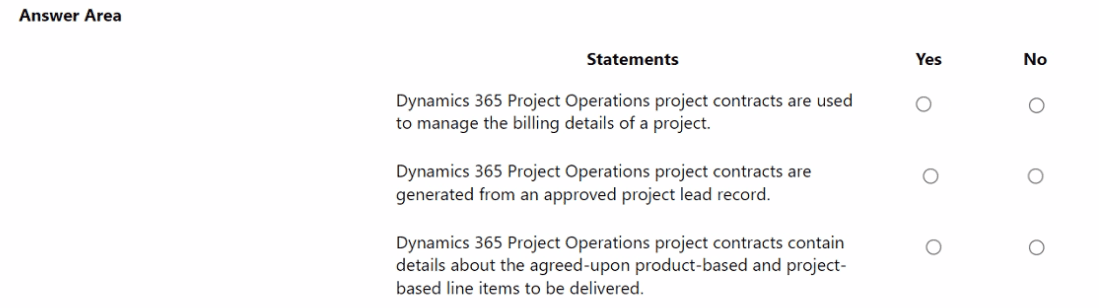
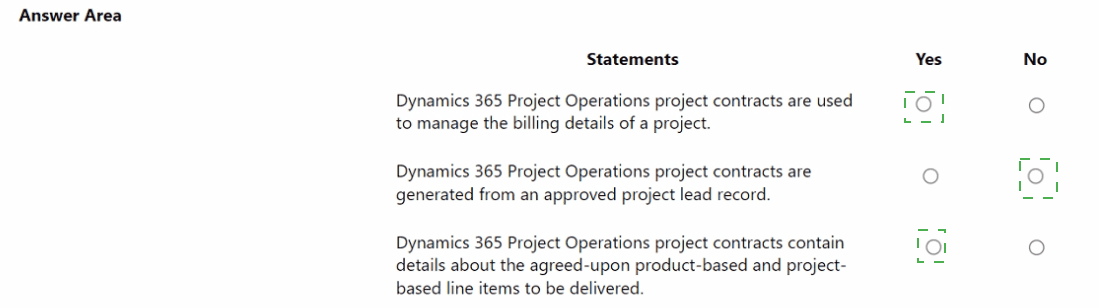
Dynamics 365 Project Operations project contracts are used to manage the billing details of a project (Yes):
The contract is where you define billing methods (such as Time and Material or Fixed Fee), billing schedules, and customer-specific price lists to ensure accurate invoicing.
Dynamics 365 Project Operations project contracts contain details about the agreed-upon product-based and project-based line items to be delivered (Yes):
A single project contract can include line items for specific physical products as well as service-based components (tasks or phases), providing a comprehensive view of the entire delivery scope.
Incorrect Option:
Dynamics 365 Project Operations project contracts are generated from an approved project lead record (No):
While a lead is the start of the sales process, a project contract is typically generated from a Project Quote once it has been won. The lead record must first be qualified into an opportunity and then quoted before a contract can be established.
Reference:
Microsoft Learn: Project contracts overview
Microsoft Learn: Working with project-based contract lines
Microsoft Learn: Sales process in Project Operations
A company plans to implement Dynamics 365 finance and operations apps.
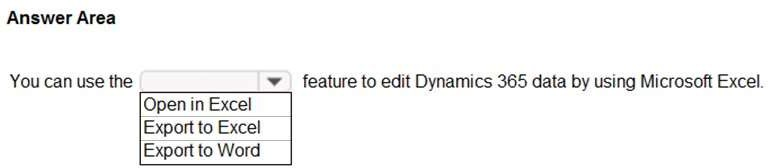
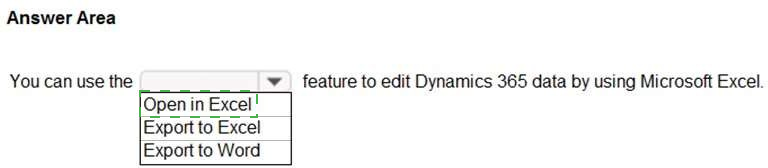
You need to recommend a feature that allow users to edit Dynamic 365 data by using Microsoft Office. Changes that you make in Microsoft Office must update Dynamic 365.
What should you recommend? To answer, select the appropriate options in the answer area.
Explanation:
Dynamics 365 finance and operations apps offer seamless integration with Microsoft Office to enhance productivity and simplify data management. For tasks involving bulk data entry or complex updates, users can leverage Excel's powerful editing capabilities while maintaining a direct link to the ERP system. This bidirectional integration ensures that data remains consistent across platforms, allowing for efficient record management without needing to manually re-enter information into the Dynamics 365 web interface.
Correct Option:
Open in Excel:
This feature utilizes the Microsoft Dynamics Office Add-in to create a live connection between the Excel workbook and the Dynamics 365 database. When a user selects this option, they can modify records directly within the spreadsheet and then use the "Publish" command in the Excel Add-in pane to sync those changes back to Dynamics 365 in real-time.
Incorrect Option:
Export to Excel:
This feature creates a static file or a dynamic worksheet for data analysis purposes only. While it allows you to view Dynamics 365 data in a spreadsheet format, it does not provide a mechanism to push edited data back to the source system to update records.
Export to Word:
This feature is primarily used for document generation, such as creating letters or formal reports based on Dynamics 365 data templates. It is a one-way output process and does not support data editing or synchronization back into Dynamics 365.
Reference:
Microsoft Learn: Office integration overview
Microsoft Learn: View and update entity data with Excel
A company plans to implement Dynamics 365 Supply Chain Management.
Which three actions can vendors perform? Each correct answer presents a complete solution.
NOTE: Each correct selection is worth one point.
A. Change the inventory cost of items.
B. Submit invoices electronically.
C. Create transfer orders.
D. Approve purchase orders.
E. Respond to a request for quote (RFQ).
D. Approve purchase orders.
E. Respond to a request for quote (RFQ).
Explanation:
Dynamics 365 Supply Chain Management utilizes a dedicated Vendor Collaboration portal to bridge the gap between an organization and its external suppliers. This interface allows vendors to interact with procurement data in real-time, reducing the administrative burden on internal purchasing agents. By providing a secure, restricted view of the system, vendors can manage their own documents, respond to business requests, and ensure that order information is synchronized without manual data entry.
Correct Option:
B. Submit invoices electronically:
Vendors can directly flip a received purchase order into an invoice within the portal. This ensures that the invoice data matches the order and receipt, facilitating a smoother "three-way match" for the accounts payable team.
D. Approve purchase orders:
When an internal buyer sends a purchase order, the vendor can review it on the portal to Accept, Reject with comments, or Suggest changes to quantities or dates.
E. Respond to a request for quote (RFQ):
This capability allows vendors to see open bidding opportunities. They can enter their best pricing, delivery lead times, and terms directly into the system for the procurement team to evaluate.
Incorrect Option:
A. Change the inventory cost of items:
Only internal users with specific financial or cost accounting roles can modify item costs. Allowing a vendor to change the internal valuation of inventory would violate core security and audit controls.
C. Create transfer orders:
Transfer orders are used to move goods between a company’s own warehouses or legal entities. This is an internal logistics movement and is not a function accessible to or relevant for external suppliers.
Reference:
Microsoft Learn: Vendor collaboration with external vendors
Microsoft Learn: Invoicing through vendor collaboration
Microsoft Learn: Procurement and sourcing overview
A company uses Dynamics 36S Human Resources. The company establishes a new department and hires employees to staff the department. The company wants to manage annual employee reviews.
What are two capabilities of Dynamics 365 Human Resources performance management?
Each correct answer presents a part of the solution.
NOTE: Each correct selection is worth one point.
A. Personnel actions
B. Competencies
C. Performance journals
D. Goals
D. Goals
The two correct capabilities are:
C. Performance journals:
These serve as a continuous feedback tool where both employees and managers can record notes about achievements, observations, or areas for improvement between formal review cycles. These entries can then be pulled into the final annual review to provide a comprehensive history of performance.
D. Goals:
This allows managers and employees to define, track, and update specific objectives. Goals can be linked to performance reviews to measure how well an employee is meeting their professional targets.
Why the other options are incorrect:
A. Personnel actions:
These are used to track formal changes to an employee's status, such as hires, transfers, or terminations, rather than their performance evaluations.
B. Competencies:
While these track skills, certifications, and proficiency levels, they are typically managed under the Competency management or Development areas rather than the core annual performance review cycle itself.
Summary of Module-Specific Capabilities
Based on your uploaded images, here is a quick-reference guide for the related modules:
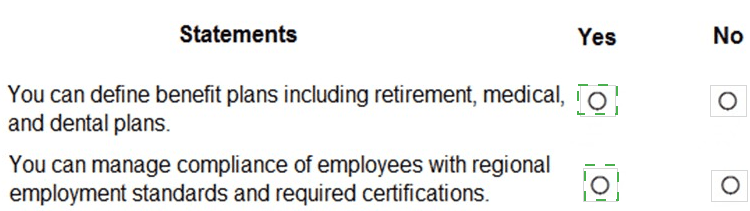
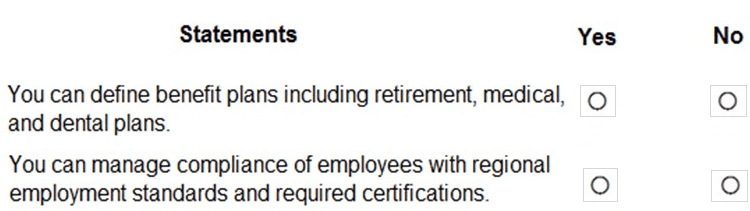
Benefits & Compliance: You can define benefit plans (medical/dental) and manage compliance with regional standards and certifications.
Reporting Tools: Use Mobile workspaces for intermittent connectivity and SSRS reports for scheduled batch reporting.
Asset Management: Finance tracks acquisition costs, while Supply Chain Management tracks maintenance lifecycle/parts.
Multinational Setup: Regional features are controlled by the primary address of the legal entity.
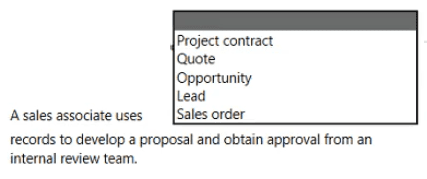
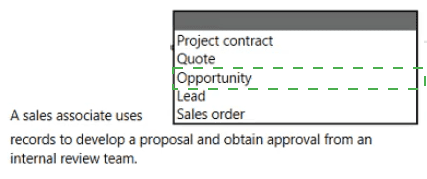
A company implements Dynamics 365 Project Operations for the sales quotation process.
A qualified lead requests a quotation for services.
Which records are used for this stage of the sales process? To answer, select the appropriate option in the answer area.
Explanation:
In the Project Operations sales lifecycle, once a lead is qualified, it typically moves to an Opportunity. From there, one or more Quotes are created to detail the specific services, estimated costs, and billing terms. The Quote is the formal document used for internal review and for presenting the final proposal to the customer.
Consolidated Answer Key for Uploaded Images
1. Project Operations & Sales (image_ca2cdb.png, image_1f3960.png)
Quotation stage records: Quote
Define a role with required competencies: Yes
Draft a WBS using initial resource assignments: Yes
2. Finance, Fixed Assets & Dimensions (image_1f2e5f.png, image_1e519e.png, image_ca38f5.png)
OCR processing of expense receipts: Yes
Books assigned to depreciation profiles: Yes
View overdue balances for a group at a point in time: aged balances
Customer ID as a financial dimension: Yes
Entity-backed dimensions shared across legal entities: Yes
Dimension set always includes main account: Yes
3. Human Resources (image_caa119.png)
Define benefit plans (medical/dental): Yes
Manage compliance and certifications: Yes
4. Reporting & Tool Selection (image_cab07b.png)
Intermittent connectivity / Mobile access: Mobile workspaces
Periodic scheduled reporting: SQL Server Reporting Services (SSRS) reports
5. Deployment, Security & Fraud (image_1e32f6.png, image_03e10e.png, image_1ebdbf.png)
Cloud infrastructure managed by Microsoft: Yes
Cloud deployment data trustee is the customer: No
Configure separation of duties: Yes
Automatic conditional approval notifications: Yes
Create decision rules for account safety: Yes
Analyze historical data for transaction rules: Yes
6. Asset Management & Commerce (image_f4775e.png, image_1eb2fa.png)
Track purchase/acquisition costs: Dynamics 365 Finance
Track maintenance lifecycle/spare parts: Dynamics 365 Supply Chain Management
Channel-specific payment methods/price groups: Yes
MPOS offline sales processing: Yes
A company implements Dynamics 365 Finance.
You need to recommend a way for the company to view overdue balances for a group of
customers at a point in time.
What should you recommend? To answer, select the appropriate option in the answer area.


Recommended Solution: Customer Aging Snapshot
A customer aging snapshot calculates aged balances for either all customers or a specific customer pool at a designated point in time. This is the most efficient way to manage and view overdue balances because:
Point in Time Analysis:
You can specify an "Aging as of" date, such as today's date or a selected historical date, to see exactly what balances were overdue at that moment.
Grouping with Customer Pools:
To view balances for a specific group of customers, you can use a Customer pool. These pools use queries to group customer records based on criteria like region, credit limit, or customer group.
Aged Balances View:
Once the snapshot is created, the information is displayed on the Aged balances list page and within the Collections workspace, providing a clear breakdown of balances across predefined aging periods (e.g., 30, 60, or 90 days past due).
Performance Optimization:
Creating snapshots is a periodic task that stores calculated data, ensuring that viewing large groups of customer balances does not slow down the system's real-time performance.
A company uses Dynamics 365 Human Resources. The company establishes a new department and hires employees to staff the department The company wants to manage annual employee reviews.
What are two capabilities of Dynamics 365 Human Resources performance management?
Each correct answer presents a part of the solution.
NOTE: Each correct selection is worth one point.
A. Personnel actions
B. Goals
C. Competencies
D. Performance journals
The two correct capabilities are:
B. Goals:
This allows managers and employees to define, track, and update specific objectives. Goals can be linked to performance reviews to measure how well an employee is meeting their professional targets.
D. Performance journals:
These serve as a continuous feedback tool where both employees and managers can record notes about achievements, observations, or areas for improvement between formal review cycles. These entries can then be pulled into the final annual review to provide a comprehensive history of performance.
Why the other options are incorrect:
A. Personnel actions:
These are used to track formal changes to an employee's status, such as hires, transfers, or terminations, rather than their performance evaluations.
C. Competencies:
While these track skills, certifications, and proficiency levels, they are typically managed under the Competency management or Development areas rather than the core annual performance review cycle itself.
Summary of Final Specific Questions
Based on your uploaded images, here is the quick-reference guide for the related modules:
Benefits & Compliance (image_caa119.png): You can define benefit plans (medical/dental) and manage compliance with regional standards and certifications.
Reporting Tools (image_cab07b.png): Use Mobile workspaces for intermittent connectivity and SSRS reports for scheduled batch reporting.
Asset Management (image_f4775e.png): Finance tracks acquisition costs, while Supply Chain Management tracks maintenance lifecycle/parts.
Multinational Setup (image_1e45fe.png): Regional features are controlled by the primary address.

Explanation of Module Capabilities
Reporting & Tool Selection (image_cab07b.png)
Requirement:
Ensure users can view, edit, and act on data with intermittent network connectivity.
Tool:
Mobile workspaces. These allow for offline data interaction that synchronizes once the device reconnects.
Requirement:
Schedule reports to run periodically via a scheduled batch job.
Tool:
SQL Server Reporting Services (SSRS) reports. These reports are the standard for high-volume business documents and fully support automated scheduling through the system's batch framework.
Enterprise Asset Management (image_f4775e.png)
Track purchase price and acquisition costs:
Use Dynamics 365 Finance. The Fixed Assets module handles the initial financial entry and subsequent depreciation.
Track maintenance, spare parts, and labor through lifecycle:
Use Dynamics 365 Supply Chain Management. The Asset Management module is purpose-built for operational maintenance and work order tracking.
ERP Modernization Issues (image_1fa2bf.png / image_1f9f3b.png)
Isolated departments:
Use Dynamics 365 Reporting. This enables secure cross-departmental visibility through unified dashboards without breaking compliance-driven data isolation.
Outdated system/Manual updates:
Use Dynamics 365 cloud deployment. Cloud-based instances are managed by Microsoft and updated automatically, ensuring the software is never outdated.
Finance Features & Security (image_03e10e.png / image_1e32f6.png)
Separation of duties:
Yes. This is a critical internal control used to prevent fraud.
Approval notifications (conditional):
Yes. Workflows can be triggered based on specific values, such as an invoice exceeding $10,000.
Cloud Infrastructure Management:
In a cloud deployment, the infrastructure is managed by Microsoft. The customer remains the data owner, but is not considered the "data trustee" for the platform's infrastructure.
Summary of Final Specific Questions
Multinational Setup (image_1e45fe.png):
Country-specific features are determined by the primary address of the legal entity.
Financial Dimensions (image_1e519e.png):
Customer IDs can be dimensions, entity-backed dimensions are shared across legal entities, and dimension sets must always include the main account.
Commerce (image_1eb2fa.png):
MPOS supports offline connectivity for sales processing, and you can set unique payment methods per channel.
| Page 2 out of 15 Pages |