A company plans to implement enterprise asset management by using Dynamics 365 Supply Chain Management.
Instructions: For each of the following statements, select Yes if the statement is true.
Otherwise, select No.
NOTE: Each correct selection is worth one point.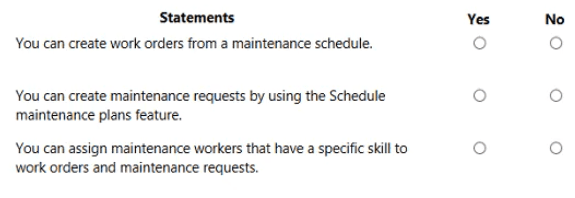
Explanation:
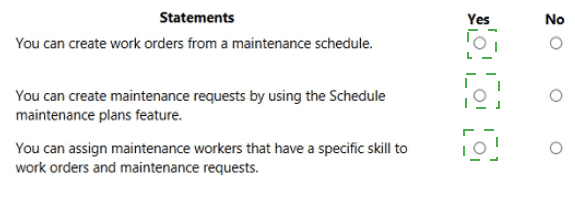
This question tests specific functionalities within the Asset Management module of Dynamics 365 Supply Chain Management, focusing on creating work orders, handling maintenance requests, and resource assignment.
Correct Option Explanations:
Statement 1:
Yes. Create work orders from a maintenance schedule. This is a core feature of preventive maintenance. You set up a maintenance schedule (time-based or meter-based) for an asset. When the schedule's threshold is reached, the system can automatically generate work orders without manual intervention.
Statement 3:
Yes. Assign workers with specific skills. You can define skills and certificates for maintenance workers (as workers in the system). When creating a work order, you can assign workers to the job, and you can filter or select them based on their required skill set for the task.
Incorrect Option Explanation:
Statement 2:
No. Create maintenance requests using Schedule maintenance plans. This statement confuses terms. Maintenance requests are typically unplanned, reactive reports of a problem (e.g., an operator logs a request for repair). They are created manually or via a mobile request. The "Schedule maintenance plans" feature is for setting up preventive maintenance schedules, which generate planned work orders, not "requests." The creation path is different.
Reference:
Microsoft Learn - "Overview of work orders in Asset Management" and "Set up workers and related entities."
The documentation confirms that work orders can be generated automatically from maintenance schedules.
It explains how to set up worker skills and assign workers to work orders.
Maintenance requests are described as a separate, unplanned entry point for creating work, not directly from scheduling plans.
A company is evaluating Dynamics 365 Supply Chain Management.
For each of the following statements, select Yes if the statement is true. Otherwise, select
No.
NOTE: Each correct selection is worth one point.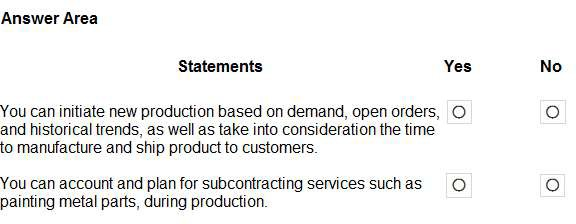
Explanation:
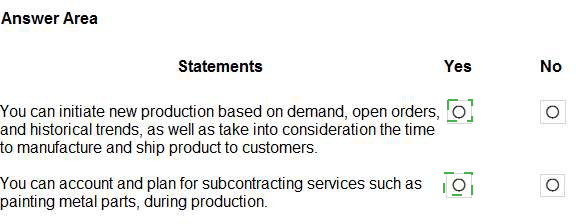
This question tests two core capabilities of the production planning and control features in Dynamics 365 Supply Chain Management: the scope of master planning and the handling of subcontracting operations.
Correct Option Explanations:
Statement 1:
Yes. Master planning based on demand, trends, and lead times. This describes the core function of Master planning (MRP). The planning engine:
Considers demand (sales orders, forecasts).
Analyzes open orders and current inventory.
Uses historical trends (if using forecasting).
Factors in manufacturing and shipping lead times to calculate the required start dates for production and purchase orders to meet customer due dates.
Statement 2:
Yes. Plan for subcontracting services. Subcontracting is a fully supported scenario. You can:
Define a route operation as a subcontracted operation.
Assign a vendor to that operation.
During planning or production order release, the system automatically generates a purchase order for the subcontracting service (e.g., painting).
Costs for the subcontracted service are included in the product's cost calculation.
Reference:
Statement 1: Microsoft Learn - "Master planning overview." The documentation explains that master planning calculates net requirements and planned orders based on demand, inventory, and lead times.
Statement 2: Microsoft Learn - "Subcontract manufacturing." This details how to set up and process subcontracted operations within production routes.
A company plans to use Dynamics 365 Supply Chain Management.
Instructions: For each of the following statements, select Yes if the statement is true.
Otherwise, select No.
NOTE Each correct selection is worth one point.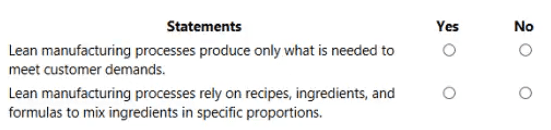
Explanation:
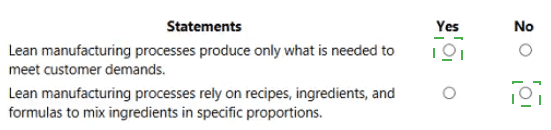
This question tests the core principles of Lean manufacturing in Dynamics 365 SCM and contrasts it with Process manufacturing. Lean manufacturing is a methodology focused on efficiency and waste reduction, while process manufacturing is about formulas and blending.
Correct Option Explanation:
Statement 1:
Yes. Lean produces only what is needed. This is the "pull" principle central to Lean manufacturing (inspired by the Toyota Production System). Production is triggered by actual demand (via kanbans), not by forecasts, to minimize overproduction and inventory waste.
Incorrect Option Explanation:
Statement 2:
No. Lean does not rely on recipes/formulas for mixing. This statement describes Process manufacturing, not Lean. Process manufacturing uses formulas and recipes to define ingredient proportions (e.g., chemicals, food). Lean manufacturing focuses on flow and pull-based production of discrete items using standardized work and kanbans; it is not about mixing ingredients.
Reference:
Microsoft Learn - "Discrete, process and lean manufacturing overview." The documentation defines:
Lean manufacturing: A pull-based, just-in-time production strategy that aims to eliminate waste and produce based on actual demand.
Process manufacturing: Used for formulas and recipes where output is not always discrete (e.g., blending).
A company uses Dynamics 365 Finance.
For each of the following statements, select Yes if the statement is true. Otherwise, select No.
NOTE: Each correct selection is worth one point.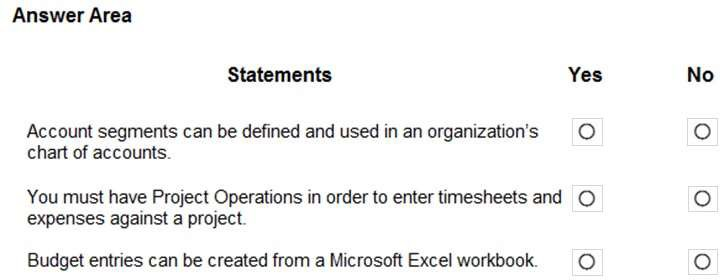
Explanation:
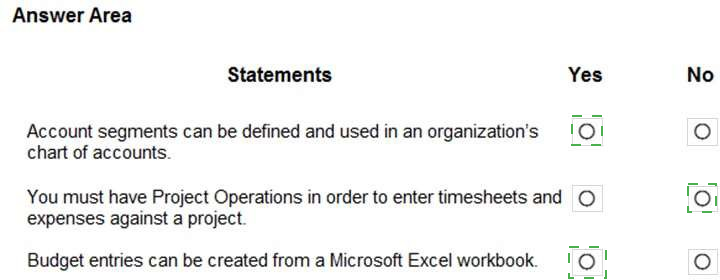
This question covers three distinct areas in Dynamics 365 Finance: the chart of accounts structure, project time/expense capabilities, and budget data management.
Correct Option Explanations:
Statement 1:
Yes. Account segments. This is true. Account segments refer to the structure of the main account number itself. In D365 Finance, you can define an account number format that includes segments (e.g., Division-Segment-Account). These segments can represent financial dimensions that are part of the main account structure (called a segmented entry control), allowing for a rich chart of accounts.
Statement 3:
Yes. Budget entries from Excel. This is a standard data management feature. Using the Data management workspace, you can import data from an Excel/CSV file. Budget register entries have a corresponding data entity, so you can create a data project, map your Excel file to the budget entity, and import budget amounts directly.
Incorrect Option Explanation:
Statement 2:
No. Project Operations is NOT required for timesheets/expenses against a project. This is false. The Project management and accounting (PMA) module is a core part of Dynamics 365 Finance. It allows employees to enter timesheets and expenses directly against projects. Dynamics 365 Project Operations is a separate, more advanced application for project-centric businesses that includes this functionality, but it is not a prerequisite; the capability exists natively within Finance.
Reference:
Statement 1: Microsoft Learn - "Plan your chart of accounts" discusses segmented entry controls and account structures.
Statement 2: Microsoft Learn - "Project management and accounting overview" shows that time and expense entry is a core feature of the PMA module in Finance.
Statement 3: Microsoft Learn - "Data management overview" and "Budget register entry entity" confirm you can import budget data via data entities.
A company plans to implement Dynamics 365 Supply Chain Management.
Instructions: For each of the following statements, select Yes if the statement is true.
Otherwise, select No.
NOTE: Each correct selection is worth one point.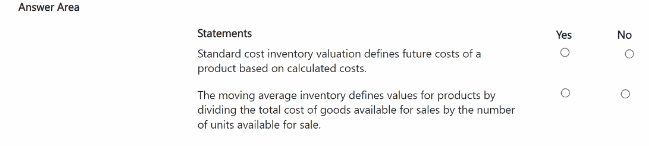
Explanation:
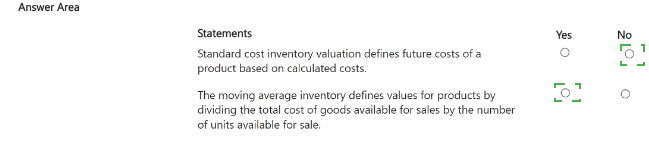
This question tests the definitions of two specific inventory costing methods in Dynamics 365 Supply Chain Management: Standard cost and Weighted average (often called Moving average). The accuracy of the definitions is key.
Correct Option Explanation:
Statement 1:
Yes. Standard cost defines future costs based on calculated costs. This is correct. Standard costing uses a predetermined, fixed cost for an item, which is typically calculated based on planned material, labor, and overhead costs. This "standard" cost is set in advance and used for valuing inventory and costing production until it is updated.
Incorrect Option Explanation:
Statement 2:
No. This is incorrect for "Moving average." This statement accurately describes the Weighted average costing method (total cost / total quantity). However, Dynamics 365 SCM does not have a costing method named "Moving Average." The supported perpetual (continuous) average cost method is called "Weighted average." The term "Moving average" might refer to a periodic calculation in other systems but is not the official name of a costing method in D365 SCM. Therefore, the statement is false.
Reference:
Microsoft Learn - "Inventory models (FIFO, LIFO, Weighted average, Standard cost)." The documentation explains:
Standard cost:
A predetermined, constant cost.
Weighted average:
The cost is recalculated as the average of available inventory after each purchase receipt. It does not use the term "Moving average."
A company uses Dynamics 365 Supply Chain Management.
Instructions: For each of the following statements, select Yes if the statement is true.
Otherwise, select No.
NOTE: Each correct selection is worth one point.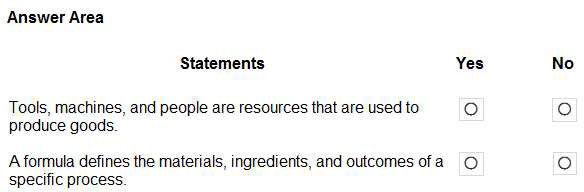
Explanation:
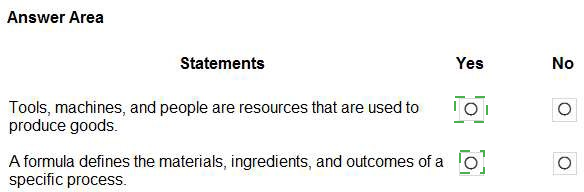
This question tests fundamental concepts in production planning within Dynamics 365 Supply Chain Management, specifically the definition of resources and the purpose of a formula in process manufacturing.
Correct Option Explanations:
Statement 1:
Yes. Tools, machines, and people are resources. In Dynamics 365 SCM, Resources are the entities that perform operations. They are categorized into Resource groups and can include:
Machine resources (tools, equipment).
Human resources (people, labor).
Tool resources.
Vendor resources (for subcontracting).
These resources are assigned to Operations in Routes to define the production process.
Statement 2:
Yes. A formula defines materials, ingredients, and outcomes. This is the precise definition of a Formula in Process manufacturing. A formula is similar to a Bill of Materials (BOM) but is used for products that are blended or chemically transformed. It specifies:
Inputs:
Raw materials and ingredients with their quantities (often by weight or volume).
Outputs:
The co-products and by-products produced alongside the main finished good.
Instructions:
The steps or resources required.
Reference:
Microsoft Learn - "Resources, operations, and routes overview" and "Formulas and formula versions." The documentation confirms that resources are the means of production (machines, human labor) and that formulas are used in process manufacturing to specify ingredient quantities and resulting products.
A company plans to add a product to its inventory.
You need to help the company configure the product by description and behavior, and by size and color variants.
Which configuration should you complete for each requirement? To answer, move the
appropriate configuration to the correct requirement. You may use each configuration once, more than once, or not at all. You may need to move the split bar between panes or scroll to view content
NOTE: Each correct selection is worth one point.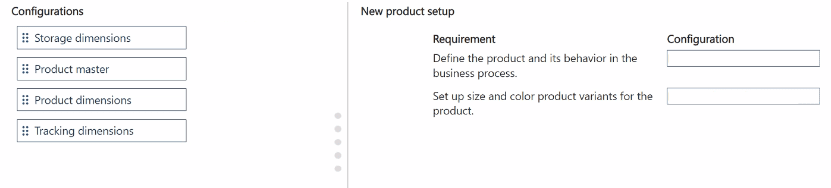
Explanation:
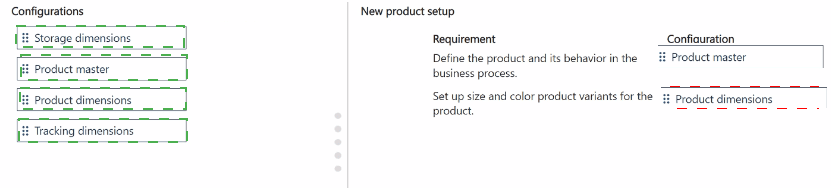
This question tests the hierarchical setup process for a new product in Dynamics 365 Supply Chain Management. It distinguishes between creating the core product definition and then defining its specific variants based on attributes like size and color.
Why These Pairings Are Correct:
Requirement:
Define the product and its behavior.
Configuration:
Product master. The Product master is the foundational product record. When you create a product master (with a specific Product subtype, like "Product master"), you define the product's number, name, and fundamental behavior—such as whether it uses product variants, its item model group (costing), item group (posting), and default dimensions. This sets up the product's template in the business process.
Requirement:
Set up size and color variants.
Configuration:
Product dimensions. Product dimensions (like Size, Color, Style, Configuration) are the attributes used to define distinct variants of a product master. After creating the product master, you define the applicable product dimensions (size and color) and then create the specific product variants (e.g., Shirt-Small-Blue, Shirt-Medium-Red) based on those dimension combinations.
Why the Other Configurations Are Incorrect for These Requirements:
Storage dimensions:
These define where inventory is stored (Warehouse, Location, Pallet, etc.). They are setup dimensions used throughout inventory management but are not specifically for defining the product itself or its variants.
Tracking dimensions:
These are used to track individual items (Batch number, Serial number). They are for traceability, not for defining product variants based on size and color.
Reference:
Microsoft Learn - "Product masters and product variants" and "Product dimensions." The documentation explains that a Product master defines the template, and Product dimensions are used to create the distinct variants from that master.
| Page 4 out of 15 Pages |