Free Microsoft AI-103 Practice Test Questions MCQs

Stop wondering if you're ready. Our Microsoft AI-103 practice test is designed to identify your exact knowledge gaps. Validate your skills with Developing AI Apps and Agents on Azure questions that mirror the real exam's format and difficulty. Build a personalized study plan based on your free AI-103 exam questions mcqs performance, focusing your effort where it matters most.

Targeted practice like this helps candidates feel significantly more prepared for Developing AI Apps and Agents on Azure exam day.

2660+ already prepared
Updated On : 17-Jul-2026
66 Questions
Developing AI Apps and Agents on Azure
4.9/5.0

Page 1 out of 7 Pages

Topic 1: Case Study Contoso, Ltd


Overview
Contoso, Ltd is a multinational retail company that builds, deploys, and manages generative Al and agent-based solutions by using Microsoft Foundry.

Identity Environment:
Contoso uses Microsoft Entra ID for identity management, authentication, and authorization capabilities that enable agents to access organizational resources and services. Contoso recently formed a new Al engineering team named Agent1Dev Team to optimize and maintain existing Al solutions.
The team collaborates with solution architects, DevOps engineers, and security engineers to design, implement, monitor, and secure Al applications.
Contoso also has a team named Agent1Test Team that is responsible for validating Al solutions before the solution deployments.

Generative Environment:
Contoso has a Microsoft Foundry deployment that contains two projects named Project1 and Project2.

Project1
Project1 contains a customer support agent named Agent1 that assists customers with product inquiries and troubleshooting requests. Agent1 has the following configurations:

Agent1 uses a base model deployment.
A safety evaluation pipeline is NOT enabled.
Tool invocation approval workflows are NOT enabled.
Conversation memory constraints are NOT configured.

Agent1 interacts with customers by using digital support channels and answers general questions about Contoso products.
Project1 is deployed to an Azure region located in the European Union (EU). Agent1Dev Team will use Project1 to optimize and maintain Agent1.

Project2
Project2 contains a deployed video generation model. The marketing department at Contoso has access to Project2 and plans to use the model to develop a video creation solution.
Development of the solution is incomplete.

Data Environment:
Contoso stores product-related information in Azure resources that support Al applications.
The Azure environment contains an Azure Blob Storage account named storage1 that stores product detail sheets for all the Contoso products.
The product sheets include specifications, feature descriptions, and product support information that Agent1 can use to answer customer questions. The product sheets are stored in the PDF format.

Problem Statement:

Contoso identifies the following issues:

Agent1 has only general knowledge of the Contoso products.
A recent chat interaction with Agent1 was analyzed for sentiment. The results of the analysis have NOT been processed yet.
Agent1 does NOT use the detailed product information in the product sheets stored in storage1 when responding to customer questions.
The finance department at Contoso reports that vendor invoices must be reviewed manually to ensure that the invoices match the terms defined in the vendor contracts. The invoices contain tables, logos, and varied layouts that make the documents difficult to process consistently.

Requirement:

Planned Changes:
Contoso plans to implement the following changes:
Implement a solution for Project1 that analyzes the vendor invoices by evaluating both the visual layout and the textual content of the invoices, so that the invoice details can be verified against the vendor contract terms.
Update the base model deployment used by Agent1 and standardize the model version to ensure continuity and consistent responses.
Enable Agent1 to retrieve and use the detailed product information from the product sheets stored in storage1.
Implement an indexing solution for the product sheets that Agent1 can use to answer customer questions.
Complete the development of the video creation solution.

Technical Requirements:

Contoso identifies the following technical requirements:
The model deployment used by Agent1 must support scalable, high-throughput generative Al workloads and dynamically scale to handle variable customer support traffic, without requiring reserved throughput capacity.
The product sheets must be processed by using an indexing pipeline that enables semantic and vector search, so that Agent1 can retrieve the relevant product information.
Responses generated by using the product sheet information must be relevant, complete, and accurate.
Agent1 must be able to use the product sheets to answer natural language questions about product details.
The model version used by Agent1 must remain consistent to ensure stable responses.
The data processed by the model must remain within the EU.

Safety and Compliance Requirements:

Contoso identifies the following security and compliance requirements:
API keys must NOT be used to access Foundry-deployed models.
Access to the Azure resources must follow the principle of least privilege.
The developers at Contoso must authenticate to Microsoft Foundry resources by using Microsoft Entra authentication.
Access to Project1 must be assigned to the members of Agent1Dev Team by using a security group named SC_Agent1_Dev.
Access to Project1 must be assigned to the members of Agent1Test Team by using a security group named SC_Agent1_Test.
Agent1 must never reveal customer information, even if a document that contains customer data is added erroneously to the product sheet repository in storage1.
The product sheets might contain images that include embedded text. Agent1 must be protected from malicious instructions potentially hidden within the images.

Business Information:
Contoso identifies the following business requirements:
Users that interact with Agent1 must have a personalized experience in future interactions, including the ability for Agent1 to retain conversation context and recall relevant information from previous interactions.
Agent1 must answer questions only about the products sold by Contoso.

You have a Python application named App1 that integrates with a Microsoft Foundry project named Project1.
You need to ensure that App1 meets the following requirements:
β€’ Authenticates by using a Microsoft Entra managed identity
β€’ Sends prompts to a deployed model by using the Azure OpenAI Responses API How should you complete the Python code? To answer, select the appropriate options in the answer area.
NOTE: Each correct selection is worth one point.
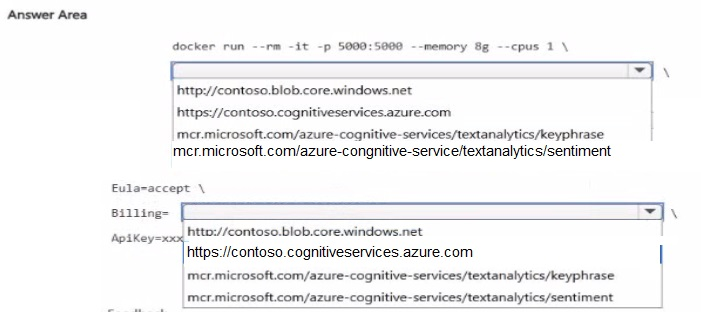
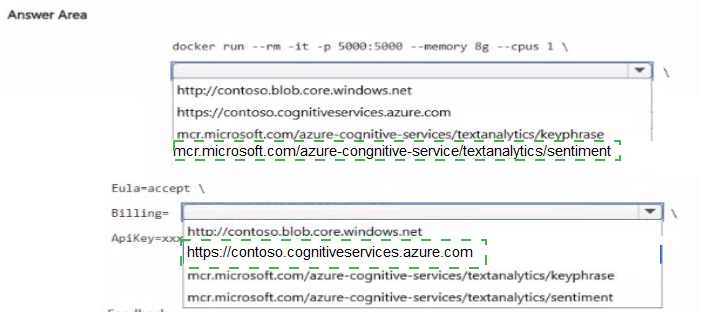


Explanation:

This question tests your ability to complete Python code for authenticating and interacting with models in a Microsoft Foundry project using the Azure AI Projects SDK. It specifically evaluates setting up Microsoft Entra managed identity credentials and executing a chat or text inference request via the Responses API.

βœ… Correct Option:
DefaultAzureCredential is the standard class from the azure.identity package used to handle Microsoft Entra token authentication, seamlessly resolving to a managed identity at runtime in Azure environments. The .responses.create method is the designated API function within the client library used to programmatically submit prompts (input) and parameter payloads to a deployed model to generate an AI response.

❌ Incorrect options:

AzureKeyCredential:
This class is exclusively dedicated to API-key-based authentication, which violates the requirement to authenticate using a Microsoft Entra managed identity.

ClientSecretCredential:
This credential type explicitly requires a hardcoded application ID and a client secret value, rather than dynamically inheriting an Azure managed identity.

compact:
This is an invalid method name for initiating model inference or text generation workflows within the Azure AI SDK structure.

retrieve:
This method is conventionally reserved for fetching metadata or current state tracking configurations of an existing run or asset rather than creating a new generative response payload.

πŸ”§ Reference:
β†’ Microsoft Foundry SDKs and Endpoints confirms that using DefaultAzureCredential handles Entra ID managed identity tokens, and the client manages model inference requests through its integrated generative endpoints.

You have a customer support agent that uses the Microsoft Foundry Agent Service. Sometimes, customers return to a session days later to continue the same support case, and the agent must resume with the full historical context. The agent must provide the following:
β€’ Multi-turn continuity within the session
β€’ Cross-session continuity for the same case
β€’ Access to the full interaction history, including user messages, agent messages, tool calls, and tool outputs
You need to ensure that the agent automatically reloads the complete history on each new turn.
What should you do?

A. Persist only the final model response stored in the client application and prepend the response to future prompts.

B. Enable memory summarization on the agent definition to persist the context automatically.

C. Create and reuse a conversation by storing the conversation’s ID and supplying the ID on subsequent requests.

C.   Create and reuse a conversation by storing the conversation’s ID and supplying the ID on subsequent requests.

Explanation:

This question tests your understanding of how to maintain conversation history and continuity across sessions in Microsoft Foundry Agent Service. The requirements include multi-turn continuity within a session, cross-session continuity for the same customer case, and access to full interaction history (user messages, agent messages, tool calls, and tool outputs). In Foundry, the conversation object is specifically designed for this purposeβ€”it is a durable, persistent object that stores all items across turns and can be reused across sessions by storing and supplying its ID on subsequent requests .

βœ”οΈ Option C: Create and reuse a conversation by storing the conversation's ID and supplying the ID on subsequent requests. (Correct)
In Microsoft Foundry Agent Service, a conversation is a durable object with a unique identifier that automatically manages message history across turns . Conversations store all interaction items including user messages, agent responses, tool calls, and tool outputs . By creating a conversation once and persistently storing its ID (e.g., in a database or client-side storage linked to the customer's case), you can supply that ID on every subsequent request. This ensures the agent automatically loads the complete historical context on each new turn, meeting both intra-session and cross-session continuity requirements . The conversation ID provides a stable reference for resuming a support case even after days of inactivity .

❌ Option A: Persist only the final model response stored in the client application and prepend the response to future prompts. (Incorrect)
Persisting only the final model response is incomplete because it loses the full interaction historyβ€”user messages, tool calls, and tool outputs. Preprending only the last response to future prompts would not provide the "complete history" required for the agent to resume context accurately. Additionally, this approach requires manual reconstruction of context and does not leverage Foundry's built-in state management, making it brittle and prone to missing critical details from previous turns.

❌ Option B: Enable memory summarization on the agent definition to persist the context automatically. (Incorrect)
Memory summarization is a feature for retaining important data over time, but it is distinct from conversation history. It is more focused on long-term storage of key information rather than preserving the full, chronological transcript of all messages, tool calls, and outputs . The requirement explicitly asks for access to the "full interaction history, including user messages, agent messages, tool calls, and tool outputs," which is not what summarization provides. Memory summarization may condense or abstract context and would not ensure that the agent reloads complete, unmodified history on each turn.

πŸ”§ Reference:
β†’ Build with agents, conversations, and responses | Microsoft Learn - Confirms conversations are durable objects with unique identifiers that store items including messages, tool calls, and outputs, and can be reused across sessions by storing the conversation ID.

You have a Microsoft Foundry project.
You plan to build a customer support solution that contains an agent. The solution must meet the following requirements:
β€’ Provide accurate, context-aware responses grounded in internal product documentation stored in Azure AI Search.
β€’ Require deep, multi-step reasoning across long contexts.
β€’ Generate detailed natural language responses.
Which type of model should you use to power the agent?

A. a multimodal model

B. a key phrase extraction model

C. a small language model (SLM)

D. a large language model (LLM)

D.   a large language model (LLM)

Explanation:

This question tests understanding of which model category fits a customer support agent requiring grounded retrieval, deep reasoning, and detailed natural language generation. The scenario needs a model capable of processing long retrieved contexts, performing multi-step reasoning, and producing rich conversational output.

βœ… Correct Option:

D. a large language model (LLM) β€” LLMs are trained on massive datasets and have the parameter scale needed to support deep, multi-step reasoning across long contexts, understand nuanced natural language queries, and generate detailed, coherent responses. When paired with retrieval from Azure AI Search, an LLM can ground its answers in internal product documentation while still handling the complex reasoning and long-context requirements described in the scenario.

❌ Incorrect options:

A. a multimodal model β€” Multimodal models are designed to process and reason across multiple input types, such as text, images, and audio, together. The scenario only describes text-based product documentation and natural language responses, so multimodal capability isn't the requirement being tested here.

B. a key phrase extraction model β€” Key phrase extraction models are narrow NLP tools that pull out important terms or phrases from text; they don't generate natural language responses or perform reasoning. This model type cannot satisfy the requirement for detailed, conversational output.

C. a small language model (SLM) β€” SLMs are optimized for lower latency and cost with a smaller parameter footprint, but this comes at the expense of reasoning depth and long-context handling. They're better suited to lightweight, narrow tasks rather than the deep multi-step reasoning and long-context grounding this scenario demands.

πŸ”§ Reference:
β†’ Microsoft Learn – What are large language models? β€” confirms LLMs are designed for complex reasoning, long-context understanding, and generating detailed natural language responses, forming the foundation of retrieval-augmented generation solutions on Azure.

Note: This section contains one or more sets of questions with the same scenario and problem. Each question presents a unique solution to the problem. You must determine whether the solution meets the stated goals. More than one solution in the set might solve the problem. It is also possible that none of the solutions in the set solve the problem. After you answer a question in this section, you will NOT be able to return. As a result, these questions do not appear on the Review Screen. You have a Microsoft Foundry project that contains an agent. The agent generates summaries from retrieved policy documents. Users report that some responses omit required regulatory clauses, even when the clauses are present in the retrieved content. You need to improve response completeness. Solution: You increase the value of the temperature parameter. Does this meet the goal?

A. Yes

B. No

B.   No

Explanation:

This question tests understanding of how temperature affects the behavior of generative AI models in Microsoft Foundry agents, and whether changing it can improve response completeness when required regulatory clauses are being omitted. The scenario is that users report some responses miss required clauses even when those clauses are present in retrieved policy documents.

βœ”οΈ Correct Option (B):
Increasing the temperature value makes the model more creative and variable, not more deterministic or complete. It encourages diverse wording and can lead to more omissions, hallucinations, or inconsistent inclusion of required content. To improve response completeness and ensure that required regulatory clauses are consistently included, you need to reduce randomness (lower temperature) and/or improve grounding, prompt instructions, or retrieval. Therefore, increasing temperature does not meet the goal of improving response completeness.

❌ Incorrect option:

❌ A (Yes):
Choosing β€œYes” implies that increasing temperature would help ensure required clauses are included. This contradicts how temperature works: higher temperature increases randomness and reduces strict adherence to instructions or source content. It would not address the problem of missing required clauses and could make the issue worse.

πŸ”§ Reference:
β‡’ Microsoft Learn – GPT Realtime & language model parameters (temperature)
This confirms that temperature controls randomness: higher values increase variability, while lower values make outputs more deterministic and instruction-following, which is what you want for consistent inclusion of required clauses.

β‡’ Microsoft Learn – Understanding β€œYes/No” solution questions in certification exams
This explains that for Yes/No scenario questions, if the proposed solution does not completely solve the stated problem, the correct answer is β€œNo”. Increasing temperature does not solve the completeness problem.

You have an app named App1 that uses a Microsoft Foundry multimodal model deployment. App1 runs optical character recognition (OCR) on uploaded images and appends the OCR output to the prompt as additional context. Some uploaded images contain embedded text. You need to prevent potentially malicious instructions from being processed by the model. What should you use?

A. protected material text

B. prompt shields for user prompts

C. image moderation

D. prompt shields for documents

D.   prompt shields for documents

Explanation:

This question tests your understanding of protecting AI applications from prompt injection attacks, specifically when processing content from external sources like user-uploaded documents. The scenario involves extracting and appending OCR text from uploaded images to a model's prompt. This creates a risk of indirect attacks, also called cross-domain prompt injection attacks, where hidden instructions embedded within third-party content can hijack the model's behavior. Prompt Shields for documents is the feature designed to detect and mitigate exactly this type of threat.

βœ”οΈ Option D: prompt shields for documents (Correct)
Prompt Shields for documents is the correct safeguard because it protects against indirect attacks that come from "information not directly supplied by the user or developer, such as external documents". Attackers can hide commands in user-provided files, and when OCR text from an uploaded image is appended to the prompt, the model might inadvertently follow them. Enabling this shield ensures that text extracted from uploaded images is scanned for embedded malicious instructions before it reaches the model, meeting the requirement to prevent processing of potentially malicious content.

❌ Option A: protected material text (Incorrect)
Protected material detection is used to scan AI-generated text for copyrighted content like song lyrics or articles. It does not prevent prompt injection attacks, so it is irrelevant to the stated requirement.

❌ Option B: prompt shields for user prompts (Incorrect)
Prompt shields for user prompts is designed to detect direct attacks from user inputs, such as jailbreak attempts aimed at bypassing system rules. The threat in this scenario comes from content extracted from images, which is treated as third-party "document" input, making this option insufficient.

❌ Option C: image moderation (Incorrect)
Image moderation analyzes visual content for harmful categories like violence or sexual content. It does not detect hidden text-based instructions embedded within the image itself, nor does it prevent the model from acting on them. Furthermore, embedded text in images is typically not analyzed by standard image moderation algorithms.

πŸ”§ Reference:
β†’ Prompt Shields in Microsoft Foundry | Microsoft Learn - Confirms Prompt Shields detect and prevent attempts to manipulate model behavior through adversarial inputs, including document attacks where hidden instructions are embedded in third-party content.

You have an Azure Speech in Foundry Tools resource that hosts a custom speech to text model deployed to a custom endpoint. An agent uses the endpoint to perform real-time speech recognition. You are approaching the expiration date of the custom speech to text model. What is the expected behavior when the model expires?

A. Speech recognition requests will fall back to the most recent base model for the same locale.

B. Speech recognition requests will continue to use the expired custom model until the model is removed manually.

C. Speech recognition requests will return a 4xx error until a new custom model is deployed.

D. The custom model will be deleted automatically when the model expires.

A.   Speech recognition requests will fall back to the most recent base model for the same locale.

Explanation:

This question tests knowledge of the custom speech model lifecycle in Azure Speech in Foundry Tools, specifically what happens at a real-time speech recognition endpoint once the deployed custom model reaches its transcription expiration date. This distinction is important for planning model refresh cycles without unexpected service disruption.

βœ… Correct Option:

A. Speech recognition requests will fall back to the most recent base model for the same locale β€” When a custom model expires, the custom endpoint doesn't fail; instead, it automatically switches to using the latest base model available for that locale. Recognition continues to return results, but accuracy for domain-specific terms may degrade since the specialized customization is no longer applied. This is the documented expected behavior at expiration.

❌ Incorrect options:

B. Speech recognition requests will continue to use the expired custom model until the model is removed manually β€” Once a model passes its transcription expiration date, it is no longer available for transcription regardless of whether it has been manually deleted. The endpoint does not keep using the expired model; it automatically redirects requests to the base model.

C. Speech recognition requests will return a 4xx error until a new custom model is deployed β€” A 4xx error on expiration applies specifically to batch transcription requests that explicitly specify an expired model ID. Real-time recognition through a deployed custom endpoint does not fail with an error; it falls back gracefully to the base model instead.

D. The custom model will be deleted automatically when the model expires β€” Expiration only affects whether the model can be used for transcription; it does not trigger automatic deletion. The model and its metadata remain in the collection unless explicitly deleted by the user.

πŸ”§ Reference:
β†’ Microsoft Learn – Custom speech model lifecycle β€” confirms that expired custom model requests fall back to the most recent base model for the same locale, while expired batch transcription requests fail with a 4xx error.

You have a Microsoft Foundry project that contains a model deployment. You have an application that calls the deployment by using the Azure OpenAl v1 API and DefaultAzureCredential. The developers at your company receive HTTP 403 errors when they send inference requests, even after running az login. You need to ensure that the developers can perform model inference. The solution must follow the principle of least privilege. Which role-based access control (RBAC) role should you assign to the developers?

A. Cognitive Services OpenAl User

B. Cognitive Services Data Reader

C. Cognitive Services User

D. Contributor

A.   Cognitive Services OpenAl User

Explanation:

This question tests how to grant developers model inference access to an Azure OpenAI (Foundry) model deployment using RBAC and managed identity, while following the principle of least privilege. The application uses the Azure OpenAI v1 API with DefaultAzureCredential, and developers are getting HTTP 403 (authorization failed) errors even after az login, which indicates they lack the required RBAC role for inference.

βœ”οΈ Correct Option (A):
Cognitive Services OpenAI User is the purpose-built RBAC role that allows users to perform model inference calls (create completions and embeddings) against Azure OpenAI deployments, while not allowing resource creation, key management, or model deployment changes. This exactly matches the requirement: developers need to perform inference, and the solution must follow least privilege. Official documentation confirms this role enables inference calls without broader administrative permissions.

❌ Incorrect options:

❌ B (Cognitive Services Data Reader):
This role is scoped to read data/logs and usage information, not to perform inference operations. It does not grant permissions to call completion or embedding APIs, so developers would still receive 403 errors when sending inference requests.

❌ C (Cognitive Services User):
This role allows reading and listing keys for Cognitive Services resources, but it does not include inference permissions for Azure OpenAI deployments. It is also not specific to OpenAI; it is more general and still insufficient for the required inference operations.

❌ D (Contributor):
Contributor is a broad management role that allows creating and managing resources, deployments, and keys. While it would technically allow inference, it violates the least privilege requirement because it grants far more permissions than necessary. The exam explicitly expects the minimal, purpose-built role for inference.

πŸ”§ Reference:
β‡’ Microsoft Learn – Azure built-in roles
This confirms that the Cognitive Services OpenAI User role provides read access to models and deployments and allows creating completion and embedding calls (inference), without broader management permissions.

You have a Microsoft Foundry project that uses Azure Al Search to ground an agent in internal documentation. After a recent content update, users report that the agent's answers have become less accurate. You need to identify whether the retrieved content is negatively influencing the model's generated responses. Which observability signal should you review?

A. prediction drift metrics

B. groundedness evaluation metrics

C. latency breakdown traces

D. indexer status and failure history

B.   groundedness evaluation metrics

Explanation:

This question tests observability and evaluation practices for RAG agents in Microsoft Foundry using Azure AI Search. It focuses on diagnosing why retrieved content leads to inaccurate responses after updates.

βœ… Correct Option:

B. groundedness evaluation metrics
Groundedness metrics measure how faithfully the agent's generated response aligns with the retrieved context without fabrication or omission of key details. Reviewing these signals (often via LLM-as-judge evaluators) directly identifies whether poor grounding from the updated documents is causing the accuracy drop.

❌ Incorrect options:

A. prediction drift metrics
Prediction drift tracks changes in model output distribution over time. It does not specifically analyze the relationship between retrieved content and generated responses.

C. latency breakdown traces
Latency traces help diagnose performance issues. They provide no insight into response accuracy or grounding quality.

D. indexer status and failure history
Indexer status checks ingestion health. It confirms content was indexed but does not evaluate how that content affects response quality.

πŸ”§ Reference:
β†’ Retrieval-Augmented Generation (RAG) Evaluators for Generative AI
Describes groundedness evaluators for assessing alignment between retrieved context and agent responses.

You have a Microsoft Foundry project that contains an agent. The agent ingests scanned PDF vendor invoices that contain tables and embedded QR codes. The agent must preserve the PDF layout in the extracted output to ensure that downstream processing can reference sections and tables. You plan to call Azure Content Understanding in Foundry Tools. You need to extract content and layout elements and detect QR codes without requiring a language model deployment. Which built-in analyzer should you use?

A. prebuilt-layout

B. prebuilt-documentFieldSchema

C. prebuilt-read

D. prebuilt-documentSearch

A.   prebuilt-layout

Explanation:

This question tests knowledge of Azure Content Understanding and selecting the correct built-in analyzer for document processing scenarios. The requirement includes preserving document layout, extracting tables and structural elements, and detecting embedded QR codes from scanned PDFs without using a language model. The correct choice is the analyzer specifically designed for document structure and layout extraction.

🟒 Correct Option:

A. prebuilt-layout

The prebuilt-layout analyzer extracts document structure while preserving layout information such as paragraphs, tables, sections, and reading order. It also supports detection of elements like barcodes and QR codes in scanned documents. Because it focuses on document understanding without requiring a language model deployment, it satisfies all requirements for structured extraction and downstream processing.

πŸ”΄ Incorrect options:

B. prebuilt-documentFieldSchema

This analyzer is intended for extracting predefined fields according to a schema rather than preserving complete document structure. It focuses on structured field extraction and does not primarily address layout preservation or comprehensive QR code detection requirements.

C. prebuilt-read

The prebuilt-read analyzer performs optical character recognition to extract text from documents and images. However, it mainly focuses on text recognition and does not provide the richer layout understanding needed for tables, document structure, and QR code-based processing.

D. prebuilt-documentSearch

The prebuilt-documentSearch analyzer is designed for document search and retrieval scenarios rather than extracting detailed layout structures. It does not specifically preserve document organization or provide the required content and QR code extraction capabilities.

πŸ”§ Reference:

β‡’ Microsoft Learn – What is the Document Intelligence layout model?
Confirms that the prebuilt-layout model extracts document structure, tables, reading order, and barcode information.

β‡’ Microsoft Learn – What is Azure Document Intelligence in Foundry Tools?
Confirms capabilities for extracting layout and structured content from documents.

You have a Microsoft Foundry project that ingests scanned PDF invoices stored in Azure Blob Storage. Each invoice contains printed line items and has a table-based layout.
Extracted results are stored as structured JSON and used as grounding data for an agent in a Retrieval Augmented Generation (RAG) solution.
You need to create a single analyzer that meets the following requirements:
β€’ Extracts the invoice number, invoice date, vendor name, and total amount across varying templates
β€’ Returns confidence scores so that results with confidence below 0.80 can be routed for supervisor review
What should you use?

A. the Azure Content Understanding in Foundry Tools prebuilt-layout analyzer

B. a Foundry agent that has groundedness guardrails enabled to extract invoice fields and confidence scores

C. a custom Azure Content Understanding in Foundry Tools analyzer that defines the required fields as the extracted fields and the returned confidence scores for routing

D. the Azure Content Understanding in Foundry Tools prebuilt-documentSearch analyzer and search.score from the Azure AI Search results for routing

C.   a custom Azure Content Understanding in Foundry Tools analyzer that defines the required fields as the extracted fields and the returned confidence scores for routing

Explanation:

This question tests your ability to design document intelligence pipelines in Microsoft Foundry. It focuses on identifying an analytical tool that extracts specific, user-defined semantic values (like invoice number and total amount) across diverse layouts while calculating exact field-level extraction confidence scores for manual review routing.

βœ… Correct Option:
A custom Azure Content Understanding analyzer allows developers to explicitly declare a target schema specifying required fields like invoice number, date, vendor, and amount. Because it is custom-built to generalize across layouts, it extracts these specific key-value pairs from varying invoice templates and naturally provides accurate, field-level extraction confidence scores to cleanly route items below 0.80 for supervisor verification.

❌ Incorrect options:

A. the Azure Content Understanding in Foundry Tools prebuilt-layout analyzer
The prebuilt-layout analyzer extracts general document structures, including paragraphs, text blocks, and tables. It does not provide semantic key-value extraction for explicit financial fields like "invoice number" or "total amount" out of the box, nor does it deliver field-specific validation confidence scores for downstream routing.

B. a Foundry agent that has groundedness guardrails enabled to extract invoice fields and confidence scores
Groundedness guardrails validate whether an agent's conversational output is based directly on the provided context to prevent hallucinations. They evaluate the truthfulness of a language model's text generation rather than serving as an extraction pipeline that outputs structured mathematical field extraction confidence scores.

D. the Azure Content Understanding in Foundry Tools prebuilt-documentSearch analyzer and search.score from the Azure AI Search results for routing
The prebuilt-documentSearch analyzer is optimized to chunk and index content for search and retrieval engines. The resulting search.score measures the keyword or semantic relevance of a search result matching a query; it does not measure the extraction accuracy of data values inside the invoice document.

πŸ”§ Reference:
β†’ Custom analyzers in Azure Content Understanding confirms that defining custom extraction fields returns explicit, targeted schema values along with field-specific extraction confidence scores ideal for automated validation routing.

Page 1 out of 7 Pages
123

Developing AI Apps and Agents on Azure Practice Exam Questions