Free Microsoft AB-731 Practice Test Questions MCQs
Stop wondering if you're ready. Our Microsoft AB-731 practice test is designed to identify your exact knowledge gaps. Validate your skills with AI Transformation Leader questions that mirror the real exam's format and difficulty. Build a personalized study plan based on your free AB-731 exam questions mcqs performance, focusing your effort where it matters most.
Targeted practice like this helps candidates feel significantly more prepared for AI Transformation Leader exam day.
2770+ already prepared
Updated On : 25-May-202677 Questions
AI Transformation Leader
4.9/5.0
You have a business unit that uses an AI solution to process loan applications. You discover that the solution rejects the application of all applicants that are older than 60 years of age. Which Microsoft responsible AI principle is this violating?
A. accountability
B. transparency
C. fairness
D. reliability and safety
Explanation:
The Fairness principle requires AI systems to treat all people equitably and avoid discriminating against specific groups based on characteristics such as age, gender, ethnicity, or disability . The scenario describes a loan application AI that automatically rejects all applicants over 60 years old. This constitutes age-based discrimination because the system treats similarly situated individuals differently based solely on age, not on their actual creditworthiness or financial qualifications .
Microsoft’s Fairness principle explicitly addresses this type of harm, noting that “when AI systems provide guidance on loan applications, they should make the same recommendations to everyone with similar financial circumstances, regardless of gender, ethnicity, or age” . The Responsible AI dashboard in Azure Machine Learning includes fairness assessment tools specifically designed to detect and mitigate bias across sensitive groups including age .
Why Other Options Are Incorrect
A. Accountability
– This principle requires that humans remain responsible for AI system outcomes, with clear ownership and oversight. It addresses who is responsible when things go wrong, not the discriminatory behavior itself .
B. Transparency
– This principle requires that AI systems be understandable, with explanations of how decisions are made. While important, transparency addresses explainability, not the underlying discriminatory outcome .
D. Reliability and Safety
– This principle focuses on consistent system performance under expected conditions and safe operation. It does not directly address discriminatory treatment of specific groups .
References
Microsoft Learn: “AI systems should treat all people fairly. For loan approval models, predict without bias based on gender, ethnicity, or age”
Microsoft Fairness principle: “Treat similar people and cases similarly by design, and test to reduce bias”
For each of the following statements, select Yes if the statement is true. Otherwise, select
No. NOTE: Each correct selection is worth one point
Explanation:
Why the Selected Options Are Correct
Statement 1 is False (No): Regression is used to predict continuous, quantitative numeric values (e.g., forecasting a house price or tomorrow's temperature). Predicting a categorical label or discrete class is the definition of Classification.
Statement 2 is False (No):Classification sorts data data points into distinct buckets, categories, or labels (e.g., determining whether an email is "Spam" or "Not Spam"). Predicting continuous numeric trends is the role of Regression.
Statement 3 is True (Yes): Clustering operates entirely without pre-labeled historical outcomes (unsupervised learning). It functions by examining the mathematical distance between data feature vectors to organically group similar records together into distinct clusters (e.g., segmenting customer demographics based on purchasing behavior).
Why the Alternate Selections Are Incorrect
Swapping the definitions of Regression and Classification is a classic trap; their definitions in Statements 1 and 2 are exactly reversed.
Marking No on Statement 3 misrepresents the fundamental definition of clustering algorithms (such as K-Means or Hierarchical clustering), which are explicitly designed for unsupervised groupings.
References
Microsoft Learn: Understand machine learning types – Differentiates supervised learning (Classification for discrete labels, Regression for continuous numbers) from unsupervised learning (Clustering for unlabelled pattern grouping).
Azure AI Fundamentals Training Manual: Explains the foundational mathematical differences between target output metrics for standard machine learning workloads.
Your company plans to use generative AI to help summarize and analyze internal business documents. You need to recommend a solution to prevent generative AI from accessing confidential or classified information. What should you include in the recommendation?
A. an information barrier (IB) policy
B. data governance
C. a data retention policy
D. communication monitoring
Explanation:
To prevent generative AI from accessing confidential or classified information, you must implement data governance—specifically, sensitivity labels and data loss prevention (DLP) policies via Microsoft Purview.
Microsoft 365 Copilot respects existing permissions and sensitivity labels . When a file is labeled as "Confidential" or "Highly Confidential," Copilot automatically inherits those protections. For example, if a user lacks permission to access a labeled file, Copilot cannot summarize or reference that content .
How data governance prevents unauthorized AI access:
Sensitivity labels classify and encrypt files. Copilot checks these labels before processing any content and only surfaces data the user is already authorized to access .
DLP policies can be configured with the "Prevent Copilot from processing content" action for files matching specific sensitivity labels . This ensures Copilot excludes labeled content from responses entirely .
Why other options are incorrect:
A. Information barrier (IB) policy
– IB policies prevent specific user groups from communicating or collaborating, but they are not designed to classify or restrict AI access to document content. IB addresses user-to-user communication silos, not AI data access.
C. Data retention policy
– Retention policies define how long data is kept before deletion. They do not prevent AI from accessing currently existing confidential information.
D. Communication monitoring
– Monitoring tracks user communications for compliance but does not block AI from accessing restricted content.
References
Microsoft Learn – Sensitivity labels with Copilot: "Copilot does not bypass data protection controls. When Copilot accesses labeled content, it checks user permissions against any encryption applied by the label"
Microsoft Learn – DLP for Copilot: "Create DLP policies that stop Copilot from using labeled file content in summaries. Select the Prevent Copilot from processing content action"
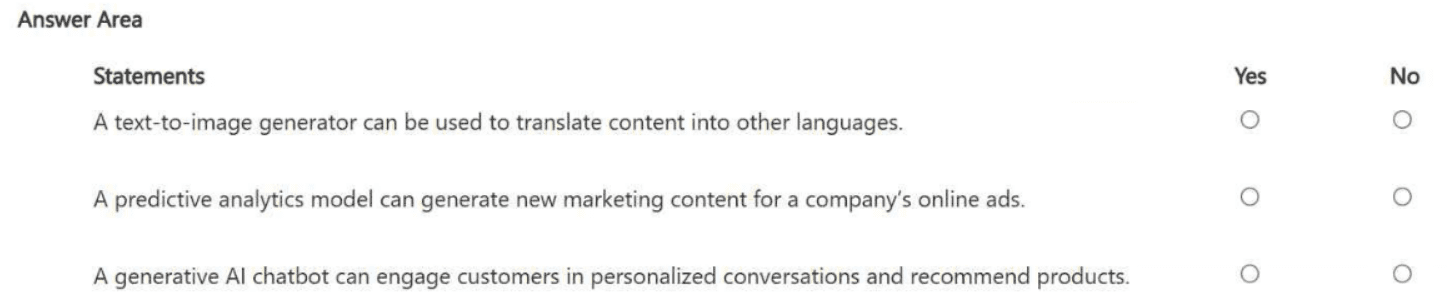
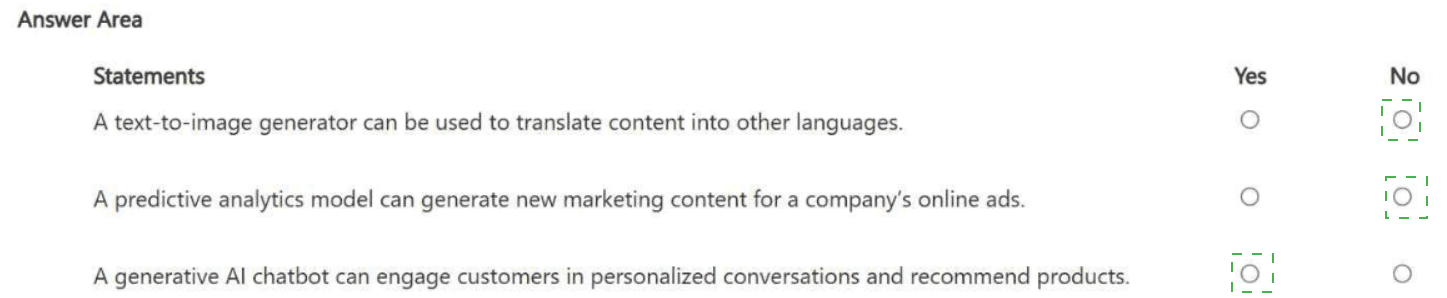
For each of the following statements, select Yes if the statement is true. Otherwise, select
No. NOTE: Each correct selection is worth one point.
Explanation
Why the Selected Options Are Correct
Statement 1:This is the foundational definition of Machine Learning (ML). Unlike traditional software engineering where a developer writes explicit, hard-coded rules (e.g., if/else blocks), ML algorithms use statistical techniques to scan training datasets, discover hidden mathematical patterns, and build an internal model to reason over new data dynamically.
Statement 2: Deep Learning (DL) is a specialized branch under the machine learning umbrella. It specifically relies on Artificial Neural Networks (ANNs) containing an input layer, an output layer, and multiple hidden layers (hence "deep") to automatically extract high-level features from complex, unstructured data.
Statement 3: Generative AI is a specific subset of broader Artificial Intelligence. While classical AI focuses on analyzing, classifying, or predicting based on existing data points, generative architectures (such as GANs, Transformers, and Diffusion models) learn the underlying distribution of a dataset to create entirely new, realistic content from scratch.
Why the Alternate Selections Are Incorrect
Choosing No on any of these parameters fundamentally misrepresents the established hierarchy of artificial intelligence domains.
Machine learning cannot exist with manual hard-coding; deep learning is structurally defined by its multi-layered networks; and generative AI's distinguishing baseline characteristic is content creation rather than basic data classification.
References
Microsoft Learn: Introduction to Azure Machine Learning – Graphically maps the structural nesting of technology branches where Deep Learning sits inside Machine Learning, which sits inside the broader landscape of Artificial Intelligence.
Azure AI Fundamentals (AI-900 Core Curriculum): Fundamental AI Concepts – Validates the explicit classification of Generative AI as an AI capability optimized for synthesizing unique, human-like contextual outputs.
Your company has an AI solution that uses a prebuilt Azure OpenAI model to generate content. You need to reduce the cost of the solution while minimizing the impact on the quality of the generated output. Which two actions should you perform? (Select TWO.) NOTE: Each correct selection is worth one point.
A. Fine-tune the existing model.
B. Apply content moderation.
C. Optimize the prompts.
D. Switch to an alternate model.
E. Decrease the number of hosting hours for the model.
D. Switch to an alternate model.
Explanation:
C. Optimize the prompts
– Prompt optimization (prompt engineering) reduces cost by shortening the number of tokens sent per API call while maintaining output quality. Shorter prompts mean fewer tokens processed, directly lowering pay-per-token costs. This requires no model changes and has zero infrastructure cost impact.
D. Switch to an alternate model
– Azure AI Foundry's Model Router can automatically route simple queries to more economical models while reserving larger models for complex requests. This optimizes cost without sacrificing output quality because simpler tasks are handled by cheaper models. Additionally, smaller fine-tuned models can provide higher quality at lower latency and reduced token consumption compared to larger base models.
Why the other options are incorrect:
A. Fine-tune the existing model
– Fine-tuning requires high-quality datasets (hundreds or thousands of examples), incurs significant training compute costs, and risks degraded performance if training data is low quality. The upfront cost and time commitment contradict minimizing cost while maintaining quality.
B. Apply content moderation
– Default content filters in Azure OpenAI are provided at no additional cost. While they don't increase expenses, they also don't reduce costs or improve generation quality—they only block harmful outputs.
E. Decrease hosting hours for the model
Most Azure OpenAI models use pay-per-token pricing, not hourly hosting charges. Provisioned Throughput Units (PTU) do charge hourly but are designed for high-volume, latency-sensitive workloads. Reducing hosting hours for a PTU deployment would reduce availability and disrupt service, impacting quality and user experience negatively.
References
Microsoft Learn – Fine-tuning benefits:"Token savings due to shorter prompts... potentially saving cost, and improving request latency"
Microsoft Community Hub – Model Router: "Automatically selects the most appropriate model for each query... optimizes both cost and performance"
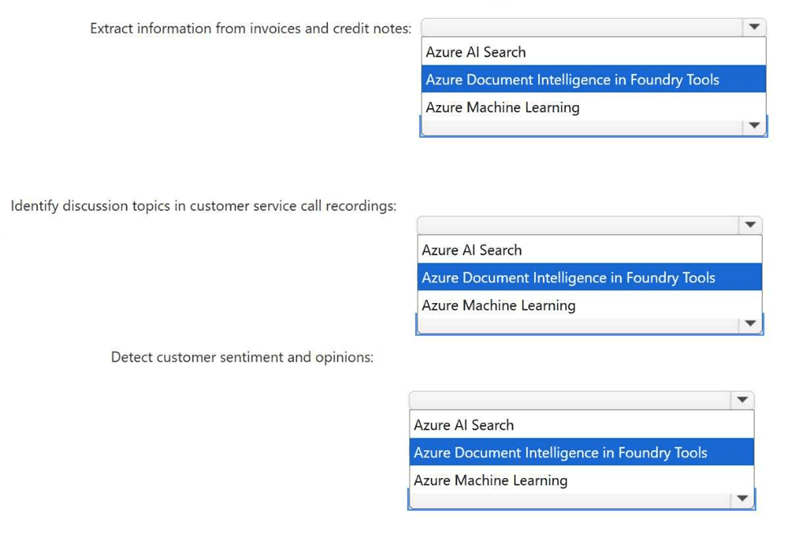
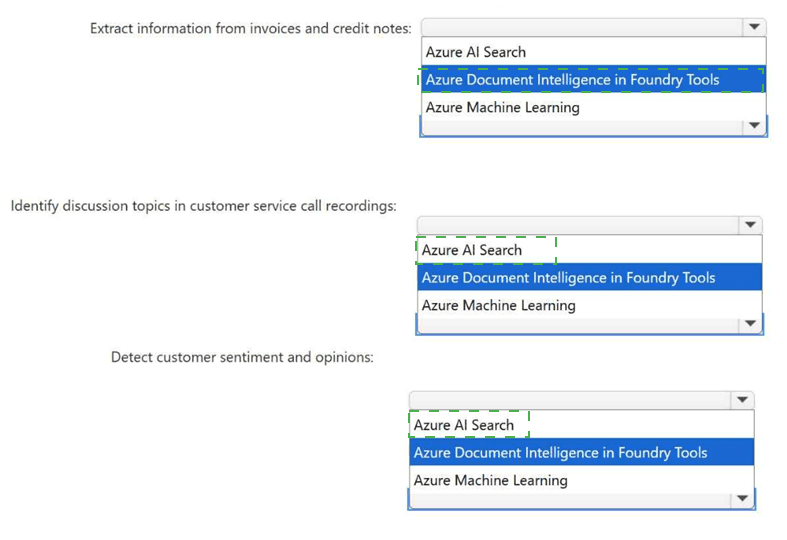
You need to recommend an AI solution for each task. The solutions must use prebuilt AI
capabilities to reduce development time. What should you recommend for each task?
Explanation:
Why the Selected Options Are Correct
Extract fields from invoices $\rightarrow$ Document intelligence: Invoices are structured or semi-structured documents containing specific data points (e.g., invoice ID, line items, total tax). Azure AI Document Intelligence provides prebuilt models explicitly trained to recognize and extract these standard transactional key-value pairs without needing manual training.
Identify defective products $\rightarrow$ Custom vision: General computer vision can recognize standard objects (like a bottle or a tire), but identifying a defect (like a crack or a missing cap) requires training a model on company-specific product images. Azure AI Custom Vision provides a prebuilt framework where you quickly upload normal vs. defective images to build a specialized classifier with minimal code.
Transcribe audio recordings $\rightarrow$ Speech-to-text: Converting spoken audio files directly into structured text strings is the fundamental out-of-the-box purpose of the prebuilt Azure AI Speech service's Speech-to-Text API.
Why the Other Options Are Incorrect
Computer vision is designed for general image tagging, facial detection, and optical character recognition (OCR), but it lacks the specialized structural logic needed to automatically map document fields like invoice data or target specific assembly line manufacturing anomalies.
Language understanding parses text to determine user intent and extract entities (used heavily in chatbots); it cannot ingest raw audio files directly or process visual product images.
References
Microsoft Learn: What is Azure AI Document Intelligence? – Details the prebuilt invoice recipe used to automatically parse vendor document properties.
Microsoft Azure Architecture Guide: Cognitive Services Choice Matrix – Confirms that Speech-to-Text handles raw voice transcription workloads, while Custom Vision handles unique object classification tasks.
Your company discovers that several employees use personal ChatGPT accounts to assist with work tasks. You are concerned about proprietary data being shared externally. You need to evaluate the business value of rolling out Microsoft 365 Copilot. Which capability is a key benefit of using Copilot instead of a personal ChatGPT account?
A. analyzing and producing reports based on complex data
B. generating ideas and solving issues
C. drafting documents, emails, presentations, and marketing materials
D. accessing internal data in accordance with existing Microsoft 365 policies
Explanation:
The core concern described is employees using personal ChatGPT accounts for work, which risks sharing proprietary data externally. The key benefit of deploying Microsoft 365 Copilot instead is its ability to access internal company data while respecting existing Microsoft 365 security, compliance, and permission policies.
Why other options are less relevant to the stated concern
A. Analyzing and producing reports based on complex data — While Copilot can perform this, it's not the differentiating benefit related to data security and governance.
B. Generating ideas and solving issues — Both ChatGPT and Copilot do this well; this does not address the proprietary data concern.
C. Drafting documents, emails, presentations, and marketing materials — Again, a general capability of both tools, not the security-focused differentiator.
The scenario specifically involves "proprietary data being shared externally." The primary benefit of Copilot over personal ChatGPT is governed access to internal data within your existing security boundary.
References
CDW Blog: "Copilot Chat changes the equation. Because it runs within your Microsoft 365 tenant, your data stays in your environment, period. No external exposure"
Microsoft Learn: "Microsoft Copilot for Microsoft 365 presents only data that each individual can access using the same underlying controls for data access used in other Microsoft 365 services"
Your company plans to adopt AI across multiple business units. You need to ensure that all AI projects align with the company’s business strategy and are implemented responsibly. What is the best approach to achieve the goal? More than one answer choice may achieve the goal. Select the BEST answer.
A. Allow each department to deploy its own AI tools and workflows.
B. Delegate AI decision-making to the company’s IT department.
C. Outsource AI development to an external vendor.
D. Establish an AI council to provide guidance, oversight, and coordination.
Explanation:
Establishing an AI council is the most effective approach to ensure that AI projects across multiple business units align with business strategy and are implemented responsibly. An AI council is a cross-functional leadership team that brings together representatives from business leadership, IT, security, legal, compliance, HR, and data science to provide centralized governance .
Why other options are incorrect:
A. Allow each department to deploy its own AI tools and workflows
– This fragmented approach leads to inconsistent governance, duplicated efforts, increased security risks, and inability to scale AI responsibly. Without central coordination, departments may adopt unsanctioned tools that expose the company to compliance and data privacy risks .
B. Delegate AI decision-making to the company's IT department
– IT alone cannot provide the cross-functional oversight required for responsible AI. AI governance requires perspectives from legal (compliance), business units (strategy alignment), HR (workforce impact), and data science (technical feasibility) . Siloing AI decisions in IT leads to blind spots around ethics, regulation, and business value.
C. Outsource AI development to an external vendor
– Outsourcing shifts control but does not eliminate the need for internal governance. Organizations remain legally and ethically accountable for AI outcomes, regardless of who builds the solution. An internal AI council is still required to set policies, approve use cases, and monitor compliance .
References
Microsoft Adoption – Creating an AI Council: "The AI Council is a cross-functional leadership team responsible for aligning AI adoption with business priorities, establishing safeguards, and guiding responsible use"
Microsoft Inside Track – Guiding hands: Inside the councils steering AI projects: "We've relied on a series of employee-led councils to help us guide our strategy, drive our transformation, and shape our AI-forward culture"
Which statement accurately describes the difference between a pretrained generative AI model and a fine-tuned generative AI model?
A. A pretrained model requires labeled data, while a fine-tuned model does not.
B. A pretrained model is faster to train than a fine-tuned model because the pretrained model uses fewer parameters.
C. A pretrained model is trained on broad datasets, while a fine-tuned model is adapted to perform well on a narrower, domain-specific dataset.
D. A pretrained model is optimized for a specific task, while a fine-tuned model is designed for general-purpose use.
Explanation:
A pretrained generative AI model (such as GPT-4, Llama, or Mistral) is initially trained on massive, general-purpose datasets that include diverse text from books, websites, articles, and other publicly available sources. This broad training gives the model general language understanding, reasoning, and generation capabilities across many domains, but it may lack deep expertise in any specific area.
Fine-tuning takes that general pretrained model and performs additional training on a smaller, domain-specific dataset (e.g., legal documents, medical records, customer support logs, or internal company data). This process adapts the model to perform better on a narrower set of tasks or to follow specific formats, tones, or styles relevant to that domain . Fine-tuning improves performance on target tasks without requiring training from scratch.
Why other options are incorrect:
A. A pretrained model requires labeled data, while a fine-tuned model does not
– False. Pretraining typically uses unlabeled data (self-supervised learning), while fine-tuning often requires labeled or task-specific data to teach the model the desired behavior.
B. A pretrained model is faster to train than a fine-tuned model because the pretrained model uses fewer parameters
– False. Pretraining is extremely computationally expensive, requiring weeks or months on thousands of GPUs. Fine-tuning is faster because it starts from an already-trained model. Also, fine-tuning does not reduce the number of parameters; it adjusts the same parameters.
D. A pretrained model is optimized for a specific task, while a fine-tuned model is designed for general-purpose use
– False. This is the reverse of reality. Pretrained models are general-purpose; fine-tuning optimizes them for specific tasks.
References
Microsoft Learn – Fine-tune a model: "Fine-tuning is the process of taking a pretrained model and further training it on a smaller, specific dataset to adapt it for a particular task or domain."
Azure OpenAI Service documentation: "Pretrained models offer broad capabilities. Fine-tuning adapts these models to perform better on specialized tasks."
Your company receives thousands of scanned invoices each month. You need to recommend an AI solution that can automatically extract key details, such as invoice numbers, vendor names, and total amounts. What is the best solution to recommend? More than one answer choice may achieve the goal. Select the BEST answer.
A. Azure Document Intelligence in Foundry Tools
B. Azure Vision in Foundry Tools
C. Azure AI Search
D. Azure Machine Learning
Explanation:
Azure Document Intelligence (formerly Form Recognizer) is the specialized Azure service designed specifically to extract structured data such as invoice numbers, vendor names, and total amounts from scanned documents and PDFs . It includes a prebuilt invoice model that uses powerful OCR capabilities combined with intelligent document processing to extract key fields—including customer name, vendor details, invoice and due dates, billing addresses, line items, and total amounts—and returns a structured JSON representation .
Why other options are incorrect:
B. Azure Vision in Foundry Tools
– Azure Vision focuses on analyzing natural images such as street signs, product labels, and photographs . While it includes OCR capabilities, it is optimized for short text blocks and small images, not for extracting structured fields like invoice numbers and totals from multi-page documents . Document Intelligence is the recommended service for complex, structured document extraction .
C. Azure AI Search
– Azure AI Search is a search and indexing service that can include OCR as part of an enrichment pipeline, but it is not designed for extracting structured field data from invoices . Its primary purpose is making content searchable, not automatically extracting key-value pairs and line items for AP workflows.
D. Azure Machine Learning
– Azure Machine Learning is used for building custom predictive models, such as demand forecasting or classification . It would require extensive custom training and development to perform invoice extraction, making it unnecessarily complex and costly compared to the prebuilt, purpose-built Document Intelligence service.
References
Microsoft Learn: "The Document Intelligence invoice model uses powerful OCR capabilities to analyze and extract key fields and line items from sales invoices, utility bills, and purchase orders"
Microsoft Learn: "Azure Document Intelligence turns documents into usable data. Previously known as Azure Form Recognizer"
| Page 1 out of 8 Pages |