- Select the answer that correctly completes the sentence.
The primary goal of generative AI is __________.


Explanation:
The primary goal of generative AI is to create new, original content—including text, images, code, audio, and video—based on patterns learned from training data. Unlike traditional AI models that classify, predict, or analyze existing information, generative AI produces novel outputs in response to user prompts. For example, it can draft an email, generate a product image, or write a function in Python. This generative capability is what distinguishes it from other forms of artificial intelligence.
Why other options are incorrect:
To analyze trends and classify data sources – This describes analytical or discriminative AI, which focuses on identifying patterns, categorizing data, or detecting anomalies. Generative AI may learn patterns, but its goal is creation, not classification.
To make predictions based on historical data – This describes predictive AI or time-series forecasting, used for tasks like demand forecasting or stock price prediction. Generative AI is not designed for reliable quantitative prediction.
References
Microsoft Learn – Generative AI: "Generative AI is a type of AI that can create new content—text, images, code, audio—based on patterns learned from training data."
Azure OpenAI Service documentation: "Generative models produce original outputs rather than simply classifying or predicting from existing data."
For each of the following statements, select Yes if the statement is true. Otherwise, select No.
NOTE: Each correct selection is worth one point
Explanation:
Why the Selected Options Are Correct:
Statement 1: The context window represents the total memory capacity of an LLM during a single inference cycle. It defines the strict boundary for the maximum number of tokens (words or word fragments) the model can hold in its attention mechanism at one time.
Statement 2: In standard transformer architectures (such as GPT or Llama models), the context window is a shared pool. The total token limit covers the entire lifecycle of the transaction: the incoming input prompt, system instructions, retrieved grounding context, and the newly generated output completion combined.
Statement 3 (No): If an input prompt completely exceeds the context window limit before generation even begins, the system will fail at the API level. It throws a token overflow error and refuses to process the request, rather than attempting to read the prompt and truncating the output.
Why the Alternate Selections Are Incorrect
Marking No on Statement 1 or Statement 2 misinterprets foundational LLM structural limitations. The context window is not an elastic boundary, and it explicitly counts both sides of the token conversation payload.
Marking Yes on Statement 3 is a dangerous assumption for an enterprise architect. A model cannot look past its hardware and attention allocation limits; it will reject the payload entirely via an HTTP 400 bad request or API exception error.
References:
Microsoft Azure OpenAI Service Documentation: Understanding Azure OpenAI Service limits and tokens – Explicitly defines the context window constraint as the cumulative sum of input prompt tokens plus max output completion tokens allowed per model architecture.
OpenAI API Architecture Guide: Managing Context Windows – Confirms that submitting a prompt larger than the model's total token context window results in an immediate API rejection error (context_length_exceeded) rather than a partial processing run.
- For each of the following statements, select Yes if the statement is true. Otherwise, select
No. NOTE: Each correct selection is worth one point.
Explanation:
Why the Selected Options Are Correct
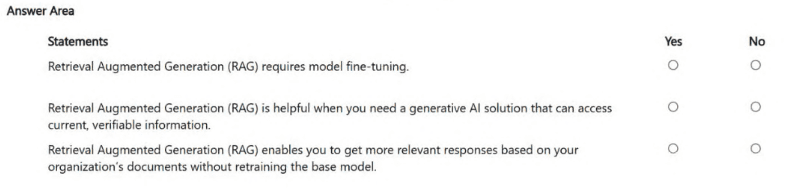
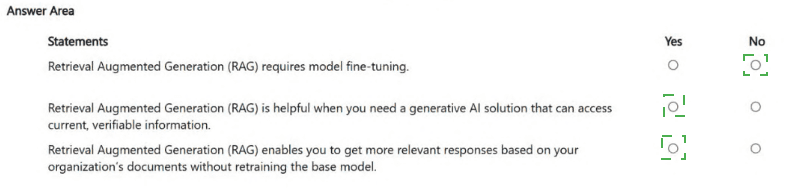
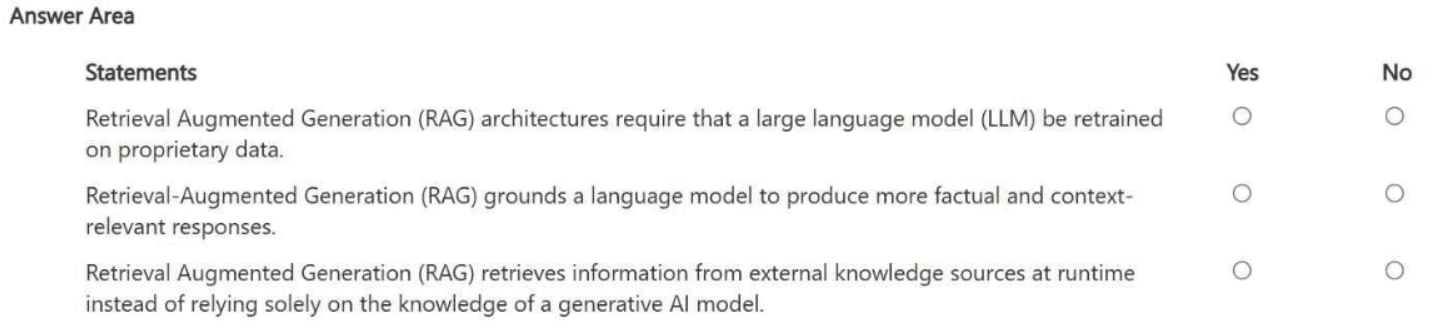
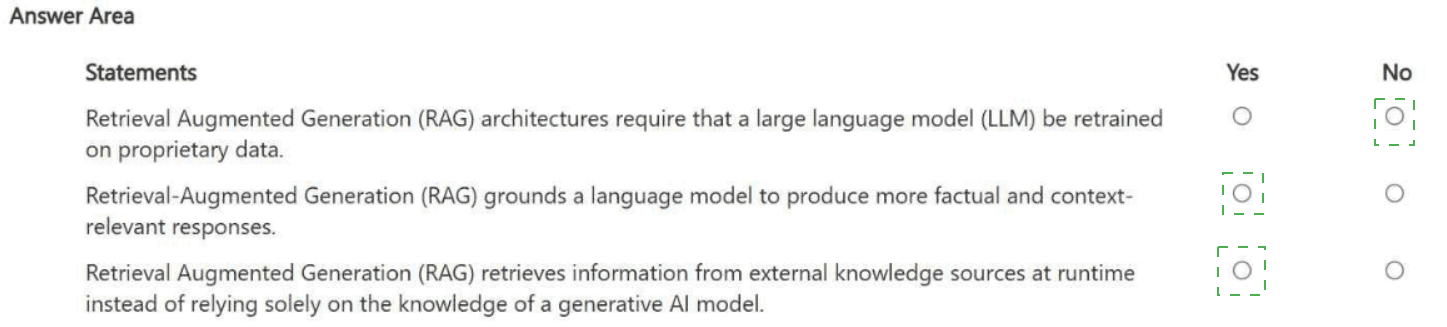
Statement 1 is False (No): One of the primary advantages of a RAG architecture is that it completely bypasses the need to retrain or fine-tune an LLM. It leaves the foundational weights of the model untouched, instead passing enterprise knowledge dynamically through the context window.
Statement 2 is True (Yes): RAG forces grounding by appending vetted, authoritative source documents to the user's prompt. This restricts the model's output boundaries, ensuring responses are driven by fact-based source documentation rather than speculative parameter weights, significantly mitigating hallucinations.
Statement 3 is True (Yes): Rather than drawing solely from frozen training data, a RAG pipeline operates at runtime. When a query is made, a search orchestrator dynamically queries an external index (such as Azure AI Search), retrieves the most relevant knowledge snippets, and feeds them into the model alongside the user prompt.
Why the Alternate Selections Are Incorrect
Marking Yes on Statement 1 misidentifies RAG as a fine-tuning or pre-training methodology, which is compute-heavy and changes model parameters permanently.
Marking No on Statements 2 and 3 misses the core architectural definition of RAG, which exists precisely to counter LLM informational drift, enforce temporal factual correctness, and supply live runtime data from external knowledge bases.
References
Microsoft Learn: What is Retrieval-Augmented Generation (RAG)? – Documents that RAG is an architecture designed to supply an LLM with external data at query time without changing model weights.
Azure Architecture Center: Grounding LLMs using Azure AI Search – Explains how runtime vector and keyword queries pull source fragments to anchor the model's response in reality and eliminate hallucinations.
For each of the following statements, select Yes if the statement is true. Otherwise, select
No. NOTE: Each correct selection is worth one point.
Explanation:
Why the Selected Options Are Correct
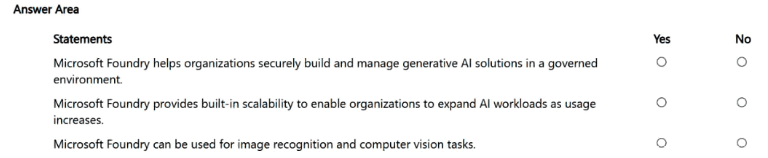
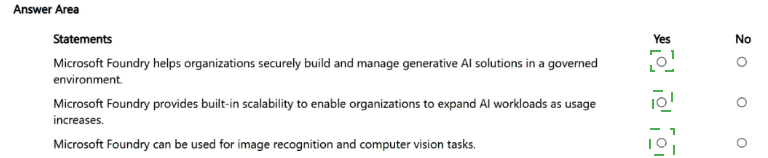
Statement 1: Microsoft Foundry (historically integrated as Azure AI Foundry) serves as the primary governance hub for managing corporate AI footprints. It provides native compliance logging, content filtering, and enterprise authentication barriers to ensure all generative workflows remain strictly inside the company's secure boundary.
Statement 2: Built directly on top of Microsoft’s cloud framework, the platform dynamically scales processing pipelines and token quotas. It adapts effortlessly from early prototype sandboxes to massive, high-concurrency production deployments.
Statement 3: Microsoft Foundry handles a comprehensive collection of multimodal capabilities. It allows developers to deploy, test, and fine-tune computer vision and image processing applications by giving them direct access to advanced vision models.
Why the "No" Selections Are Incorrect
Marking No on Statement 1 overlooks the core security purpose of Foundry, which acts as an enterprise-grade control panel rather than an open-source, unmonitored development tool.
Selecting No on Statement 2 misrepresents the solution's cloud-native scaling abilities, falsely suggesting developers must manually provision separate servers to support growing user demands.
Choosing No on Statement 3 incorrectly minimizes Foundry's multi-modal feature set, falsely implying the workbench is limited to strictly processing text-only large language models.
References
Microsoft Learn: What is Azure AI Foundry? – Details how the unified platform delivers centralized enterprise security, advanced content filtering guardrails, and programmatic workspace management.
Microsoft Azure Architecture Center: Scaling AI Workloads with Microsoft Foundry – Confirms the native integration of high-throughput model endpoints, automatic load balancing, and advanced computer vision frameworks within the ecosystem.
Select the answer that correctly completes the sentence.
Prompt engineering is the process of __________.


Explanation:
Prompt engineering is the practice of designing and refining input instructions (prompts) given to a generative AI model to produce desired, relevant, and high-quality outputs. It does not involve changing the model’s training or architecture. Instead, it focuses on structuring natural language instructions, providing context, specifying output format, and optionally including examples to steer the model’s behavior at inference time. Effective prompt engineering is critical for reducing ambiguity, improving consistency, and aligning AI outputs with user expectations.
Why other options are incorrect:
Integrating AI-powered tools into business workflows – This describes AI integration or orchestration, not prompt engineering. Prompt engineering is about how you ask the model, not where or how you deploy it.
Identifying and fixing errors in AI-generated content – This is post-processing, validation, or content editing. Prompt engineering happens before generation to prevent errors, though iterative refinement may involve fixing prompts based on observed errors.
Designing, developing, and training generative AI models – This describes model development or fine-tuning, which changes the model itself. Prompt engineering works with the model as-is.
References
Microsoft Learn: "Prompt engineering is the process of designing and optimizing prompts to consistently achieve the desired output from a generative AI model."
Azure OpenAI best practices: "Crafting clear, context-rich instructions is the core of prompt engineering."
- For each of the following statements, select Yes if the statement is true. Otherwise, select
No. NOTE: Each correct selection is worth one point.
Explanation:
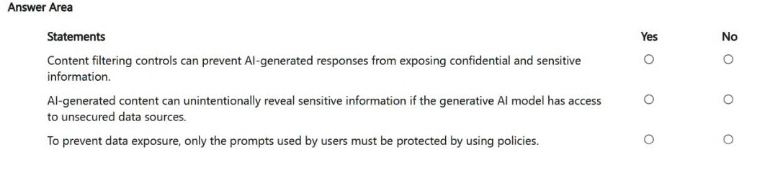
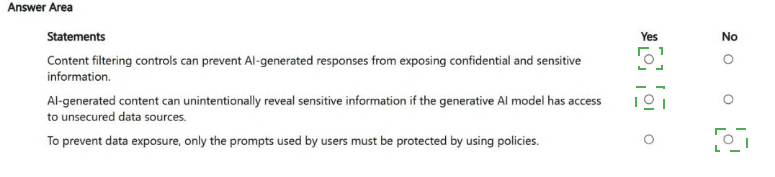
Statement 1: Content Filtering Controls (Yes)
Why it is correct: Content filtering systems (such as Azure OpenAI Content Filters or Microsoft Purview) actively scan both inbound prompts and outbound completions. By configuring custom deployment blocklists, regular expressions, or pattern-matching parameters, organizations can stop AI models from accidentally returning protected data elements—such as social security numbers, credit card tokens, or internal financial records.
Why "No" is incorrect: Dismissing output content filtering removes a vital defensive layer designed to catch automated data leaks before they reach the user interface.
Statement 2: Unsecured Data Sources (Yes)
Why it is correct: Large Language Models (LLMs) and Retrieval-Augmented Generation (RAG) pipelines surface whatever information they have programmatic access to. If an AI service hooks into unsecured, over-permissioned internal data repositories (like open SharePoint sites or unencrypted databases containing proprietary intellectual property), it will synthesize and output that restricted data when prompted by unauthorized end-users.
Why "No" is incorrect: AI models lack innate awareness of corporate organizational hierarchies; they rely entirely on the permission boundaries of the underlying data sources they ingest.
Statement 3: Only Protecting Prompts (No)
Why it is correct: End-user prompts represent only one side of the data governance equation. To completely prevent enterprise data leakage, security policies must protect the entire lifecycle, including incoming prompt payloads, model training/fine-tuning datasets, retrieved reference content, stored chat caches, and outgoing model completions.
Why "Yes" is incorrect: The word "only" makes this option structurally false. Relying strictly on input prompt filtering while ignoring insecure downstream generation, logging storage, or underlying data lake access leaves wide security gaps.
References
Microsoft Purview Deployment Documentation: Data security and compliance for generative AI apps – Mandates securing input prompts, model processing tiers, and outbound completions alongside enforcing strict role-based access controls (RBAC) on connected company knowledge stores.
Azure OpenAI Service Security Guide: Introduction to Content Filtering – Establishes output filtering configurations as a primary mechanism to prevent data extraction and programmatic leakage of confidential enterprise records.
| Page 2 out of 8 Pages |