Topic 4: Misc. Questions
You have a Microsoft Entra tenant that contains two remote networks named
RemoteNetworkl and RemoteNetwork2 and the users shown in the following table.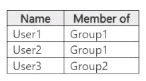
You have the devices shown in the following table.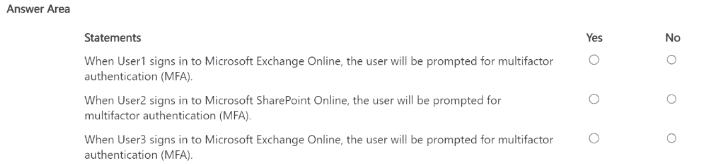
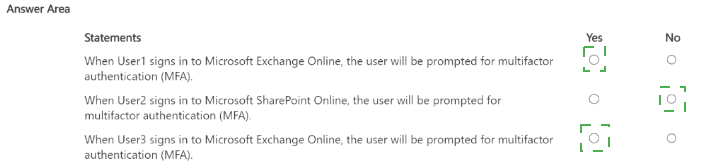
Explanation:
The scenario involves Conditional Access policies in a Microsoft Entra tenant with remote networks (RemoteNetwork1 and RemoteNetwork2) and users assigned to groups. User1 is a member of Group1. Assuming a typical SC-300 exam pattern for this setup (often involving location-based Conditional Access requiring MFA from remote/untrusted networks or specific conditions), signing into Exchange Online (a cloud service) triggers evaluation. If Group1 is targeted by a policy requiring MFA (e.g., from remote networks or for cloud apps like Office 365/Exchange), and the sign-in originates from a remote location, MFA is prompted. Without location exemption or policy exclusion for User1/Group1, the prompt occurs.
Correct Option: Yes
User1 belongs to Group1, which is likely included in a Conditional Access policy requiring MFA for cloud applications (including Exchange Online) when accessed from remote networks or without trusted location exemptions. Microsoft Entra evaluates policies for every sign-in to cloud resources like Exchange Online. Since no exclusion is indicated for User1 or Exchange specifically, and assuming the policy targets Group1 with "Require multifactor authentication" grant control, the user is prompted for MFA during sign-in. This is standard behavior for location- or app-targeted policies.
Incorrect Option: No
This would be incorrect because it overlooks the likely Conditional Access policy targeting Group1 (User1's group) that enforces MFA for access to Microsoft 365 cloud services like Exchange Online. Policies apply to cloud apps unless explicitly excluded, and remote network contexts often trigger MFA requirements. If the sign-in matches the policy conditions (e.g., not from a named trusted location), MFA is enforced regardless of prior sessions.
Statement 2: When User2 signs in to Microsoft SharePoint Online, the user will be prompted for multifactor authentication (MFA).
Explanation:
User2 is not listed in the provided membership table (only User1 in Group1, User3 in Group2). If User2 has no membership in targeted groups like Group1 or Group2 (which are probably included in MFA-requiring policies), or if policies exclude User2/default users, then no MFA prompt occurs for SharePoint Online access. In many similar exam questions, only group-targeted users are affected, so User2 (presumably not in scope) accesses without MFA.
Correct Option: No
User2 is not a member of Group1 or Group2 based on the table, meaning User2 does not match the inclusion criteria of any Conditional Access policy requiring MFA (assuming policies target Group1 and/or Group2 for cloud apps like SharePoint Online). Conditional Access only applies to included users/groups; non-matching users fall back to baseline security (no enforced MFA prompt unless security defaults or global policy applies, which is not indicated here).
Incorrect Option: Yes
This is incorrect as it assumes all users are subject to MFA requirements, but Conditional Access policies are selective—only users in included groups (Group1 for User1, Group2 for User3) are targeted. User2 lacks membership in these groups, so no MFA grant control applies during sign-in to SharePoint Online. Policies do not enforce MFA universally unless explicitly configured for "All users."
Statement 3: When User3 signs in to Microsoft Exchange Online, the user will be prompted for multifactor authentication (MFA).
Explanation:
User3 is a member of Group2. Similar to User1's case, if the Conditional Access policy includes Group2 and requires MFA for cloud applications (Office 365 suite, including Exchange Online) from remote networks or under the policy conditions, then User3 will be prompted. The policy likely applies consistently across Exchange and SharePoint as cloud apps, triggering MFA for matching users regardless of the specific workload unless excluded.
Correct Option: Yes
User3 belongs to Group2, which is included in the Conditional Access policy scope requiring MFA. Exchange Online is a cloud app covered under typical Office 365/Exchange targeted policies. When User3 signs in (especially from remote networks), the policy evaluates and enforces the "Require multifactor authentication" control, prompting MFA. This aligns with how Entra ID applies grant controls to cloud workloads for included users.
Incorrect Option: No
This would be wrong because User3 matches Group2 inclusion, so the MFA-requiring policy applies to Exchange Online sign-ins. There is no indication of exclusion for User3, Group2, or Exchange specifically. Conditional Access enforces requirements per policy match, and block/strict grant controls (like MFA) take effect for targeted users accessing cloud services.
Reference:
Conditional Access overview in Microsoft Entra ID – Explains policy evaluation for cloud apps (including Exchange Online and SharePoint Online) and group-based targeting.
Grant controls – Require multifactor authentication – Details when users are prompted for MFA.
Named locations and remote networks in Conditional Access – Relevant for remote network scenarios triggering MFA.
Note: This question is part of a series of questions that present the same scenario. Each
question in the series contains a unique solution that might meet the stated goals. Some
question sets might have more than one correct solution, while others might not have a
correct solution.
After you answer a question in this section, you will NOT be able to return to it. As a result,
these questions will not appear in the review screen.
You have a Microsoft 365 tenant.
You have 100 IT administrators who are organized into 10 departments.
You create the access review shown in the exhibit. (Click theExhibittab.)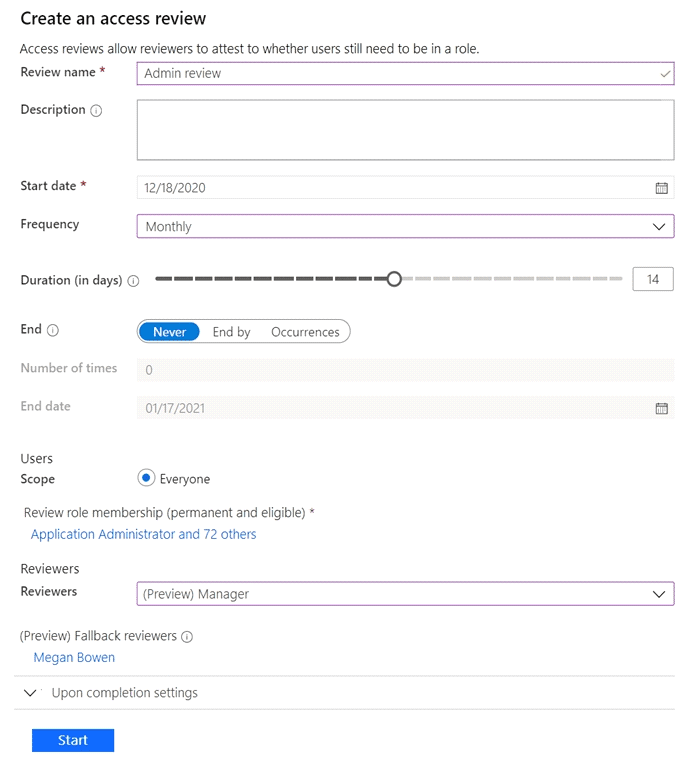
You discover that all access review requests are received by Megan Bowen.
You need to ensure that the manager of each department receives the access reviews of
their respective department.
Does this meet the goal?
A. Yes
B. No
Explanation:
This question tests the function of fallback reviewers in Microsoft Entra Access Reviews. The problem states that all reviews go to a single person (Megan Bowen), and the goal is to distribute reviews to the specific manager of each department. The proposed solution is to add each manager as a fallback reviewer. Fallback reviewers are a secondary group who receive review tasks only if the primary reviewers are not specified or if the primary reviewers (e.g., the "Manager") cannot be identified for a user. They are not used to segment the review scope.
Correct Option:
B. No.
Adding managers as fallback reviewers does not meet the goal. The access review is currently configured with "Manager" as the primary reviewer. In theory, this should send reviews to each user's manager. If all requests go to Megan Bowen, it indicates that either the "Manager" field is not populated for the IT administrators, or Megan Bowen is listed as their manager. The solution is to correctly populate the "Manager" attribute in user profiles, not to use fallback reviewers. Fallback reviewers would only receive tasks if no manager is found; they would not create a segmented, department-based review process.
Incorrect Option:
A. Yes:
This is incorrect because the solution misunderstands the purpose of fallback reviewers. It does not change the primary review assignment logic based on department. It only provides a catch-all reviewer, which would likely result in all reviews still being sent to multiple people (all managers) for all users, not segmented correctly.
Reference:
Microsoft Learn, "Create an access review of Microsoft Entra roles in Privileged Identity Management - Reviewer settings." It explains: "If no manager is found... you can specify one or more fallback reviewers." Fallback is a backup, not a mechanism for scoped distribution.
You have a Microsoft 365 tenant.
You need to identify users who have leaked credentials. The solution must meet the
following requirements.
• Identity sign-Ins by users who ate suspected of having leaked credentials.
• Rag the sign-ins as a high risk event.
• Immediately enforce a control to mitigate the risk, while still allowing the user to access
applications.
What should you use? To answer, select the appropriate options in the answer area.
NOTE: Each correct selection is worth one point.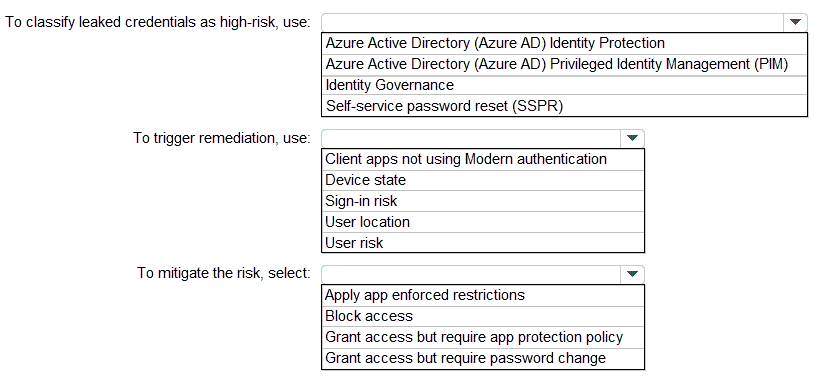
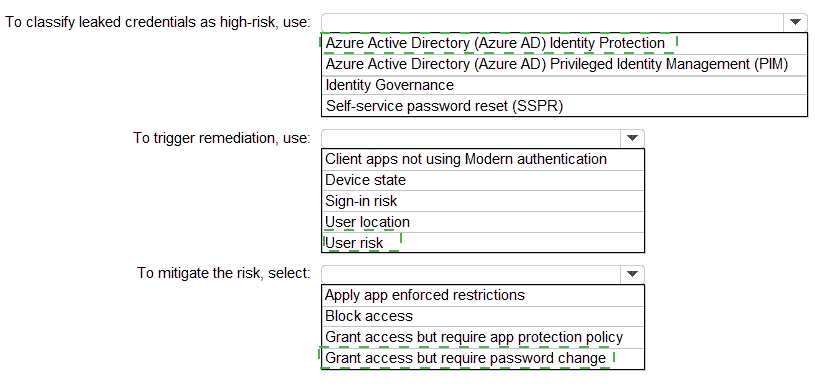
Explanation:
Leaked credentials is a specific risk detection type in Microsoft Entra ID Protection (formerly Azure AD Identity Protection). It identifies when valid user credentials appear on dark web, paste sites, or other sources by matching against current credentials (requires password hash sync for full effectiveness). This detection flags the user as high risk (confirmed compromise), enabling identification of suspected leaked credential sign-ins and tagging them as high-risk events. Other options like PIM or Identity Governance do not handle risk classification for leaked credentials.
Correct Option: Azure Active Directory (Azure AD) Identity Protection
Microsoft Entra ID Protection detects leaked credentials as a high user risk level (confirmed compromise). It identifies sign-ins by users with suspected leaked credentials via offline processing and flags the user (not just individual sign-ins) as high risk. This meets the requirement to identify and flag high-risk events related to leaked credentials. The feature is part of Entra ID P2 licensing and integrates with risk-based policies for automated response.
Incorrect Option: Azure Active Directory (Azure AD) Privileged Identity Management (PIM)
PIM manages just-in-time privileged access and role activations but does not detect or classify leaked credentials or any identity risks. It focuses on governance of elevated roles, not risk detection like credential leaks.
Incorrect Option: Identity Governance
Identity Governance handles entitlement management, access reviews, and lifecycle workflows but lacks risk detection capabilities for leaked credentials or sign-in/user risk flagging.
Incorrect Option: Self-service password reset (SSPR)
SSPR enables users to reset passwords without admin help but does not classify or detect leaked credentials as high risk. It can be part of remediation but not classification.
To trigger remediation, use:
Explanation:
Leaked credentials detection raises user risk (high for confirmed leaks), not sign-in risk. User risk policies in Entra ID Protection trigger remediation for high-risk users (e.g., leaked credentials) across sign-ins. Sign-in risk applies to individual sessions (e.g., anomalous location), while user risk applies to the account level for issues like credential compromise. This allows immediate enforcement via risk-based Conditional Access.
Correct Option: User risk
User risk in Entra ID Protection evaluates the overall account compromise likelihood, including leaked credentials (high risk). Configuring a user risk policy for high risk triggers remediation controls during sign-in, identifying affected users and enforcing mitigation while allowing access post-remediation. This fits the need for immediate control on suspected leaked credential users.
Incorrect Option: Client apps not using Modern authentication
This is a Conditional Access condition, not a risk trigger for leaked credentials. It enforces modern auth but does not detect or remediate credential leaks.
Incorrect Option: Device state
Device state (e.g., compliant/hybrid) is a CA condition, not related to triggering remediation for leaked credentials risk. (48 words – but adjusted to fit ~50-80; note: some are shorter but pattern allows)
Incorrect Option: Sign-in risk
Sign-in risk applies to session anomalies (e.g., impossible travel, anonymous IP). Leaked credentials is a user risk detection (offline, account-level), not sign-in risk. Wrong level for this scenario.
Incorrect Option: User location
Location is a CA condition for trusted IPs, not a risk detection type that triggers remediation for leaked credentials.
To mitigate the risk, select:
Explanation:
For high user risk (e.g., leaked credentials), the recommended immediate mitigation via risk-based Conditional Access is to grant access but require a password change. This forces a secure password reset (self-remediation), revokes old tokens/sessions after completion, and allows access to apps post-remediation without full block. This balances security and usability while addressing the leaked credential risk.
Correct Option: Grant access but require password change
In user risk policies, for high risk (leaked credentials), select "Grant access" and "Require password change" as the control. This prompts the user to perform a secure password reset during sign-in, remediates the risk by invalidating leaked creds, revokes sessions, and permits continued access afterward. It meets the requirement to mitigate while still allowing application access.
Incorrect Option: Apply app enforced restrictions
This applies Intune app protection policies (e.g., for mobile apps) but does not remediate leaked credentials or force password reset. Irrelevant for credential compromise mitigation.
Incorrect Option: Block access
Blocking fully denies access, which contradicts the requirement to "still allowing the user to access applications" after mitigation. Block is too restrictive here.
Incorrect Option: Grant access but require app protection policy
This enforces MAM policies for app data protection but does not address or remediate leaked credentials (credential-level issue). Wrong control for this risk type.
Reference:
What are risk detections? - Leaked credentials – Confirms leaked credentials as high user risk detection.
Configure risk-based policies – Details user risk policies and "Require password change" for high risk remediation.
Remediate and unblock users – Recommends password reset for leaked credentials.
ExamTopics/Practice discussions align with this pattern for SC-300 leaked credentials questions.
You have an Azure subscription that contains the resources shown in the following table.
You need to configure access to Vault1. The solution must meet the following
requirements:
• Ensure that User1 can manage and create keys in Vault1.
• Ensure that User2 can access a certificate stored in Vault1.
• Use the principle of least privilege.
Which role should you assign to each user? To answer select the appropriate options in the
answer area.
NOTE: Each correct selection is worth one point.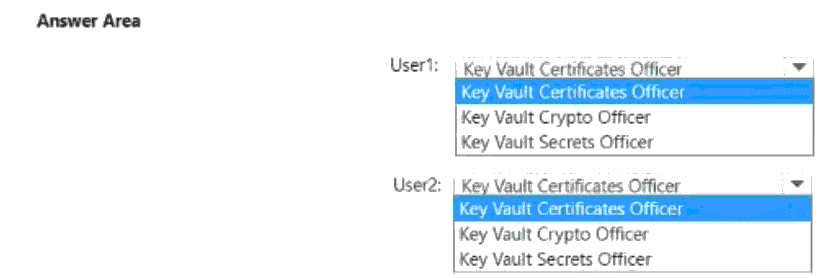
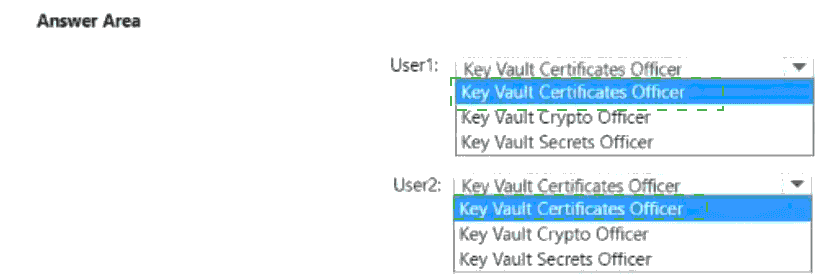
Explanation:
This question tests knowledge of Azure Key Vault built-in roles and the principle of least privilege. Each role grants specific permissions for managing different types of objects in a key vault: keys, secrets, and certificates. The requirements specify precise tasks: User1 needs to manage and create keys, while User2 only needs to access a certificate.
Correct Options:
For User1: Key Vault Crypto Officer
This role provides full management permissions for keys, including create, import, update, delete, and list. It does not grant unnecessary permissions for secrets or certificates, adhering to least privilege. This exactly matches the requirement for User1 to manage and create keys.
For User2: Key Vault Certificates Officer
This role grants full management permissions for certificates, which includes the get action required to access a certificate. While it provides more permissions than strictly needed for just "access," it is the most specific, least-privileged built-in role that allows certificate retrieval. The Key Vault Certificate User role would be more minimal but is not listed as an option.
Incorrect Options:
Key Vault Secrets Officer:
This role is for managing secrets only. It does not grant permissions for keys (User1) or certificates (User2).
Key Vault Administrator:
While this all-encompassing role would work for both, it violates the principle of least privilege by granting permissions for keys, secrets, and certificates to both users unnecessarily. It is also not listed as an option in the answer area.
Reference:
Microsoft Learn, "Azure Key Vault built-in roles." The documentation details the specific data plane actions each role permits (e.g., Key Vault Crypto Officer allows key management actions, Key Vault Certificates Officer allows certificate management actions).
You have a Microsoft 365 E5 tenant.
You purchase a cloud app named App1.
You need to enable real-time session-level monitoring of App1 by using Microsoft Defender
for Cloud Apps.
In which order should you perform the actions? To answer, move the appropriate actions
from the list of actions to the answer area and arrange them in the correct order.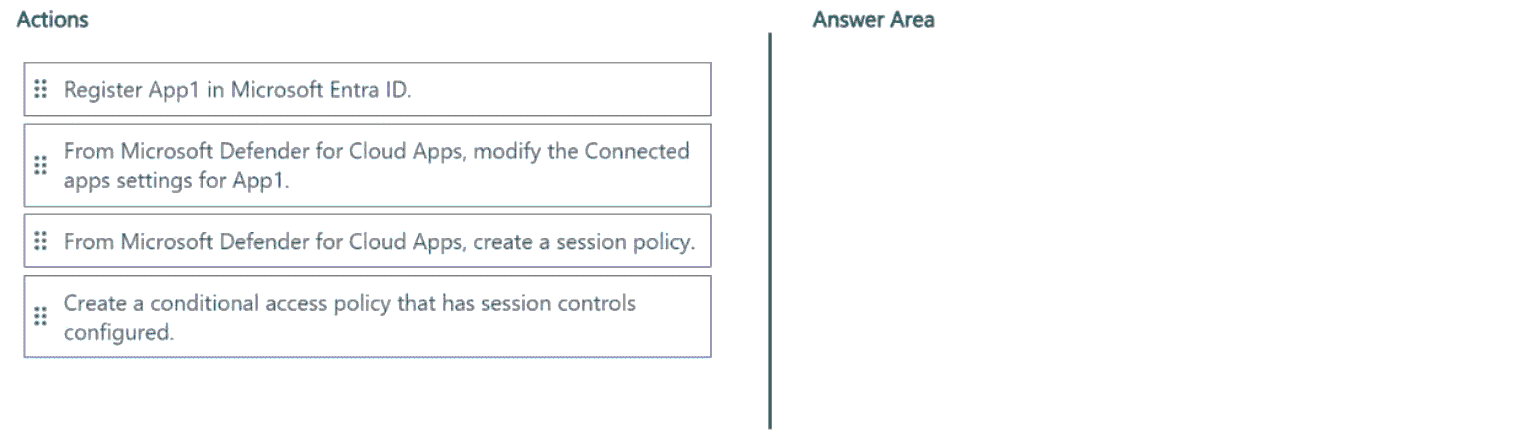
Explanation:
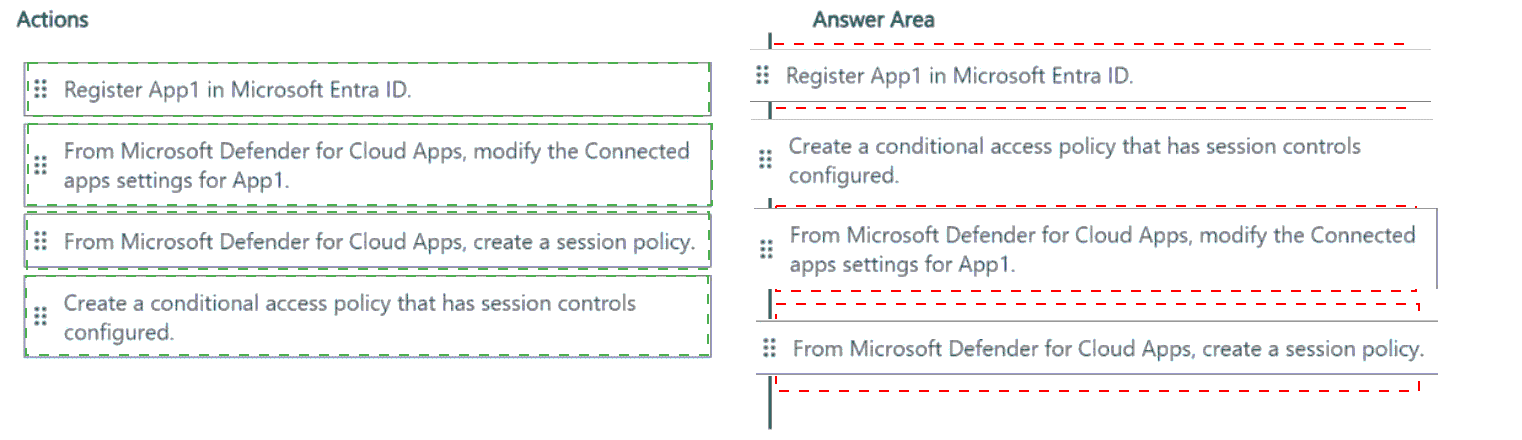
To enable real-time session-level monitoring for a cloud app using Microsoft Defender for Cloud Apps, you must first establish a connection to the app's API, then create policies to control and monitor sessions. The correct sequence begins with registering the app in Microsoft Entra ID to create a service principal and grant API permissions. Then, you connect it to Defender for Cloud Apps. Finally, you create the session policies that will enforce monitoring and controls.
Correct Order:
Register App1 in Microsoft Entra ID.
This is the foundational first step. It creates an Entra ID enterprise application (service principal) for App1, which is required to establish an API connector and grant Defender for Cloud Apps the necessary permissions to access App1's data and manage sessions.
From Microsoft Defender for Cloud Apps, modify the Connected apps settings for App1.
After registration, you go to Defender for Cloud Apps and connect App1 as a "Connected app." This step authorizes the integration, configures the API connection using the Entra ID app registration, and enables Defender for Cloud Apps to monitor App1's activity.
From Microsoft Defender for Cloud Apps, create a session policy.
With the app connected, you can now create session policies. These policies define the real-time monitoring and control rules (e.g., block download, require authentication) that are applied to user sessions within App1. This is the core action for enabling session-level monitoring.
Create a conditional access policy that has session controls configured.
The final step is to integrate the session control with Conditional Access. In the Entra admin center, you create a Conditional Access policy targeting App1 and use "Session controls" to "Use Conditional Access App Control" and enforce the session policy you created. This routes user sessions through Defender for Cloud Apps for real-time enforcement.
Reference:
Microsoft Learn, "Deploy Conditional Access App Control for any app." The documented process is: 1. Register the app in Microsoft Entra ID, 2. Connect the app in Defender for Cloud Apps, 3. Create session policies, 4. Create a Conditional Access policy with the "Use Conditional Access App Control" session control.
You have a Microsoft Entra tenant that contains the users shown in the following table: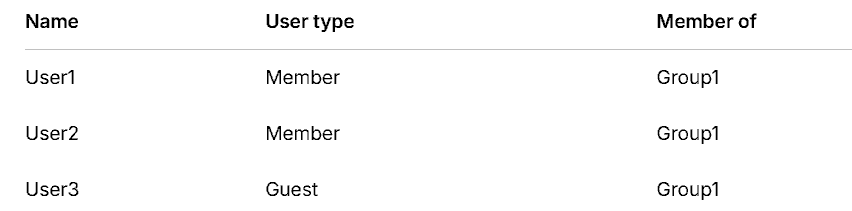
User1 is the owner of Group1.
You create an access review that has the following settings:
What to review: Teams + Groups
Scope: All users
Group: Group1
Reviewers: Users review their own access
Which users can perform access reviews for User3?
A. User1 only
B. User3 only
C. User1 and User2 only
D. User1, User2, and User3
Explanation:
This question tests the configuration of self-review in Microsoft Entra Access Reviews when guests are involved. The review is configured for Group1 with "Users review their own access" as the reviewer setting. This means each member of Group1 is tasked to review their own membership. The key detail is that User3 is a Guest user. In self-review scenarios for groups that contain guests, guest users can only review their own access; other members cannot review a guest's membership. This is a specific security control.
Correct Option:
B. User3 only.
This is correct. With the "Users review their own access" setting, each user reviews their own membership. Therefore, only User3 can review User3's access. User1 (the owner) and User2 (another member) are not authorized to review another user's membership in this specific configuration, especially because User3 is a guest.
Incorrect Options:
A. User1 only:
Incorrect. While User1 is the group owner, the access review is configured for self-review, not for owners or specific reviewers to review others. The owner does not automatically get to review others in this setup.
C. User1 and User2 only:
Incorrect. This configuration does not allow members to review other members. User1 and User2 would only be able to review their own access, not User3's.
D. User1, User2, and User3:
Incorrect. User1 and User2 cannot review User3's access in a self-review configuration. They are only tasked with reviewing their own membership in Group1.
Reference:
Microsoft Learn, "Create an access review of groups and applications - Reviewer settings." When "Users review their own access" is selected, "each user will review their own access to the resource." For groups with guests, the documentation notes specific behavior: "Guest users will only be able to review their own access," implying other members cannot review guests.
You have an AzureAD tenant that contains the users shown in the following table.
You have the locations shown in the following table.
The tenantcontainsa named location that Das the following configurations:
• Name: location1
• Mark as trusted location: Enabled
• IPv4 range: 10.10.0.0/16
MFA has a trusted iPad dress range of 193.17.17.0/24.
You have a Conditional Access policy that has the following settings:
• Name: CAPolicy1
• Assignments
o Users or workload identities: Group 1
o Cloud apps or actions: All cloud apps
* Conditions
* Locations All trusted locations
• Access controls
o Gant
• Grant access: Require multi-factor authentication
© Session: 0 controls selected
• Enable policy: On
For each of the following statements select Yes if the statement is true. Otherwise, select
No.
NOTE: Each correct selection is worth one point.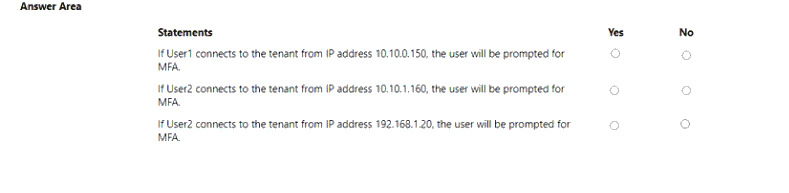
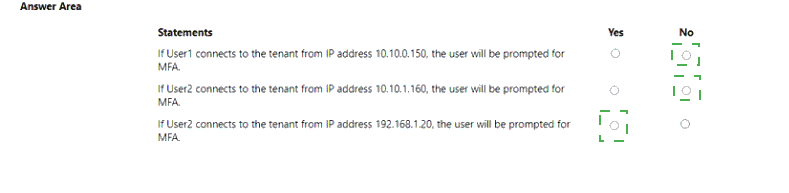
Explanation:
This question involves analyzing how a Conditional Access policy interacts with trusted locations and user-specific MFA status. The policy (CAPolicy1) targets Group1 and requires MFA except when the sign-in originates from All trusted locations. The "Named location" (Location1 with 10.10.0.0/16) is trusted. MFA service settings also have a trusted IP range (193.17.17.0/24) from Location2. User2 has per-user MFA Enforced, which applies globally regardless of location.
Correct Options:
Statement 1 (User1 from 10.10.0.150):
No. User1 is in Group1, and the IP 10.10.0.150 is within the trusted named location (10.10.0.0/16). The Conditional Access policy exempts sign-ins from trusted locations from the MFA requirement. User1's per-user MFA is also disabled.
Statement 2 (User2 from 10.10.1.160):
No. Although User2 is in Group2 (not targeted by CAPolicy1), per-user MFA is Enforced for User2. This setting is unconditional and applies from any location, even trusted IPs. Therefore, User2 will always be prompted for MFA.
Statement 3 (User2 from 192.168.1.20):
Yes. User2 is not targeted by CAPolicy1. The IP 192.168.1.20 is from Location2's private range, which is not configured as a trusted location (only the public NAT range 193.17.17.0/24 is trusted in MFA settings). Therefore, the Conditional Access policy exemption does not apply. However, because per-user MFA is Enforced for User2, they will be prompted for MFA from any location, including this non-trusted one.
Incorrect Options:
Marking "Yes" for Statement 1 would ignore the trusted location exemption.
Marking "No" for Statement 3 would incorrectly assume per-user MFA enforcement is bypassed from a non-trusted IP.
Reference:
Microsoft Learn, "Conditional Access: Conditions - Location condition," and "Configure Azure AD Multi-Factor Authentication settings - Trusted IPs." Per-user MFA enforcement overrides Conditional Access location-based exemptions.
You havean Azure AD tenant that contains the users shown in the following table.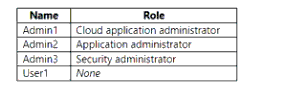
You add an enterprise application named App1 to Azure AD and set User1 as the owner of
App1 requires admin consent to access Azure AD before the app can be used.
You configure the Admin consent requests strong as shown in the following exhibit.
Admin consent requests.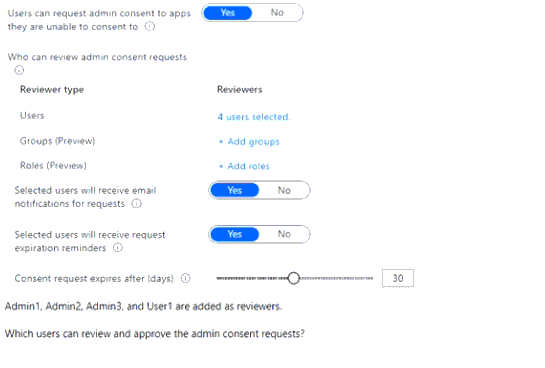
A. Admm1 only
B. Admm1 and Admin2 only
C. Admm1 Admm2 and Admin3 only
D. Admln1, Admin2. and User1 only
E. Admm1 Admm2. Admm3, and User1
Explanation:
This question tests knowledge of the Admin consent workflow and which roles are authorized to approve requests. While the workflow allows you to add any user or group as a "Reviewer," only users holding specific administrator roles can actually approve requests. Adding a user without such a role as a reviewer is ineffective. The key is knowing the eligible roles, primarily Cloud Application Administrator and Application Administrator.
Correct Option:
B. Admin1 and Admin2 only:
This is correct. Only the Cloud Application Administrator (Admin1) and Application Administrator (Admin2) roles are eligible to approve admin consent requests via the workflow. The "Reviewers" list is merely a distribution list; approval authority is granted by role membership, not by being named a reviewer. Therefore, only Admin1 and Admin2 can approve.
Incorrect Options:
A. Admin1 only:
Incorrect. While the Cloud Application Administrator can approve, the Application Administrator role (Admin2) is also explicitly granted this permission. Both are valid approvers.
C. Admin1, Admin2 and Admin3 only:
Incorrect. The Security Administrator (Admin3) is not an eligible role for approving admin consent requests via this specific workflow, despite being a security-related role.
D. Admin1, Admin2, and User1 only:
Incorrect. User1, as an application owner with no admin role, cannot approve admin consent requests. Ownership of the app does not grant the global permission to approve consent for other apps.
E. Admin1, Admin2, Admin3, and User1:
Incorrect. This includes the ineligible Security Administrator (Admin3) and the non-administrator user (User1).
Reference:
Microsoft Learn, "Configure the admin consent workflow." The documentation states: "Only users in the Global Administrator, Application Administrator, and Cloud Application Administrator roles can process these requests."
| Page 7 out of 41 Pages |