Topic 9: Misc. Questions
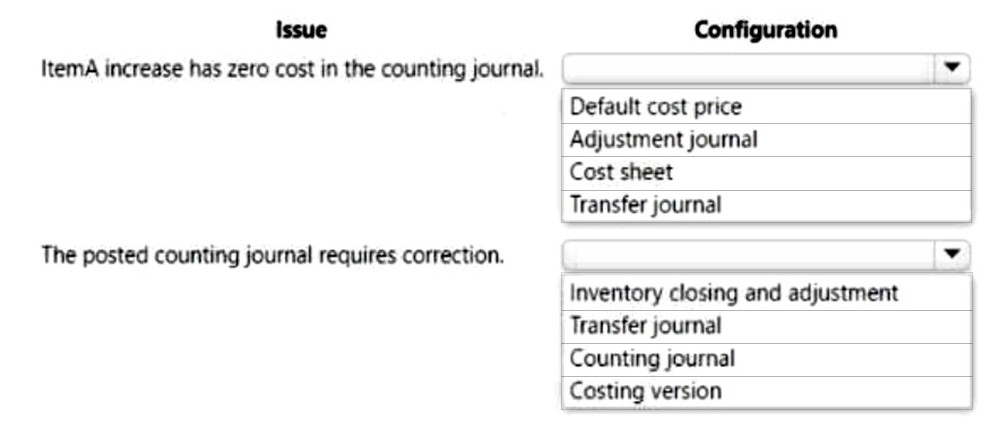
A company uses Dynamics 365 Supply Chain Management. Inventory is valued through
FIFO costing.
The warehouse manager identifies item discrepancies and increases quantities in a
counting journal. Finance then discovers that the cost on Item A posted as zero dollars on
the journal transaction.
You need to configure the system to ensure that the cost is populated on the transaction.
What should you configure? To answer, select the appropriate options in the answer area,
NOTE: Each correct selection is worth one point.
Explanation:
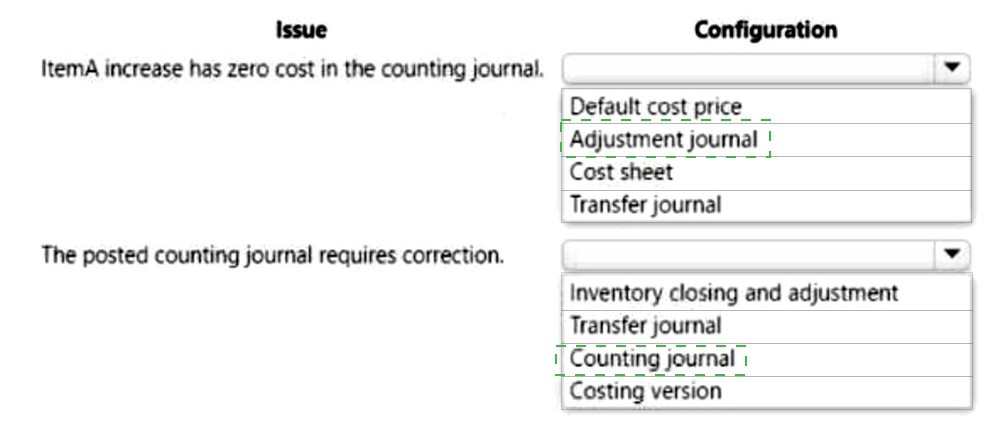
Box 1: Adjustment journal
Inventory adjustment
When you use an inventory adjustment journal, you can add cost to an item when you add
inventory. The additional cost is automatically posted to a specific general ledger account,
based on the setup of the item group posting profile. Use this inventory journal type to
update gains and losses to inventory quantities when the item should keep its default
general ledger offset account. When you post an inventory adjustment journal, an inventory
receipt or issue is posted, the inventory values are changed, and ledger transactions are
created.
Box 2: Counting journal
Counting journals let you correct the current on-hand inventory that is registered for items
or groups of items, and then post the actual physical count, so that you can make the
adjustments that are required to reconcile the differences.
A company is configuring the handheld warehouse mobile device in Dynamics 365 Supply
Chain Management
Several warehouse activities are documented as required configurations. The activity
configurations require a menu item in the device interface.
You need to create the menu items.
Which menu item mode should you use for each activity? To answer, move the appropriate
menu item modes to the correct activities. You may use each menu item mode once, more
than once, or not at all. You may need to move the split bar between panes or scroll to view
content.
NOTE: Each correct selection is worth one point.


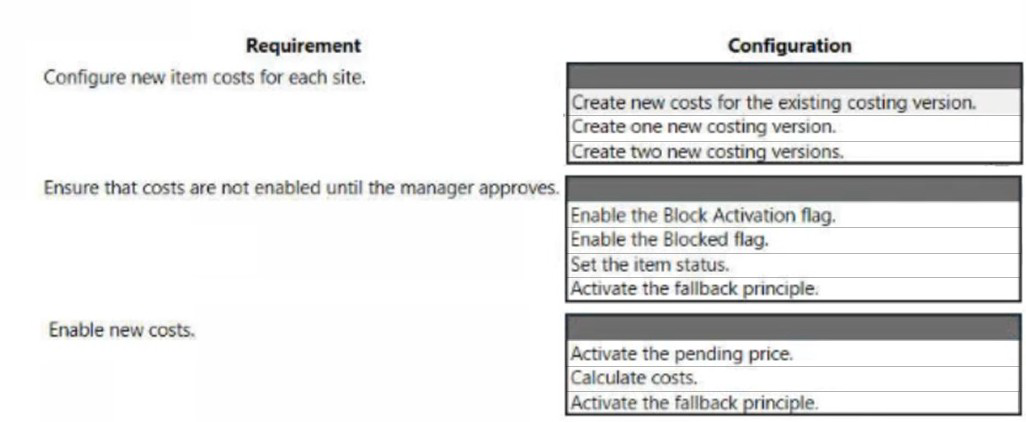
A company uses Dynamics 365 Supply Chain Management. The company has two sites at
ports of entry, one in Atlanta and one in San Francisco.
Due to supply chain constraints and cost fluctuations, the company must change from one
standard cost for all products to two standard cost structures, one for Atlanta and one for
San Francisco. A costing manager for each site will manage and approve the costing. The
historical costs must be retained for analytical purposes. Costs are revised annually.
You need to configure the system.
What should you configure? To answer, select the appropriate options in the answer area.
NOTE: Each correct selection is worth one point.
Explanation:
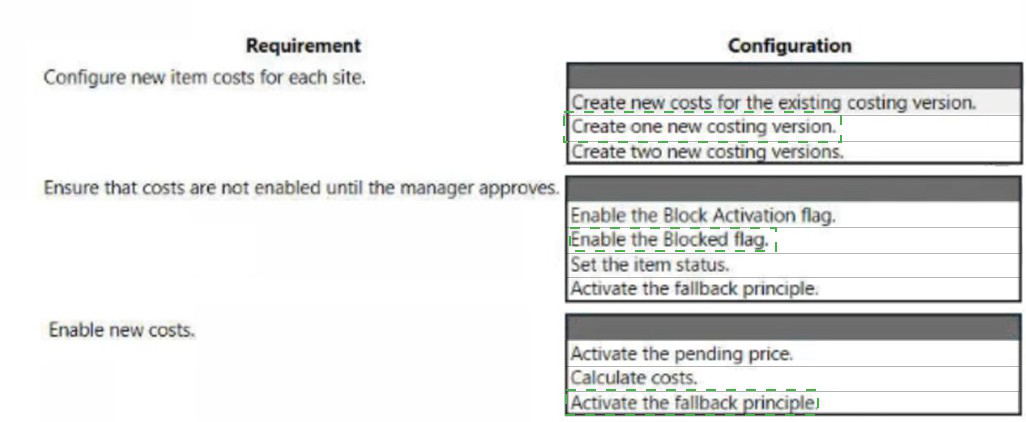
Box 1: Create a new costing version.
As we need two standard cost structures, we need two cost versions.
Note: A costing version can support a standard cost inventory model for items, where the
costing version contains a set of standard cost records about items and manufacturing
processes.
Box 2: Enable the Blocked flag.
The manager could use the Costing version setup page to change the blocking flag to allow
activation of the pending cost records in the second costing version.
Box 3: Activate the fallback principle
Update standard costs for a new manufactured item (see last line below).
The following guidelines assume that you use a two-version approach to update standard
costs. In this approach, one costing version contains the standard costs that were originally
defined for the frozen period, and the second costing version contains the incremental
updates that pertain to the new manufactured items. The incremental updates are entered
as cost records in the second costing version, and eventually they are enabled. The two version
approach requires that you define a second costing version. Here are the
guidelines for defining this costing version:
Assign a costing type of Standard cost.
Assign a significant identifier that indicates the contents of the costing version, such as
2016-UPDATES.
In the Allow price types field group, make sure that Cost price is set to Yes.
Allow cost records to be entered for all sites (that is, leave the Site field blank). If you enter
a site, cost records can be entered only for that site.
Use a fallback principle of Active.
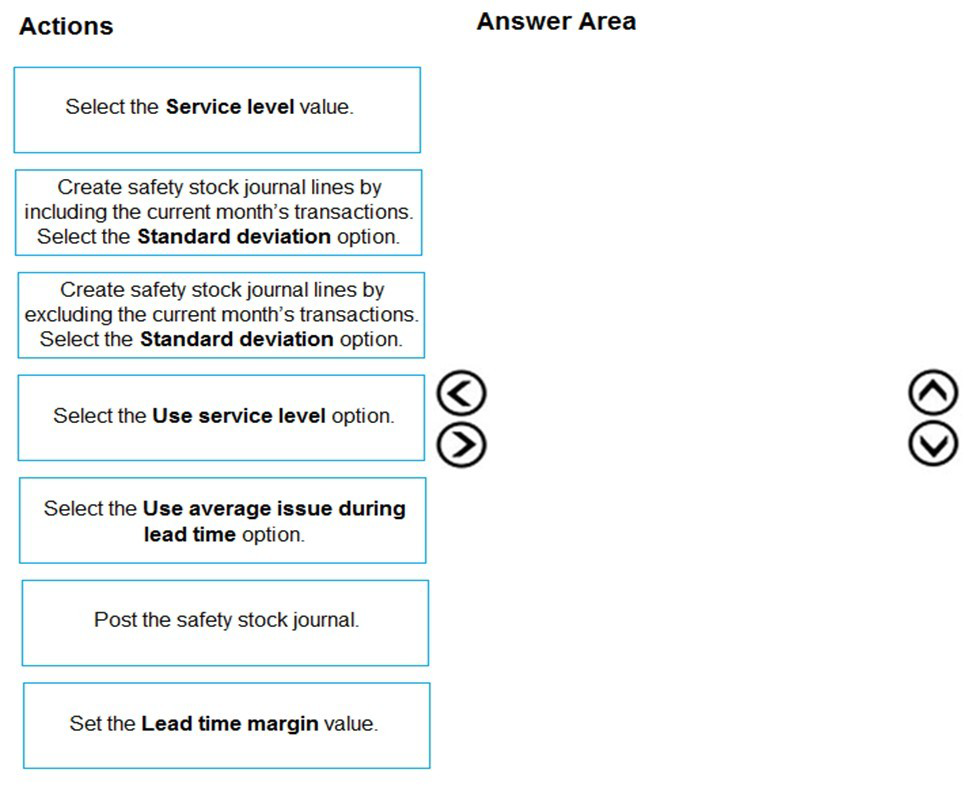
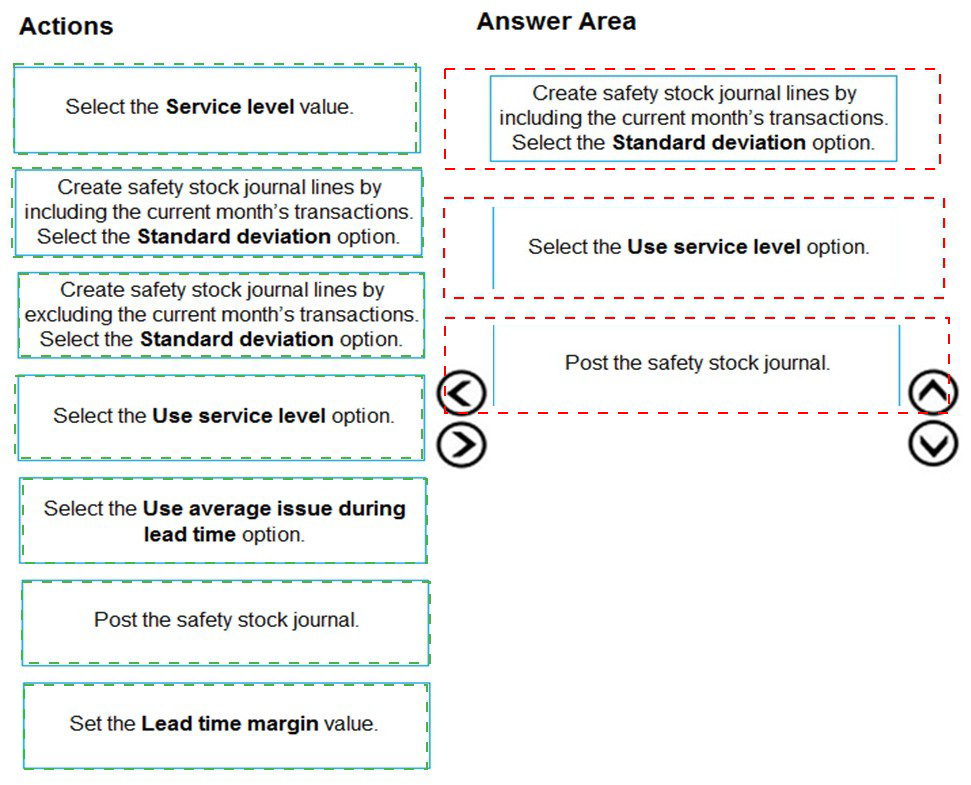
A manufacturing company uses Dynamics 365 Supply Chain Management.
You must review the safety stock level for raw materials.
You need to calculate the minimum coverage proposals based on standard deviation.
Which three actions should you perform in sequence? To answer, move the appropriate
actions from the list of actions to the answer area and arrange them in the correct order.
| Page 11 out of 41 Pages |