Free Microsoft DP-750 Practice Test Questions MCQs
Stop wondering if you're ready. Our Microsoft DP-750 practice test is designed to identify your exact knowledge gaps. Validate your skills with Implementing Data Engineering Solutions Using Azure Databricks questions that mirror the real exam's format and difficulty. Build a personalized study plan based on your free DP-750 exam questions mcqs performance, focusing your effort where it matters most.
Targeted practice like this helps candidates feel significantly more prepared for Implementing Data Engineering Solutions Using Azure Databricks exam day.
2580+ already prepared
Updated On : 12-Oct-202658 Questions
Implementing Data Engineering Solutions Using Azure Databricks
4.9/5.0
Topic 1: Contoso Case Study
Topic 1, Contoso Case Study
Overview
Contoso has a single Azure Databricks workspace named Workspace1 in the West US
Azure region. Workspace1 is enabled for Unity Catalog.
Workspace1 contains all-purpose clusters for both development and production workloads.
The company's Azure environment contains:
• In the West US, Central US, and East US Azure regions, Azure event hubs that stream
telemetry data and an Azure Data Lake Storage Gen2 account in each region for each hub
• A single Azure SQL database in the West US region that hosts enterprise resource
planning (ERP) data
• An Azure Database for PostgreSQL server in the West US region that stores operational
maintenance data
Company information
Contoso, Inc. is a renewable energy provider that operates solar and wind farms across
North America.
Data Environment
Contoso ingests the following operational and business data:v
• Telemetry data: More than 40,000 loT sensors across 28 sites emit JSON telemetry
events every few seconds. Each site sends the events to the nearest event hub, which
writes the data into the corresponding Data Lake Storage Gen2 account. These files
frequently experience schema drift.
• Maintenance logs: Maintenance systems generate historical repair logs, daily incremental
updates, technician notes, and unstructured attachments that are stored in the Data Lake
Storage Gen2 accounts.
• Operational maintenance data: Structured operational maintenance data is stored on the
Azure Database for
PostgreSQL server.
• External weather data: Hourly weather forecasts are retrieved from a REST API and
written to the Data Lake Storage Gen2 accounts.
• ERP data: Daily CSV extracts of 50 to 100 GB contain equipment metadata, work orders,
and purchase order information.
Problem Statements
The company's existing analytics environment has several issues:
Ingestion
• Telemetry pipelines fall behind during peak loads.
• Telemetry ingestion fails when schema drift occurs.
• Streaming pipelines reprocess events after a pipeline restarts.
Compute
• Production and development workloads run on the same all-purpose clusters.
• Production and development workloads do NOT support autoscaling or workload
isolation.
Governance
• The ERP data is duplicated across systems and development teams.
• Naming conventions are inconsistent across development teams, regions, and products.
• Ownership of the loT sensors changes over time, and analysts must track the full history of the ownership.
• Occasionally, equipment manufacturers must correct data-entry mistakes in equipment
names. Historical values are NOT required.
Pipeline operations
• Pipelines lack resiliency, alerting, and centralized scheduling.
Planned Changes
Contoso plans to implement the following changes:
• Implement scalable data pipeline orchestration.
• Create a managed analytics catalog in Unity Catalog.
• Implement a consistent approach to creating curated datasets.
• Establish a centralized governance model across ingestion, cleansed, and curated layers.
• Grant data engineers access to the ERP tables by using minimal development effort.
• Adopt a compute strategy that isolates production workloads and supports autoscaling.
• Adopt a slowly changing dimension (SCD) approach to address current data modeling
issues.
Technical Requirements
Contoso identifies the following environment and compute requirements:
• Ensure that production ingestion workloads run on compute clusters that can scale
automatically during telemetry spikes.
• Provide fast and consistent performance for business intelligence (Bl) workloads.
• Prevent development activity from affecting production pipelines.
• Production ingestion workloads must run as scheduled, non-interactive pipelines rather
than on shared interactive development clusters.
Contoso identifies the following data ingestion and processing requirements:
• Auto-scale ingestion pipelines to handle bursty workloads.
• Handle schema drift for the maintenance and telemetry data.
• Ingest file-based telemetry data by using minimal operational effort.
• Store all the ingested data in a format that supports incremental processing.
• Support the continuous ingestion of telemetry data from the event hubs by using exactlyonce
semantics.
• Support the ingestion of the structured maintenance data from the Azure Database for
PostgreSQL server.
• Build a new telemetry pipeline that ingests raw events from the event hubs, cleanses the
data, and publishes curated tables to Unity Catalog.
• Ensure that the Apache Spark Structured Streaming pipelines reading from the event
hubs write the data into a managed Delta table named telemetry.raw_events. The pipelines
must support schema drift and resume processing after failures without reprocessing the
data.
Contoso identifies the following data modeling and optimization requirements:
• Build curated tables that standardize business logic.
• Overwrite equipment metadata attributes, such as name, manufacturer, model, and
commissioning date, when the attributes change. Historical values are NOT required.
Contoso identifies the following pipeline deployment and operation requirements: |^ •
Orchestrate multi-step ingestion and transformation workflows.
• Define a clear execution order and dependencies.
• Automatically retry failed steps and notify operators.
• Schedule ingestion and transformation workloads consistently.
Governance Requirements
Contoso identifies the following governance requirements:
• Centralize the metadata catalog.
• Provide isolated development areas that follow standard naming conventions.
• Establish a consistent structure for organizing raw, cleansed, and curated data.
• Provide a read-only mechanism to reference the ERP data through a foreign catalog.
Business Requirements
Contoso identifies the following business requirements:
• Improve ingestion reliability and reduce operational effort.
• Standardize data definitions across development teams.
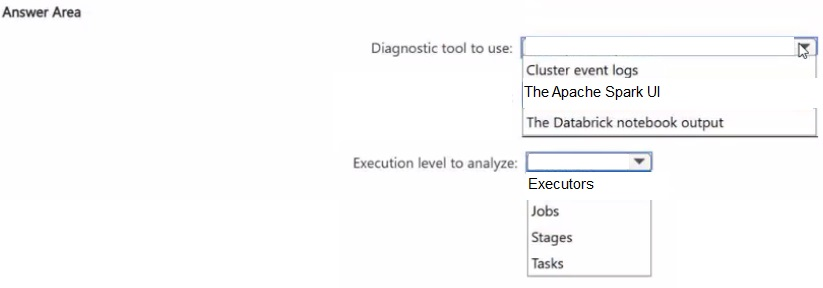
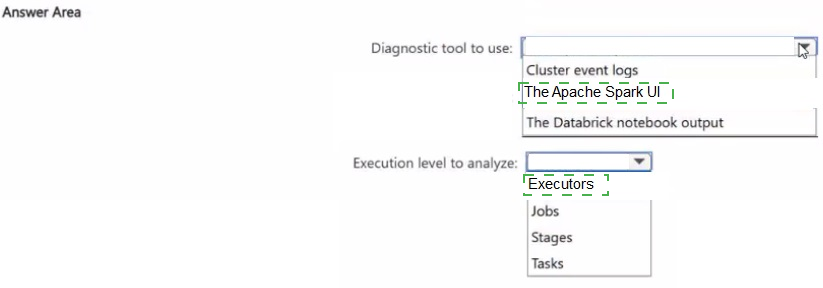
You have an Azure Databricks workspace that contains an all-purpose cluster named
Cluster1.
You discover that out of- memory (OOM) errors intermittently cause jobs running on
Cluster1 to fail.
You need to identify the root cause of the failures by analyzing the runtime execution
behavior. What should you do? To answer, select the appropriate options in the answer
area.
NOTE: Each correct selection is worth one point.
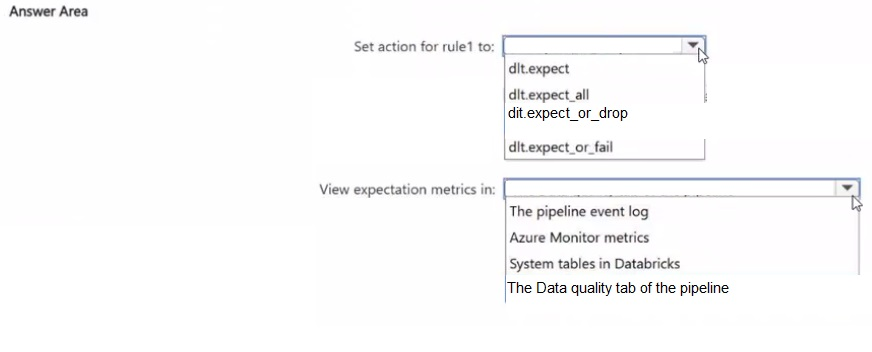
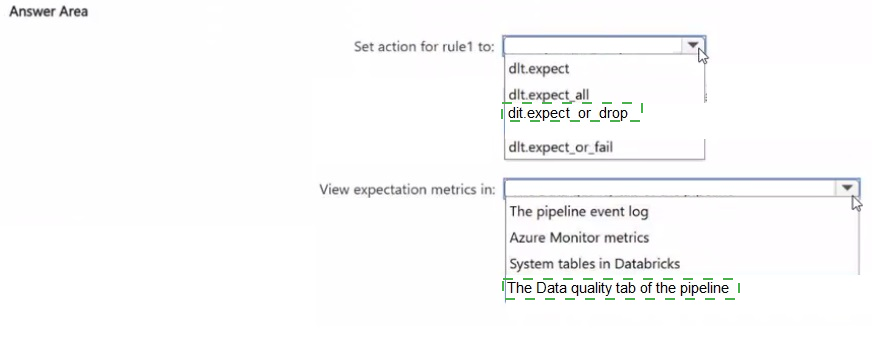
You have an Azure Databricks workspace that is enabled for Unity Catalog.
You have a Lakeflow Spark Declarative Pipelines (SDP) pipeline that writes records to a
Delta table named Table1 by using a data quality rule named rule1
You need to meet the following requirements:
• Records that violate rule! must NOT be written to Table1. but the pipeline must continue
processing valid records.
• Data engineers must be able to review expectation metrics by using minimal development
effort.
What should you do? To answer, select the appropriate options in the answer area.
NOTE: Each correct selection is worth one point
| Page 1 out of 6 Pages |