Topic 6: Misc. Questions
A company plans to use Apache Spark analytics to analyze intrusion detection data.
You need to recommend a solution to analyze network and system activity data for
malicious activities and policy violations. The solution must minimize administrative efforts.
What should you recommend?
A. Azure Data Lake Storage
B. Azure Databricks
C. Azure HDInsight
D. Azure Data Factory
Explanation:
Azure HDInsight offers pre-made, monitoring dashboards in the form of solutions that can
be used to monitor the workloads running on your clusters. There are solutions for Apache
Spark, Hadoop, Apache Kafka, live long and process (LLAP), Apache HBase, and Apache
Storm available in the Azure Marketplace.
Note: With Azure HDInsight you can set up Azure Monitor alerts that will trigger when the
value of a metric or the results of a query meet certain conditions. You can condition on a
query returning a record with a value that is greater than or less than a certain threshold, or
even on the number of results returned by a query. For example, you could create an alert
to send an email if a Spark job fails or if a Kafka disk usage becomes over 90 percent full.
Reference:
https://azure.microsoft.com/en-us/blog/monitoring-on-azure-hdinsight-part-4-workloadmetrics-
and-logs/
You have an Azure SQL database named db1 on a server named server1.
You need to modify the MAXDOP settings for db1. What should you do?
A. Connect to db1 and run the sp_configure command.
B. Connect to the master database of server1 and run the sp_configure command.
C. Configure the extended properties of db1.
D. Modify the database scoped configuration of db1.
You plan to perform batch processing in Azure Databricks once daily.
Which type of Databricks cluster should you use?
A. automated
B. interactive
C. High Concurrency
You have an Azure subscription that contains a server named Server1. Server1 hosts two
Azure SQL databases named DB1 and DB2.
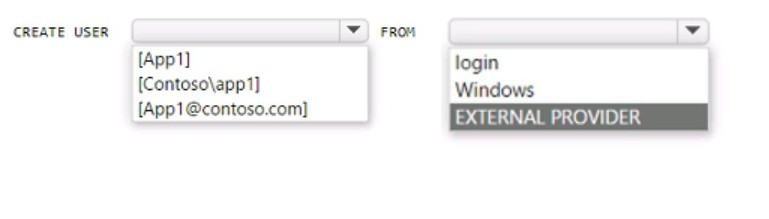
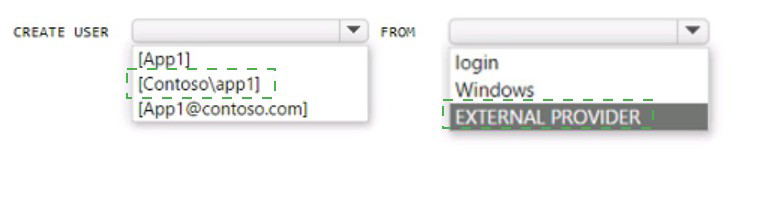
You plan to deploy a Windows app named App1 that will authenticate to DB2 by using SQL
authentication.
You need to ensure that App1 can access DB2. The solution must meet the following
requirements: What should you create?
A. a contained database user for App1 on DB2
B. a login for App1 on Server1
C. a contained database user from an external provider for App1 on DB2
D. a contained database user from a Windows login for App1 on DB2
You have an Azure Stream Analytics job.
You need to ensure that the job has enough streaming units provisioned.
You configure monitoring of the SU % Utilization metric.
Which two additional metrics should you monitor? Each correct answer presents part of the
solution.
NOTE: Each correct selection is worth one point.
A. Late Input Events
B. Out of order Events
C. Backlogged Input Events
D. Watermark Delay
E. Function Events
D. Watermark Delay
Explanation:
To react to increased workloads and increase streaming units, consider setting an alert of
80% on the SU Utilization metric. Also, you can use watermark delay and backlogged
events metrics to see if there is an impact.
Note: Backlogged Input Events: Number of input events that are backlogged. A non-zero
value for this metric implies that your job isn't able to keep up with the number of incoming
events. If this value is slowly increasing or consistently non-zero, you should scale out your
job, by increasing the SUs.
You are designing a star schema for a dataset that contains records of online orders. Each
record includes an order date, an order due date, and an order ship date.
You need to ensure that the design provides the fastest query times of the records when
querying for arbitrary date ranges and aggregating by fiscal calendar attributes.
Which two actions should you perform? Each correct answer presents part of the solution.
NOTE: Each correct selection is worth one point.
A. Create a date dimension table that has a DateTime key.
B. Create a date dimension table that has an integer key in the format of YYYYMMDD.
C. Use built-in SQL functions to extract date attributes.
D. Use integer columns for the date fields.
E. Use DateTime columns for the date fields.
D. Use integer columns for the date fields.
You are designing a date dimension table in an Azure Synapse Analytics dedicated SQL pool. The date dimension table will be used by all the fact tables.
Which distribution type should you recommend to minimize data movement?
A. HASH
B. REPLICATE
C. ROUND_ROBIN
You are planning a solution that will use Azure SQL Database. Usage of the solution will
peak from October 1 to January 1 each year.
During peak usage, the database will require the following:
24 cores
500 GB of storage
124 GB of memory
More than 50,000 IOPS
During periods of off-peak usage, the service tier of Azure SQL Database will be set to
Standard.
Which service tier should you use during peak usage?
A. Business Critical
B. Premium
C. Hyperscale
You have an Azure Data Factory that contains 10 pipelines.
You need to label each pipeline with its main purpose of either ingest, transform, or load. The labels must be available for grouping and filtering when using the monitoring experience in Data Factory. What should you add to each pipeline?
A. an annotation
B. a resource tag
C. a run group ID
D. a user property
E. a correlation ID
Explanation:
Azure Data Factory annotations help you easily filter different Azure Data Factory objects
based on a tag. You
can define tags so you can see their performance or find errors faster.
Note: This question is part of a series of questions that present the same scenario.
Each question in the series contains a unique solution that might meet the stated
goals. Some question sets might have more than one correct solution, while others
might not have a correct solution.
After you answer a question in this section, you will NOT be able to return to it. As a
result, these questions will not appear in the review screen.
You have an Azure Data Lake Storage account that contains a staging zone.
You need to design a daily process to ingest incremental data from the staging zone,
transform the data by executing an R script, and then insert the transformed data into a
data warehouse in Azure Synapse Analytics.
Solution: You schedule an Azure Databricks job that executes an R notebook, and then
inserts the data into the data warehouse.
Does this meet the goal?
A. Yes
B. No
| Page 9 out of 34 Pages |
| DP-300 Practice Test | Previous |