Topic 6: Misc. Questions
You have an instance of SQL Server on Azure Virtual Machines named SQL1.
SQL1 contains an Extended Events session named session! that captures Microsoft SQL
Server events.
You need to correlate the session events with events captured by Event Tracing for
Windows (ETW).
What should you do for session1?
A. Modify the Set Session Event Filters settings.
B. Add a target.
C. Add an action.
D. Modify the Specify Session Data Storage settings.
You have an Azure AD tenant and a logical Microsoft SQL server named SQL1 that hosts
several Azure SQL databases.
You plan to assign Azure AD users permissions to the databases automatically by using
Azure Automation.
You need to create the required Automation accounts.
Which two accounts should you create? Each correct answer presents part of the solution.
NOTE: Each correct selection is worth one point.
A. From the Azure Active Directory admin center, create a service principal.
B. From the Azure Active Directory admin center, create a user-assigned managed identity for SQL1.
C. On SQL1. create a SQL user in the databases.
D. On SQL1, create a SQL login.
E. From the Azure Active Directory admin center, create an external identity.
C. On SQL1. create a SQL user in the databases.
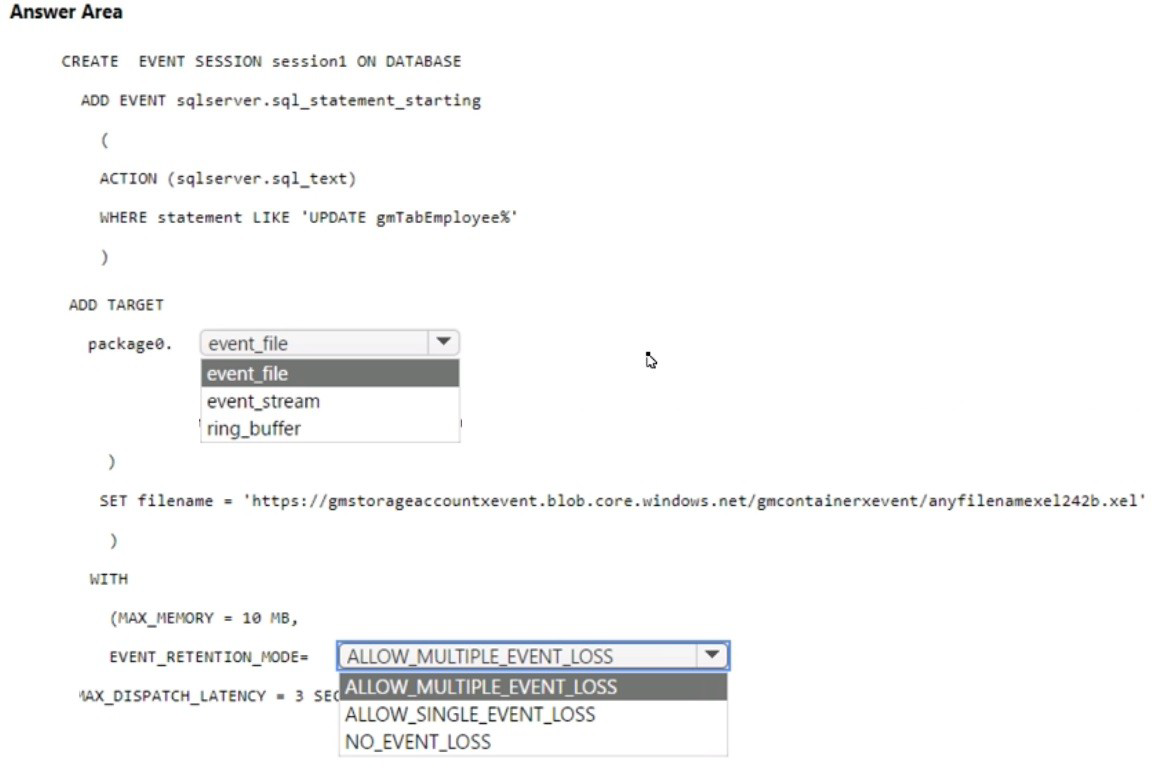
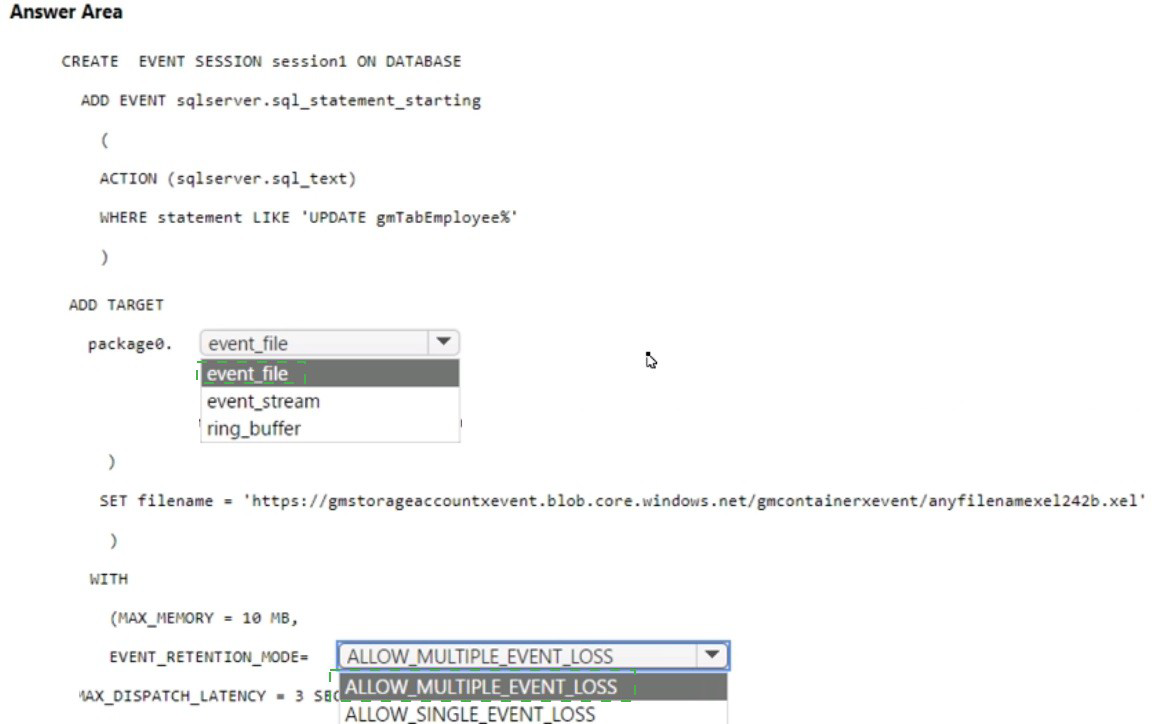
You have an Azure subscription that contains an instance of SQL Server on Azure Virtual
Machines. The virtual machine hosts a database named DB1. You need to monitor DB1 by
using Extended Events. The solution must meet the following requirements:
• Capture raw event data and store the data in Azure Storage.
• Minimize the performance impact of capturing extended events.
How should you complete the Transact-SQL statement? To answer, select the appropriate
options in the answer area.
NOTE: Each correct selection is worth one point.
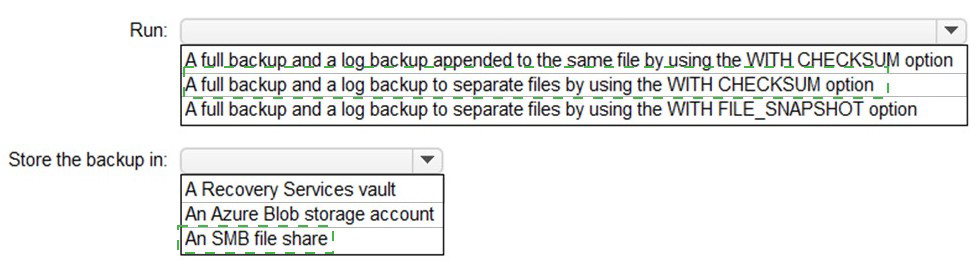
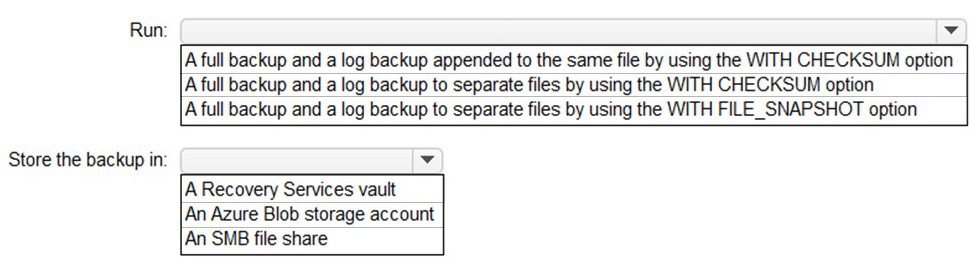
You have an on-premises Microsoft SQL Server 2019 instance that hosts a database
named DB1.
You plan to perform an online migration of DB1 to an Azure SQL managed instance by
using the Azure Database Migration Service.
You need to create a backup of DB1 that is accessible to the Azure Database Migration
Service.
What should you run for the backup and where should you store the backup? To answer,
select the appropriate options in the answer area.
NOTE: Each correct selection is worth one point.
You have an on-premises Microsoft SQL Server 2019 instance named SQL1 that hosts a
database named db1. You have an Azure subscription that contains an Azure SQL
managed instance named MI1 and an Azure Storage account named storage1.
You need to ensure that you can back up db1 to storage1. The solution must meet the
following requirements:
* Use block blob storage.
* Maximize security.
A. Generate a shared access signature (SAS)
B. Enable infrastructure encryption.
C. Create an access policy.
D. Rotate the storage keys
You have an Azure subscription that contains two Azure SQL managed instances named
SQLMI1 and SQLMI2 . SQLM2 contains a database named DB1 and a user named User1.
User1 drops DB1.
You need to perform a point-in-time restore of DB1 to SQLMI2.
A. Azure CLI
B. Transact-SQL
C. The Azure portal
D. Azure PowerShell
You have SQL Server 2019 or an Azure virtual machine that runs Windows Server 2019.
The virtual machine has 4 vCPUs and 28 GB of memory.
Vou scale up the virtual machine to 8 vCPUs and 64 GB of memory.
You need to reduce tempdb contention without regatively affecting server performance.
What is the number of secondary data files that you should configure for tempdb?
A. 2
B. 4
C. 8
D. 64
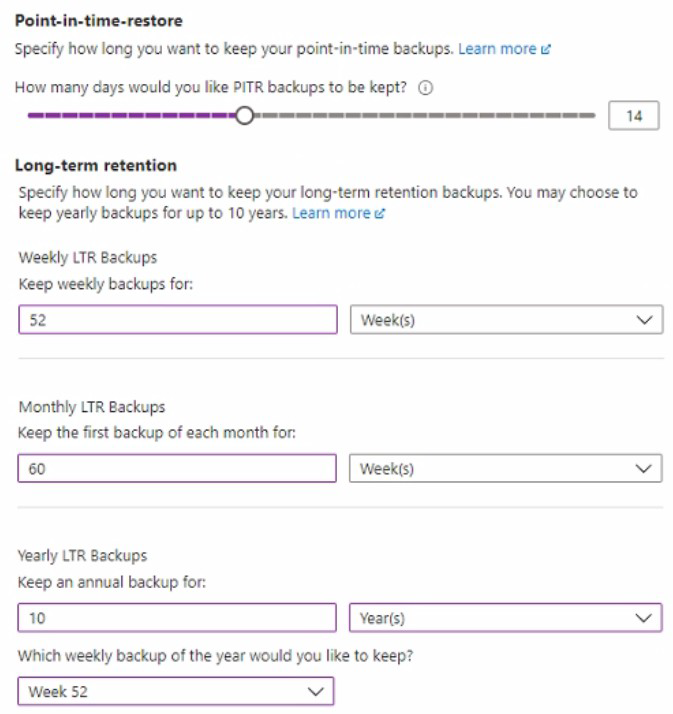
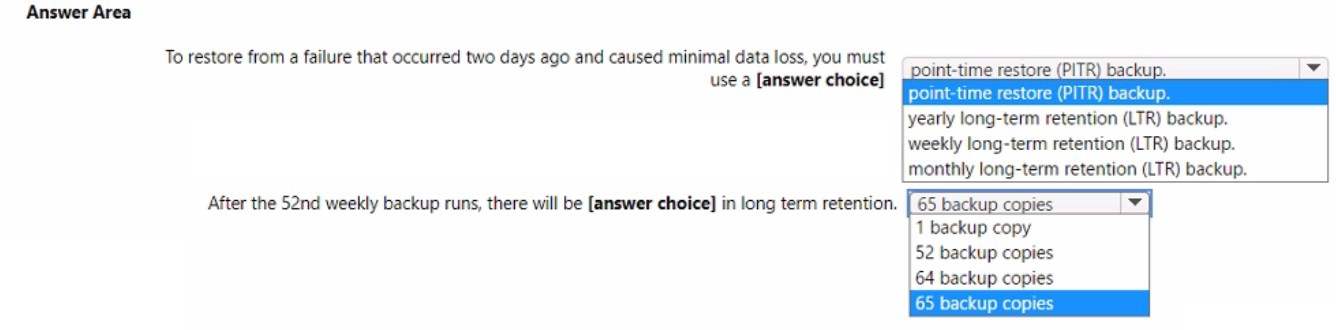
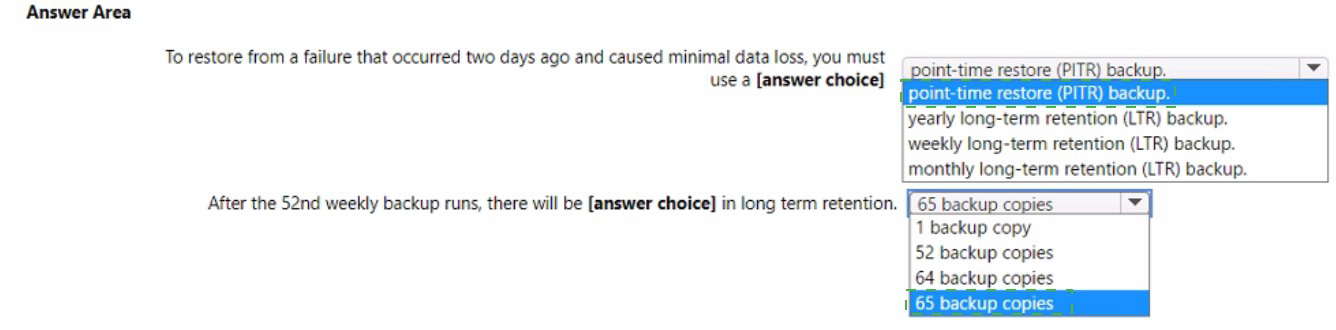
You configure backups for an Azure SQL database as shown in the following exhibit.
Use the drop-down menus to select the answer choice that completes each statement
based on the information presented in the graphic.
NOTE: Each correct selection is worth one point.
You have an Azure subscription that contains an instance of SQL Server on Azure Virtual
Machines named SQLVM1 and a user named User1. SQLVM1 hosts a database named
DB1.
You need to ensure that User1 can perform the following tasks on DB1:
• Create jobs.
• View all jobs.
• Modify, delete, and disable the jobs the user created.
The solution must use the principle of least privilege.
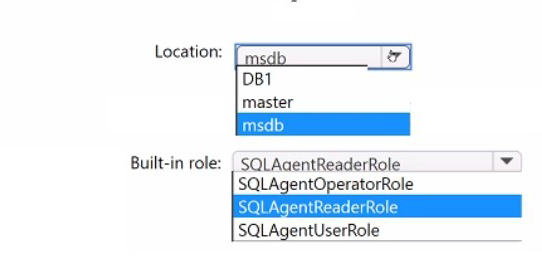
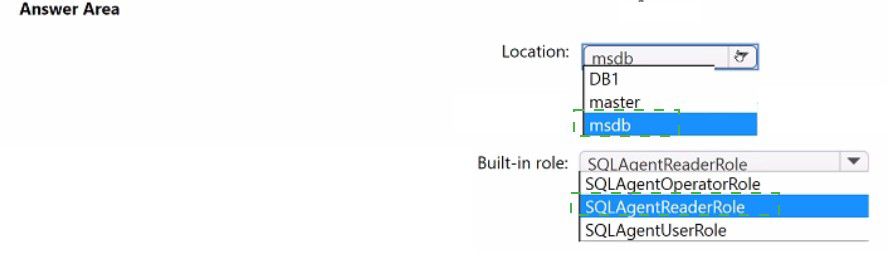
Which built-in database role should you assign to User1, and where is the role defined? To
answer, select the appropriate options in the answer area.
NOTE: Each correct selection is worth one point.
You have an Azure subscription.
You plan to deploy an instance of SQL Server on Azure Virtual Machines by using an
Azure Marketplace image
You need to register the SQL Server laaS Agent extension (SqllaasExtension). The
solution must meet the following requirements:
• Install critical updates for SQL Server automatically.
• Minimize performance impact on the virtual machine.
Which management mode should you select?
A. full
B. lightweight
C. NoAgent
| Page 12 out of 34 Pages |