Topic 3: Misc. Questions
You have an Azure subscription. The subscription contains a virtual machine named VM1
that runs Windows Server and is in the East US Azure region. The subscription contains
the storage accounts shown in the following table.
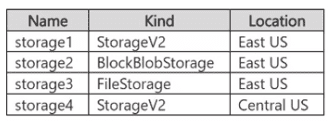
You plan to configure the Diagnostic settings for VM1. Which storage accounts should you
specify for the settings?
A. storage1 only
B. storage1 and storage2 only
C. storage1 and storage4 only
D. storage1, storage2, and storage3 only
E. storage1, storage2, storage3, and storage4
Explanation:
This question tests the requirements for selecting a destination storage account when configuring Azure Monitor Diagnostic settings for a regional resource such as a virtual machine. The storage account must be in the same Azure region as the VM and must be a supported Standard account type (Premium accounts are excluded).
✅ Correct Option:
A. storage1 only
storage1 is a StorageV2 (general-purpose v2) account located in East US, matching the region of VM1. Azure Monitor Diagnostic settings support Standard storage accounts in the same region as the monitored resource, so only this account meets both the location and account-type requirements.
❌ Incorrect options:
B. storage1 and storage2 only
storage2 is a BlockBlobStorage account (Premium). Premium storage accounts are not supported as destinations for diagnostic settings.
C. storage1 and storage4 only
storage4 is in Central US. For regional resources such as VMs, the storage account destination must be in the same region (East US).
D. storage1, storage2, and storage3 only
Both storage2 (BlockBlobStorage) and storage3 (FileStorage) are Premium account kinds, which are unsupported destinations for diagnostic settings.
E. storage1, storage2, storage3, and storage4
This includes unsupported Premium accounts (storage2, storage3) and an account in a different region (storage4).
🔧 Reference:
→ Microsoft Learn – Diagnostic settings in Azure Monitor
Confirms that the destination storage account must be in the same region as the regional resource and that Premium storage accounts are not supported (only Standard accounts are).
You have an Azure subscription that contains the virtual machines shown in the following
table.
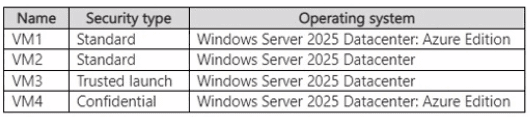
You plan to use Azure Site Recovery to replicate supported virtual machines to a
secondary Azure region. Which virtual machines can be replicated by using Azure Site
Recovery?
A. VM1 only
B. VM1 and VM2 only
C. VM1 and VM4 only
D. VM1.VM2, and VM4 only
E. VM1, VM2, VM3, and VM4
You have 50 on-premises servers that run Windows Server.
You have an Azure subscription that contains a Microsoft Sentinel workspace.
You plan to monitor the servers by using Microsoft Sentinel.
You need to perform the following actions in Microsoft Sentinel;
• Add the Windows Forwarded Events data connector.
• Create a playbook that has an incident trigger.
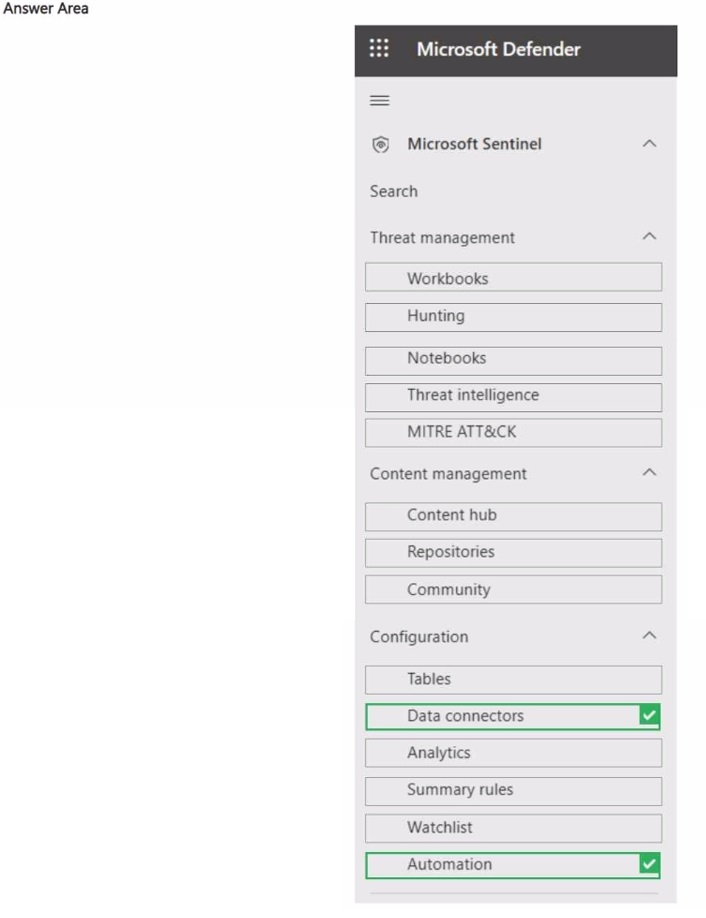
Which two settings should you use? To answer, select the appropriate settings in the
answer area.
NOTE: Each correct selection is worth one point.
 Explanation:
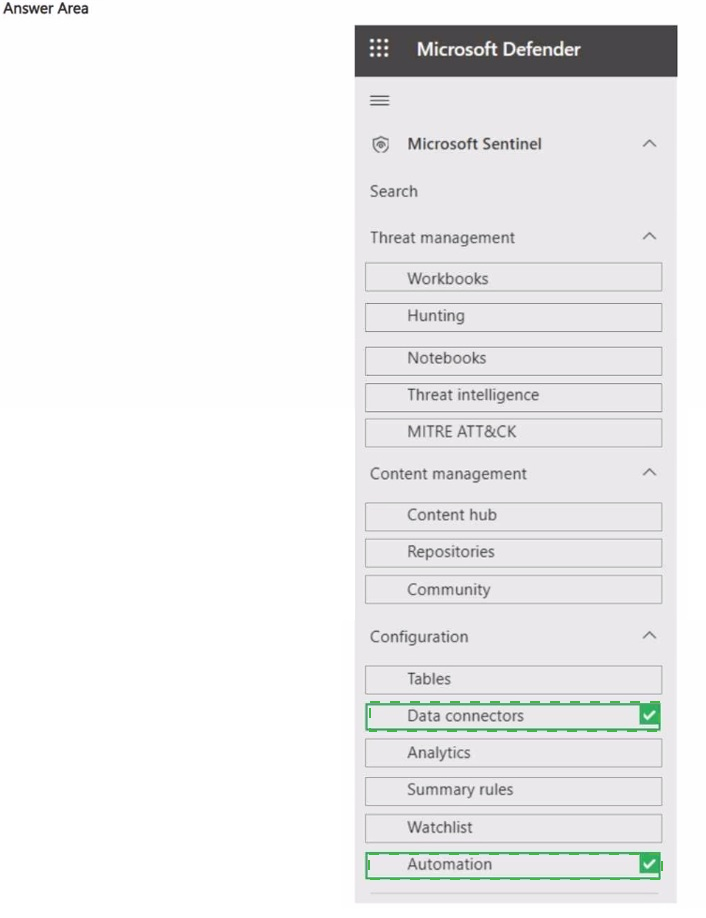
The question tests two separate Microsoft Sentinel configuration tasks: connecting Windows Forwarded Events for log collection and creating a playbook with an incident trigger. Data ingestion is configured through Data connectors, while playbooks and incident-triggered automation are managed through Automation.
🟢 Correct Option 1: Data connectors
Data connectors is the page used to configure data sources that send events to Microsoft Sentinel. The Windows Forwarded Events connector uses Windows Event Collection (WEC) with Azure Monitor Agent to collect forwarded Windows events. Therefore, Data connectors is the appropriate setting for adding the Windows Forwarded Events data connector to the Sentinel workspace.
🟢 Correct Option 2: Automation
Automation is used to configure automated responses and work with playbooks. A playbook can use the Microsoft Sentinel incident trigger, which runs when an incident is created or updated. Microsoft recommends incident-triggered playbooks for most incident automation scenarios, making Automation the appropriate page for this requirement.
🔴 Incorrect options:
Tables
Tables are used to view and manage data tables in the Log Analytics workspace. They are not used to configure external data connectors or create Sentinel playbooks, so this setting does not satisfy either requirement.
Analytics
Analytics is primarily used to create and manage detection rules that identify threats from collected data. It is not the page for adding the Windows Forwarded Events connector or creating an incident-triggered playbook.
Summary rules
Summary rules aggregate and summarize log data for specific querying and performance scenarios. They do not configure Windows event ingestion or provide the interface for creating Sentinel playbooks.
Watchlist
Watchlists contain reference data that can be used with queries and analytics rules. They are unrelated to configuring Windows Forwarded Events ingestion or creating a playbook with an incident trigger.
🔧 Reference:
→ Connect Microsoft Sentinel to other Microsoft services with a Windows agent-based data connector — Confirms that Windows Forwarded Events are configured through the Sentinel data connector and use WEC with Azure Monitor Agent.
→ Microsoft Sentinel playbook triggers — Confirms that the Microsoft Sentinel incident trigger is used for incident-based playbooks.
Your network contains an Active Directory Domain Services (AD DS) domain.
You need to deploy a Storage Spaces Direct cluster. The solution must support dual parity.
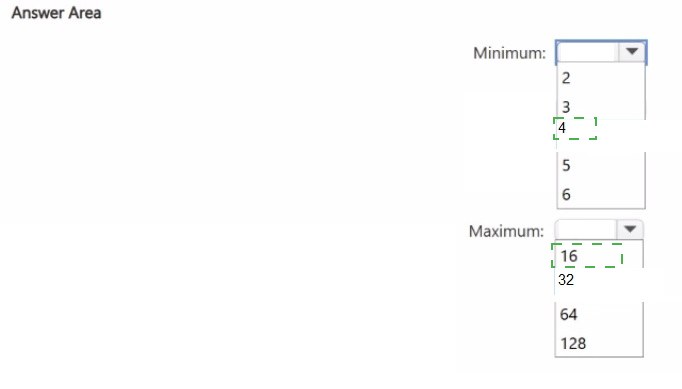
What is the minimum and maximum number of nodes you can deploy to the cluster? To
answer, select the appropriate options in the answer area.
NOTE: Each correct selection is worth one point.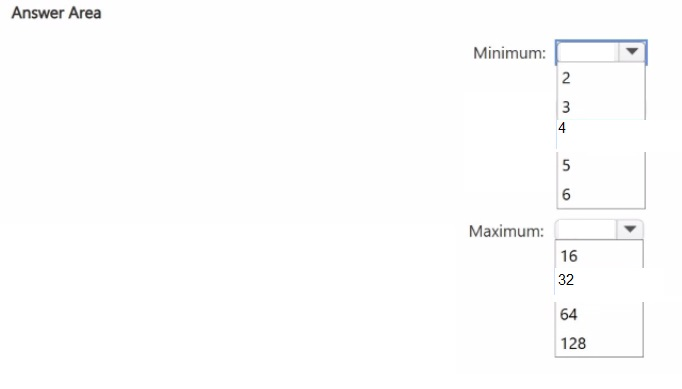
 Explanation
This question tests your knowledge of the scale requirements for different resiliency types in a Storage Spaces Direct (S2D) cluster. To support dual parity, the cluster must meet the minimum node count required for this specific fault tolerance option.
✅ Correct Option: Minimum → 4
Dual parity requires a minimum of four hardware fault domains, which in a Storage Spaces Direct cluster corresponds to four servers . This is because the underlying Reed-Solomon erasure coding (with an RS 2+2 layout) needs at least four nodes to implement the required distribution of data and parity symbols.
✅ Correct Option: Maximum → 16
The maximum number of nodes for a Storage Spaces Direct cluster is 16 . While dual parity can be used at any scale from 4 to 16 nodes, Microsoft's official efficiency tables and cluster size limits confirm 16 as the upper boundary .
❌ Incorrect options:
Minimum values (2, 3, 5, 6):
Values below 4 are insufficient for dual parity. A 2 or 3-node cluster can only use mirroring (two-way or nested) for fault tolerance, not dual parity .
Maximum values (16, 32, 64, 128):
The maximum supported cluster size for Storage Spaces Direct is 16 nodes . While dual parity becomes more efficient with more nodes, the cluster itself cannot exceed 16 .
🔧 Reference
→ Fault tolerance and storage efficiency on Azure Local and Windows Server clusters | Microsoft Learn
This documentation confirms the minimum required fault domains for dual parity is 4 and lists efficiency tables for deployments from 4 to 16 nodes.
You have an on-premises server named Server 1 that runs Windows Server.
You have an Azure subscription.
You migrate Server1 to an Azure virtual machine named VM1.
You need to configure a backup solution for VM1. The solution must provide recovery
points.
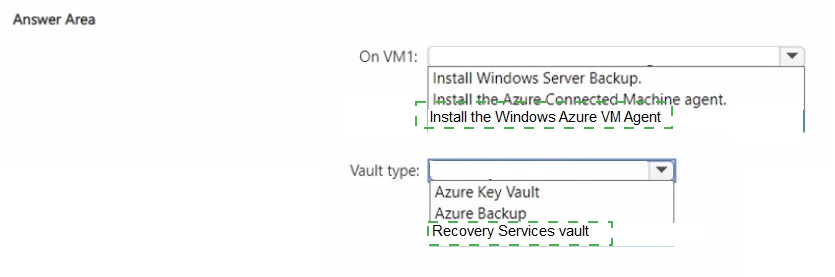
What should you do on VM1, and in which type of vault should you store the backups? To
answer, select the appropriate options in the answer area.
NOTE: Each correct selection is worth one point.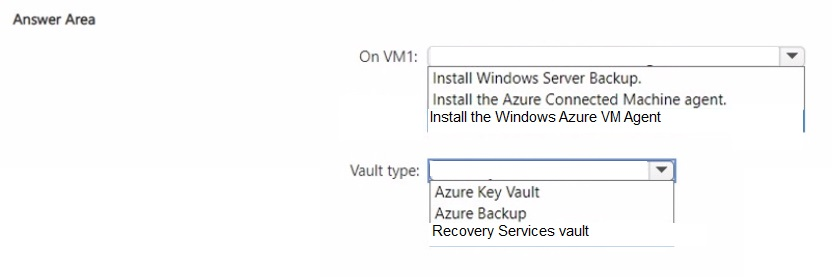
 Explanation:
The question requires configuring Azure Backup for an Azure VM that was migrated from an on-premises Windows Server. Azure Backup for IaaS VMs relies on a Recovery Services vault to store recovery points and uses an extension that depends on the Windows Azure VM Agent being present on the VM.
✅ Correct Option: On VM1 – Install the Windows Azure VM Agent
Azure Backup installs a backup extension on top of the Windows Azure VM Agent. Marketplace VMs already include the agent, but VMs migrated from on-premises often do not. Installing the agent on VM1 is therefore required so the backup extension can run and create application-consistent recovery points.
✅ Correct Option: Vault type – Recovery Services vault
Azure Backup stores VM recovery points (including Instant Restore snapshots and long-term retention points) exclusively in a Recovery Services vault. This is the vault type used for all Azure VM backup operations.
❌ Incorrect options:
❌ On VM1 – Install Windows Server Backup.
Windows Server Backup is the native on-premises backup feature. It is not used for Azure VM backups and does not integrate with Azure Backup or create recovery points in an Azure vault.
❌ On VM1 – Install the Azure Connected Machine agent.
The Azure Connected Machine agent is used to onboard servers to Azure Arc. It is unrelated to Azure Backup for Azure VMs.
❌ Vault type – Azure Key Vault
Azure Key Vault stores secrets, keys, and certificates. It is not used to store backup recovery points.
❌ Vault type – Azure Backup
“Azure Backup” is the service name, not a vault type. Recovery points are stored in a Recovery Services vault managed by the Azure Backup service.
🔧 Reference:
→ Microsoft Learn: Back up Azure VMs in a Recovery Services vault – Install the VM agent
Confirms that migrated VMs may require manual installation of the Windows Azure VM Agent and that recovery points are stored in a Recovery Services vault.
| Page 8 out of 29 Pages |