Topic 3: Misc. Questions
You have a cluster named Cluster! that contains two servers named Server! and Server2.
Cluster1 has Storage Spaces Direct enabled. Cluster1 contains a virtual disk named
Volume1 that is a 2-TB three-way mirror.
You discover that Volume! is full.
You connect a new 2-TB physical disk to each node of Cluster1.
You need to increase the size of Volume1. The solution must maintain resiliency.
How should you complete the script? To answer, select the appropriate options in the
answer area.
NOTE: Each correct selection is worth one point.
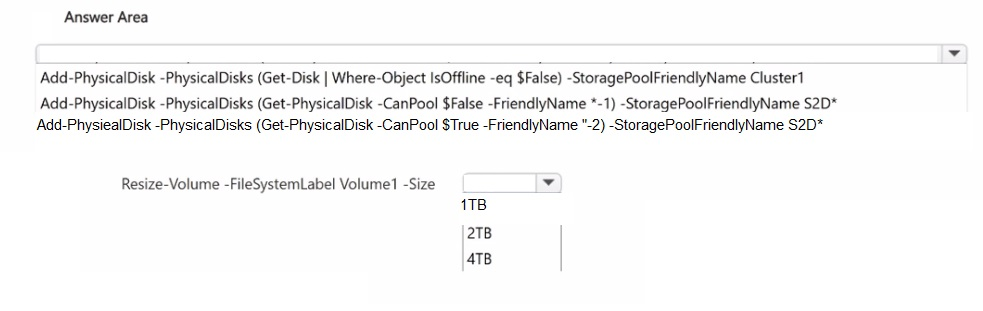
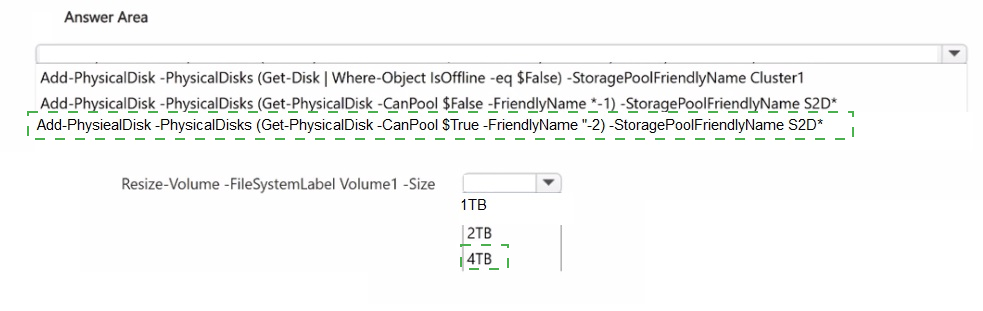 Explanation:
This question tests the procedure for expanding a Storage Spaces Direct (S2D) volume while maintaining its resiliency (a three-way mirror). The process involves two steps: first, add the new physical disks to the S2D storage pool, and then expand the virtual disk itself. For a three-way mirror, the volume can only be resized to a multiple of its resiliency's stripe size, making 2TB the correct choice.
✅ Correct Options:
First Option - Add-PhysicalDisk -PhysicalDisks (Get-PhysicalDisk -CanPool $True -FriendlyName "*-2") -StoragePoolFriendlyName S2D*
This command correctly identifies and adds all new, available physical disks that can be pooled, as indicated by the -CanPool $True parameter and the specific friendly name pattern . This is the required first step before the volume can be expanded.
Second Option - 2TB
For a Storage Spaces Direct three-way mirror, the volume size must remain a multiple of the resiliency's data capacity. With the addition of two 2-TB disks, the pool can be expanded by 2 TB of usable space, allowing the volume to be resized to 4TB (from 2TB). You must choose the incremental size of 2TB .
❌ Incorrect options:
First Dropdown - Add-PhysicalDisk -PhysicalDisks (Get-Disk | Where-Object IsOffline -eq $False) -StoragePoolFriendlyName Cluster1
This command only filters for offline disks, which is insufficient and incorrect for identifying the new physical disks to add to the S2D pool.
First Dropdown - Add-PhysicalDisk -PhysicalDisks (Get-PhysicalDisk -CanPool $False -FriendlyName *-1) -StoragePoolFriendlyName S2D*
Using -CanPool $False explicitly excludes the new, available disks from being added, making the command ineffective.
Second Dropdown - 1TB & 4TB
1TB is not a multiple of the 2TB capacity added. 4TB represents the total new size, not the incremental increase to apply to the volume. The correct expansion amount is 2TB .
🔧 Reference:
→ Add-PhysicalDisk (Storage) | Microsoft Learn: Confirms that this cmdlet is used to add physical disks to a storage pool and details its key parameters like -CanPool.
You have 50 on-premises servers that run Windows Server.
You have an Azure subscription that contains a Recovery Services vault named Vaultl.
You plan to back up the on-premises servers to Vault1 by using Microsoft Azure Backup
Server (MABS).
You need to configure prerequisites to support MABS. The solution must minimize costs.
What should you do for Vault1, and what should you deploy on-premises? To answer,
select the appropriate options in the answer area.
NOTE: Each correct selection is worth one point.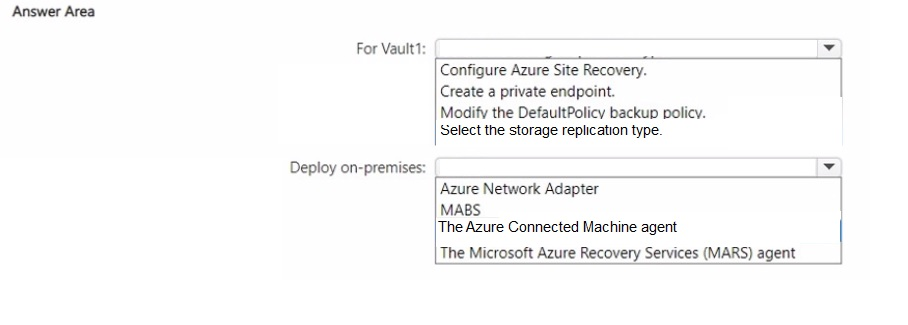
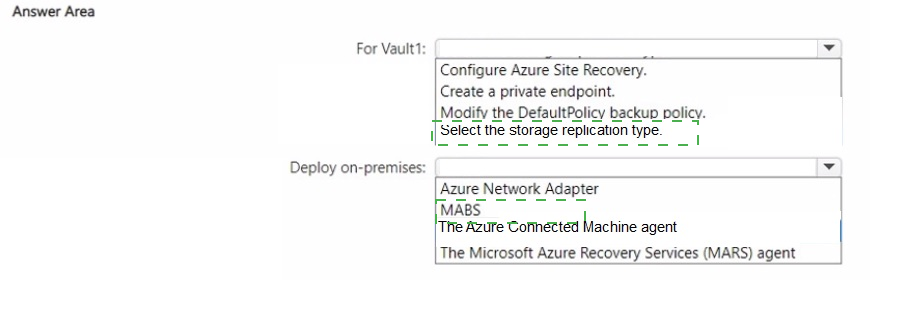 Explanation
This question tests the prerequisites for deploying Microsoft Azure Backup Server (MABS) to protect on-premises Windows Servers while keeping costs low. It checks both the required Recovery Services vault setting and the on-premises component that must be installed to enable MABS backups.
✅ Select the storage replication type
Vault1 requires the storage replication type to be configured because every Recovery Services vault must have its redundancy setting (such as locally-redundant storage) defined before backups can be sent to it. Choosing LRS instead of geo-redundant storage keeps replication costs low while still meeting the requirement to support MABS, satisfying the "minimize costs" condition without needing extra configuration steps.
✅ MABS
Microsoft Azure Backup Server itself must be deployed on-premises to protect the 50 on-premises Windows Servers, since MABS is the component that performs local backups and forwards protected data to Vault1. It requires no extra Azure licensing or infrastructure beyond the vault, making it the cost-effective on-premises deployment choice for this scenario.
❌ Configure Azure Site Recovery
Azure Site Recovery handles disaster recovery replication of VMs, not file/server backup, so it's unrelated to preparing Vault1 for MABS and adds unnecessary cost and complexity to a backup-only requirement.
❌ Create a private endpoint
A private endpoint only secures network traffic to the vault over a private connection. It's optional, adds cost, and isn't required simply to support MABS backups, so it fails the cost-minimization requirement.
❌ Modify the DefaultPolicy backup policy
Backup policies control schedule and retention settings after backups are already running; they aren't a prerequisite for enabling the vault to support a new MABS deployment.
❌ Azure Network Adapter
This isn't an actual Azure Backup or MABS component — no such adapter exists in this context, so it can't be the required on-premises deployment.
❌ The Azure Connected Machine agent
This agent onboards servers into Azure Arc for management and monitoring, not for backup via MABS, so it doesn't fulfill the deployment requirement here.
❌ The Microsoft Azure Recovery Services (MARS) agent
MARS backs up individual files and folders directly to a vault without MABS. It's an alternative backup method, not a component deployed alongside MABS.
Reference
🔧 Install and upgrade Azure Backup Server – Microsoft Learn → confirms MABS deployment and vault storage redundancy configuration as prerequisites for on-premises server backup.
Your on-premises network contains an Active Directory Domain Services (AD DS) domain.
The domain contains a scale-out file server (SOFS) cluster named Cluster1. Cluster1
contains four nodes that run Windows Server 2022.
You need to upgrade the nodes to Windows Server 2025. The solution must minimize the
downtime of Cluster1.
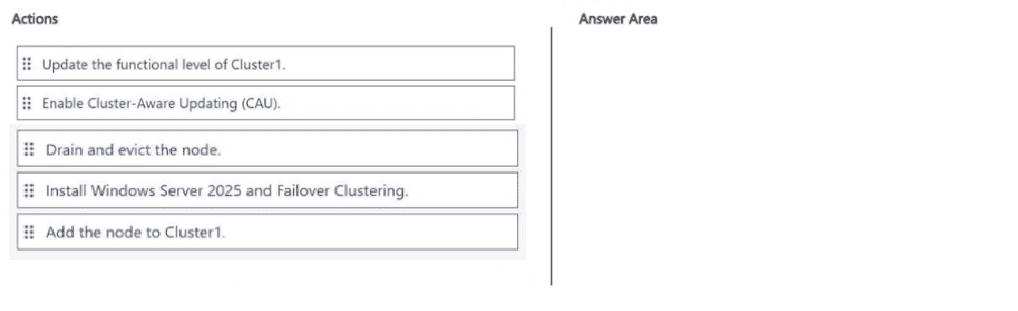
Which three actions should you perform on each node in sequence? To answer, move the
appropriate actions from the list of actions to the answer area and arrange them in the
correct order.
 Explanation:
This is a Cluster OS Rolling Upgrade for a Scale-Out File Server (SOFS) cluster. To keep Cluster1 online with minimal downtime, you upgrade one node at a time while the remaining nodes continue serving clients. The functional level is raised only after every node has been upgraded. Cluster-Aware Updating (CAU) is used for patches, not for full OS version upgrades.
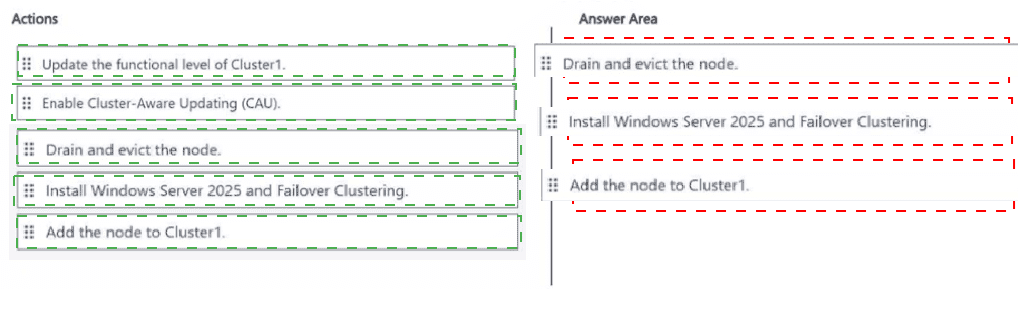
✅ Correct sequence on each node:
Drain and evict the node – Moves all roles/resources off the node and removes it from the cluster so it can be safely re-imaged or upgraded.
Install Windows Server 2025 and Failover Clustering – Performs a clean install (recommended) of the new OS and the Failover Clustering feature.
Add the node to Cluster1 – Joins the upgraded node back into the mixed-mode cluster.
After the last node is upgraded and rejoined, you update the cluster functional level (a one-time action that is not performed per node).
❌ Incorrect / out-of-sequence actions:
Update the functional level of Cluster1 – Performed only once, after all nodes are running Windows Server 2025. Doing it earlier breaks the rolling-upgrade process.
Enable Cluster-Aware Updating (CAU) – Used for applying Windows updates/patches in a coordinated way; it is not part of the OS version upgrade procedure.
🔧 Reference:
→ Microsoft Learn: Upgrade the OS of a Windows Server failover cluster by performing a cluster OS rolling upgrade
Confirms the per-node sequence (drain/evict → upgrade OS + Failover Clustering → rejoin) and that the functional level is raised only after all nodes are upgraded.
| Page 7 out of 29 Pages |