Topic 1: Litware inc. Case Study: 1
Overview
Existing Environment
Litware, Inc. an independent software vendor (ISV) Litware has a main office and five
branch offices.
Application Architecture
The company’ s primary application is a single monolithic retirement fund management
system based on ASP.NE T web forms that use logic written in V8.NET. Some new
sections of the application are written in C#.
Variations of the application are created for individual customers. Currently, there are more
than 80 have code branches in the application’s code base.
The application was developed by using Microsoft Visual Studio. Source code is stored in
Team Foundation Server (TFS) in the main office. The branch offices access of the source
code by using TFS proxy servers.
Architectural Issues
Litware focuses on writing new code for customers. No resources are provided to refactor
or remove existing code. Changes to the code base take a long time, AS dependencies are
not obvious to individual developers.
Merge operations of the code often take months and involve many developers. Code
merging frequently introduces bugs that are difficult to locate and resolve.
Customers report that ownership costs of the retirement fund management system
increase continually. The need to merge unrelated code makes even minor code changes
expensive.
Requirements
Planned Changes
Litware plans to develop a new suite of applications for investment planning. The
investment planning Applications will require only minor integration with the easting
retirement fund management system.
The investment planning applications suite will include one multi-tier web application and
two iOS mobile applications. One mobile application will be used by employees; the other
will be used by customers.
Litware plans to move to a more agile development methodology. Shared code will be
extracted into a series of package.
Litware has started an internal cloud transformation process and plans to use cloud based
services whenever suitable.
Litware wants to become proactive m detecting failures, rather than always waning for
customer bug reports.
Technical Requirements
The company's investment planning applications suite must meet the following technical
requirements:
• New incoming connections through the firewall must be minimized.
• Members of a group named Developers must be able to install packages.
• The principle of least privilege must be used for all permission assignments
• A branching strategy that supports developing new functionality in isolation must be used.
• Members of a group named Team leaders must be able to create new packages and edit the permissions of package feeds
• Visual Studio App Center must be used to centralize the reporting of mobile application
crashes and device types in use.
• By default, all App Center must be used to centralize the reporting of mobile application
crashes and device types in use.
• Code quality and release quality are critical. During release, deployments must not
proceed between stages if any active bugs are logged against the release.
• The mobile applications must be able to call the share pricing service of the existing
retirement fund management system. Until the system is upgraded, the service will only
support basic authentication over HUPS.
• The required operating system configuration tor the test servers changes weekly. Azure
Automation State Configuration must be used to ensure that the operating system on each
test servers configured the same way when the servers are created and checked
periodically.
Current Technical
The test servers are configured correctly when first deployed, but they experience
configuration drift over time. Azure Automation State Configuration fails to correct the
configurations.
Azure Automation State Configuration nodes are registered by using the following
command.

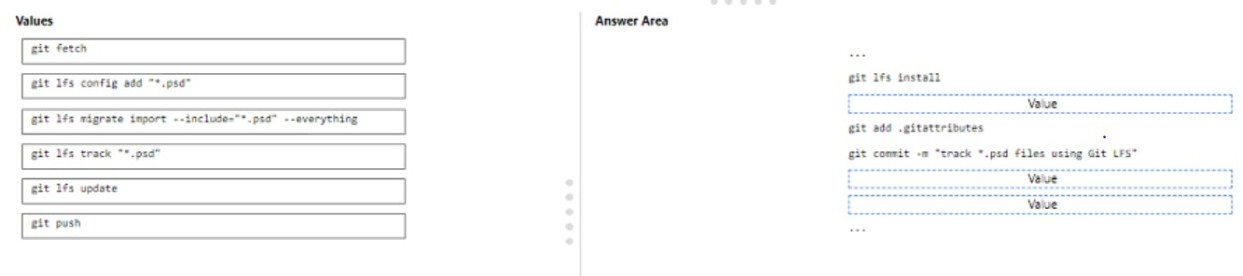
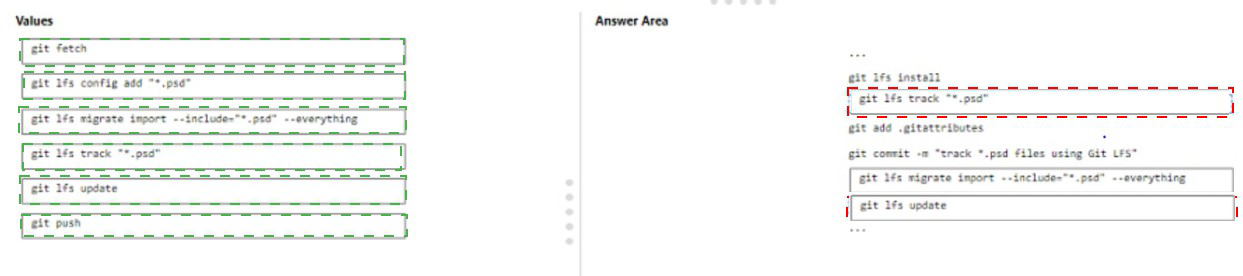
You have an Azure Repos repository that contains large PSD files. You need to configure
Get LFS to manage all the files.
How should you complete the script? To answer, drag the appropriate access levels to the
correct groups. Each access level may be used once, more than once, or not at all. You
may need to drag the split bar between panes or scroll to view content.
NOTE: Each correct selection is worth one point.
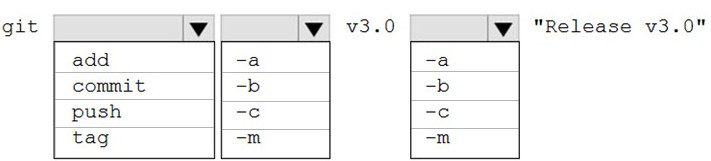
You are finalizing a release in GitHub.
You need to apply the following labels to the release:
Name
Email
Release v3.0
Release date
How should you complete the get command? To answer, select the appropriate options in
the answer area.
NOTE: Each correct selection is worth one point.
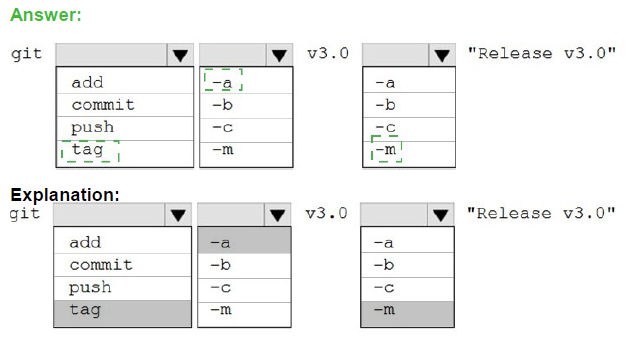
Box 1; tag
Tagging. Like most VCSs, Get has the ability to tag specific points in a repository’s history
as being important. Typically, people use this functionality to mark release points (v1.0,
v2.0 and so on).
Box 2: -a
Creating an annotated tag in Get is simple. The easiest way is to specify -a when you run
the tag command:
Example:
$ get tag -a v1.4 -m "my version 1.4"
Box 3: -m
You have the services shown in the following table.
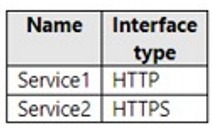
You manage a project by using Azure Boards.
You need to notify the services Of build Status changes.
Which services can be notified by using a web hook?
A. Service1 only
B. Service2 only
C. Service1 and Service2 only
You need to prepare a network security group (NSG) named az400-9940427-nsg1 to host
an Azure DevOps pipeline agent. The solution must allow only the required outbound port
for Azure DevOps and deny all other inbound and outbound access to the Internet.
To complete this task, sign in to the Microsoft Azure portal.
Answer: See solution below.
Explanation:
1. Open Microsoft Azure Portal and Log into your Azure account.
2. Select network security group (NSG) named az400-9940427-nsg1
3. Select Settings, Outbound security rules, and click Add
4. Click Advanced
5. Change the following settings:
Destination Port range: 8080
Protocol. TCP
Action: Allow
Note: By default, Azure DevOps Server uses TCP Port 8080.
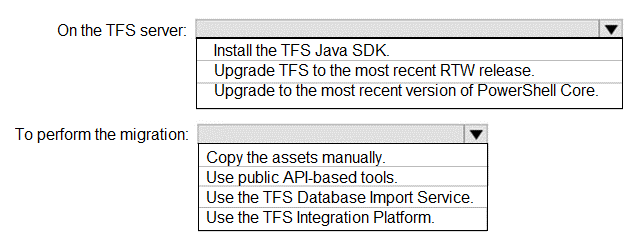
Your company uses Team Foundation Server 2013 (TFS 2013).
You plan to migrate to Azure DevOps.
You need to recommend a migration strategy that meets the following requirements:
Preserves the dates of Team Foundation Version Control changesets
Preserves the changes dates of work items revisions
Minimizes migration effort
Migrates all TFS artifacts
What should you recommend? To answer, select the appropriate options in the answer
area.
NOTE: Each correct selection is worth one point.
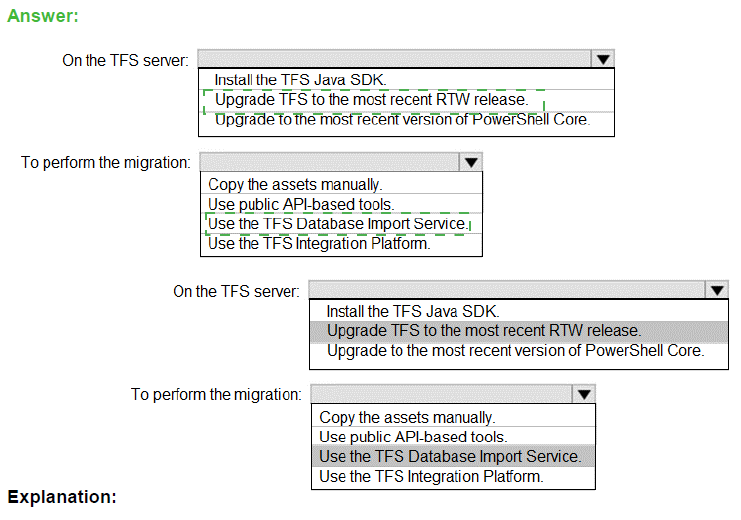
Box 1: Upgrade TFS to the most recent RTM release.
One of the major prerequisites for migrating your Team Foundation Server database is to
get your database schema version as close as possible to what is currently deployed in
Azure Devops Services.
Box 2: Use the TFS Database Import Service
In Phase 3 of your migration project, you will work on upgrading your Team Foundation
Server to one of the supported versions for the Database Import Service in Azure Devops
Services.
References: Team Foundation Server to Azure Devops Services Migration Guide
You have a GitHub repository that contains the source code for an app.
You need to identify all the changes made between versions 1.4.16 and 1.6.12 of the
source code.
How should you complete the Get command? To answer, select the appropriate options in
the answer area.
NOTE: Each correct selection is worth one point.

Answer: see the answer below.
Explanation:
Answer below
get diff v1.4.16 v1.6.12 | helper-script > changes.txt
This command will compare the changes made between versions 1.4.16 and 1.6.12 of the
source code in your GitHub repository, pipe the output through the helper-script and save
the result to a file called "changes.txt" Please note that, this command assumes that you
have a helper-script that can handle get diff output as an input and processes it further. It is
not a default get command.
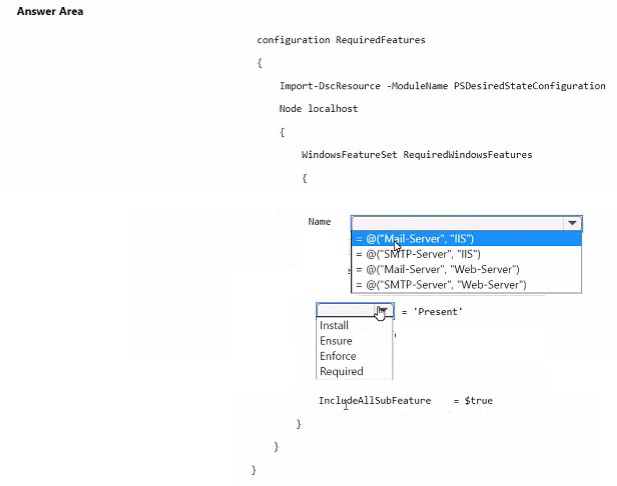
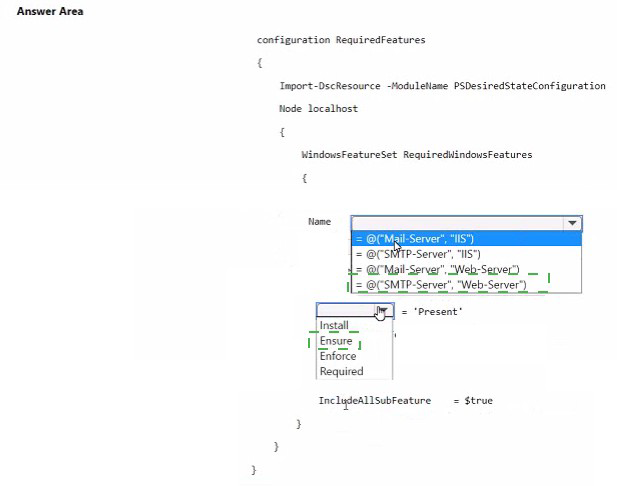
You plan to use Desired State Configuration (DSC) to maintain the configuration of a server that runs Windows Server 2022. The server must have the following features installed:
• A web server
• An email server
How should you complete the DSC configuration file? To answer, select the appropriate
options in the answer area.
NOTE: Each correct selection is worth one point.
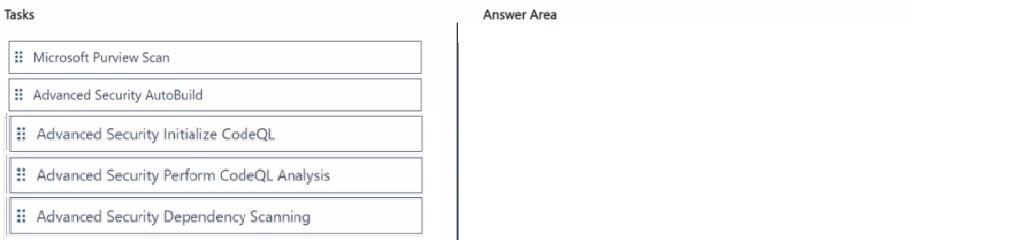
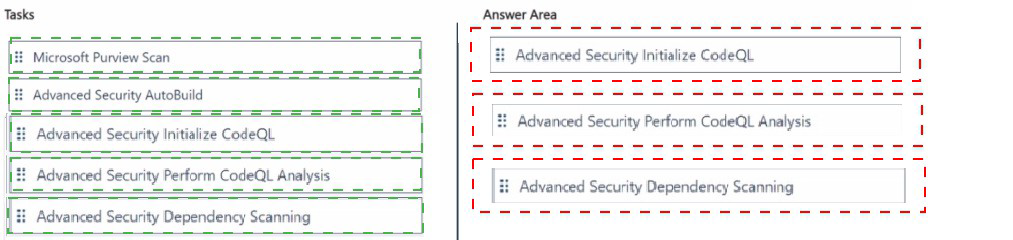
You have an Azure Repos repository named Repo1 that is used for source control.
You need to configure code scanning for Repo1.
Which three tasks should the pipeline perform in sequence? To answer, move the
appropriate tasks from the list of tasks to the answer area and arrange them in the correct
order
You create an alert rule in Azure Monitor as shown in the following exhibit.
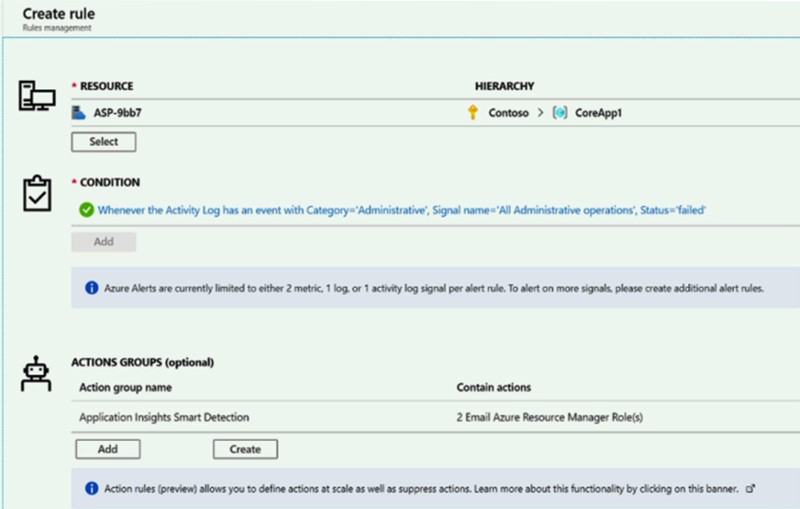
Which action will trigger an alert?
A. a failed attempt to delete the ASP-9bb7 resource
B. a change to a role assignment for the ASP-9bb7 resource
C. a successful attempt to delete the ASP-9bb7 resource
D. a failed attempt to scale up the ASP-9bb7 resource
You need to configure an Azure web app named az400-9940427-main to contain an environmental variable named “MAX_ITEMS”. The environmental variable must have a value of 50. To complete this task, sign in to the Microsoft Azure portal.
Answer: See solution below.
Explanation:
1. In the Azure portal, navigate to the az400-9940427-main app's management page. In
the app's left menu, click Configuration > Application settings.
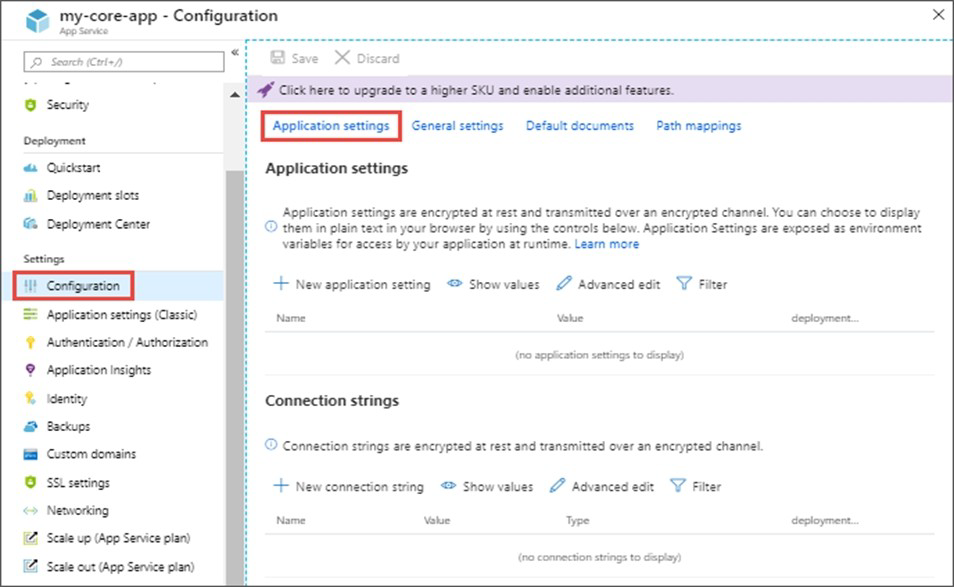
2. Click New Application settings
3. Enter the following:
Name: MAX_ITEMS
Value: 50
| Page 7 out of 49 Pages |