Topic 4: Mix Questions Set

You are developing an iOS application by using Azure DevOps. You need to test the application manually on 10 devices without releasing the application to the public.
Which two actions should you perform?
Each correct answer presents part of the solution.
NOTE: Each correct selection is worth one point.

A. Create a Microsoft Intune device compliance policy.

B. Deploy a certificate from an internal certification authority (CA) to each device.

C. Register the application in the iTunes store.

D. Onboard the devices into Microsoft Intune.

E. Distribute a new release of the application.

F. Register the IDs of the devices in the Apple Developer portal.

E.   Distribute a new release of the application.
F.   Register the IDs of the devices in the Apple Developer portal.

Your company has an Azure DevOps project. The source code for the project is stored in an on-premises repository and uses on an onpremises build server. You plan to use Azure DevOps to control the build process on the build server by using a self-hosted agent. You need to implement the self-hosted agent. You download and install the agent on the build server. Which two actions should you perform next?
Each correct answer presents part of the solution.

A. From Azure, create a shared access signature (SAS).

B. From the build server, create a certificate, and then upload the certificate to Azure Storage

C. From the build server, create a certificate, and then upload the certificate to Azure Key Vault.

D. From DevOps, create a personal access token (PAT

E. From the build server, run config.cmd.

D.   From DevOps, create a personal access token (PAT
E.   From the build server, run config.cmd.

You have a project in Azure DevOps named Project1. You need to ensure that all new pipelines in Project1 execute three specific tasks during pipeline execution. What should you create?

A. a task group

B. a JSON template

C. a YAML template

D. a PowerShell task

C.   a YAML template

Explanation: A task group in Azure DevOps is a collection of tasks that can be reused across multiple pipelines. You can create a task group that contains the three specific tasks that you need to execute during pipeline execution, and then reference that task group in all new pipelines in Project1. This way, you can ensure that the three specific tasks are executed in all new pipelines without having to manually add them to each pipeline.

Note: This question is part of a series of questions that present the same scenario. Each question in the series contains a unique solution that might meet the stated goals. Some question sets might have more than one correct solution, while others might not have a correct solution. After you answer a question in this section, you will NOT be able to return to it. As a result, these questions will not appear in the review screen. Your company uses Azure DevOps to manage the build and release processes for applications.
You use a Git repository for applications source control.
You need to implement a pull request strategy that reduces the history volume in the master branch.
Solution: You implement a pull request strategy that uses an explicit merge.
Does this meet the goal?

A. Yes

B. No

B.   No

Explanation:
Instead use fast-forward merge.
Note:
No fast-forward merge - This option merges the commit history of the source branch when the pull request closes and creates a merge commit in the target branch.

You have a build pipeline in Azure Pipelines that uses different jobs to compile an application for 10 different architectures. The build pipeline takes approximately one day to complete. You need to reduce the time it takes to execute the build pipeline.
Which two actions should you perform? Each correct answer presents part of the solution.
NOTE: Each correct selection is worth one point.

A. Move to a blue/green deployment pattern

B. Create an agent pool.

C. Create a deployment group

D. Reduce the size of the repository.

E. Increase the number of parallel jobs.

B.   Create an agent pool.
E.   Increase the number of parallel jobs.

Explanation:
Question: I need more hosted build resources. What can I do?
Answer: The Azure Pipelines pool provides all Azure DevOps organizations with cloudhosted build agents and free build minutes each month. If you need more Microsoft-hosted build resources, or need to run more jobs in parallel, then you can either: Host your own agents on infrastructure that you manage. Buy additional parallel jobs.

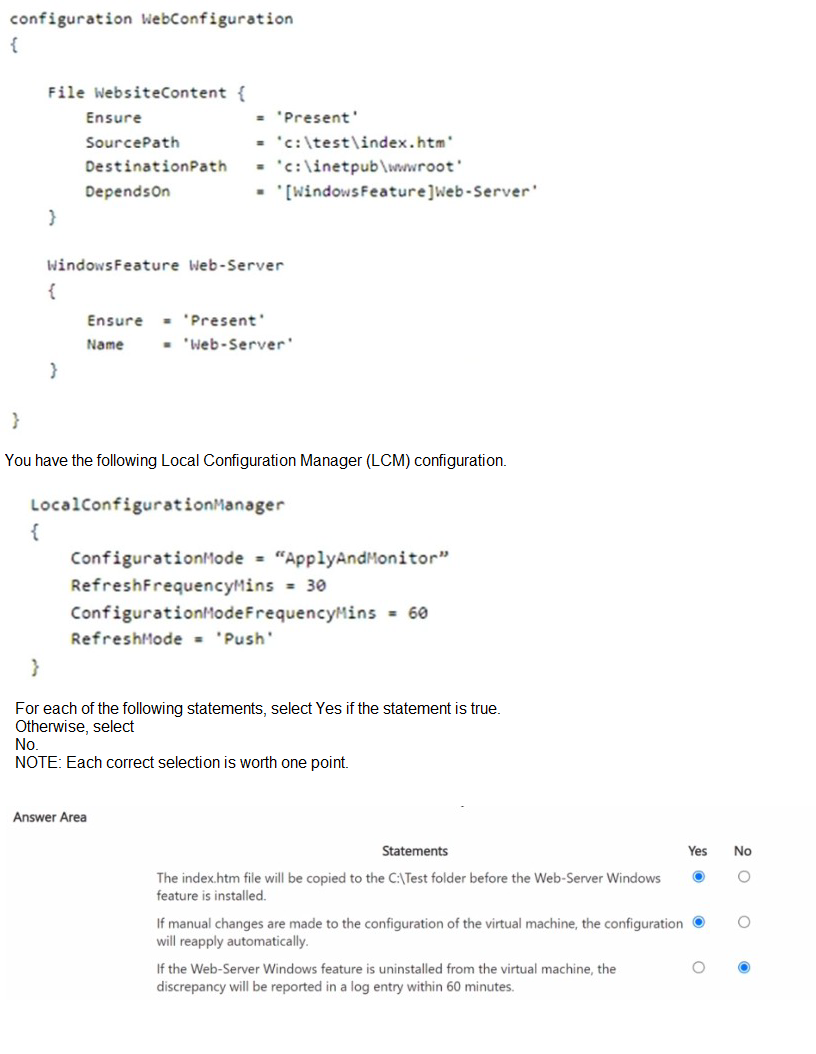
You have a virtual machine that runs Windows Server 2019 and is managed by using Desired State Configuration (DSC).
You have the following DSC configuration.


Explanation:
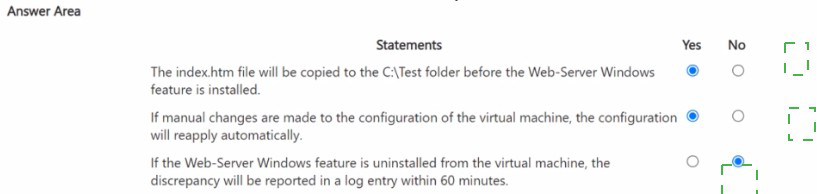
Yes " Dependson are defined"
Yes "Mode is Apply and Monitor"
No "Configuration Mode FreqMin : 60 "
------
Configuration Mode Freq Min:How often, in minutes, the current configuration is checked and applied. This property is ignored if the Configuration Mode property is set to Apply Only.

You use Azure Pipelines to build and release application code, The pipelines include validation tests that must be completed successfully before deployment proceeds from the test stage to production. You discover inconsistent test outcomes for the same source code. You need to validate the test logic. What should you do?

A. Decrease the test pass rate.

B. Configure a parallel test runner.

C. Enable flaky test detection.

D. Install the Analytics extension.

B.   Configure a parallel test runner.

You use Azure SQL Database Intelligent Insights and Azure Application Insights for monitoring. You need to write ad-hoc queries against the monitoring data. Which query language should you use?

A. Kusto Query Language (KQL)

B. PL/pgSQL

C. PL/SQL

D. Transact-SQL

A.   Kusto Query Language (KQL)

Explanation: Azure Monitor Logs is based on Azure Data Explorer, and log queries are written using the same Kusto query language (KQL). This is a rich language designed to be easy to read and author, and you should be able to start using it with minimal guidance.

Your company uses Azure DevOps to manage the build and release processes for applications. You use a Git repository for applications source control. You plan to create a new branch from an existing pull request. Later, you plan to merge the new branch and the target branch of the pull request. You need to use a pull request action to create the new branch. The solution must ensure that the branch uses only a portion of the code in the pull request. Which pull request action should you use?

A. Set as default branch

B. Approve with suggestions

C. Cherry-pick

D. Reactivate

E. Revert

C.   Cherry-pick

Explanation:
Cherry-pick a pull request
To copy changes made in a pull request to another branch in your repo, follow these steps: In a completed pull request, select Cherry-pick, or for an active pull request, select Cherry-pick from the ... menu. Cherry-picking a pull request in this way creates a new branch with the copied changes. Merge into a target branch in a second pull request.
In Target branch, enter the branch you want to merge the copied changes.
In Topic branch name, enter a new branch to contain the copied changes, then select Cherry-pick.
Select Create pull request to merge the topic branch into the target branch to complete the cherry-pick.

You need to create a virtual machine template in an Azure DevTest Labs environment named az400-9940427-dtl1. The template must be based on Windows Server 2016 Datacenter. Virtual machines created from the template must include the selenium tool and the Google Chrome browser.
To complete this task, sign in to the Microsoft Azure portal.


Answer: See solution below.

Explanation:
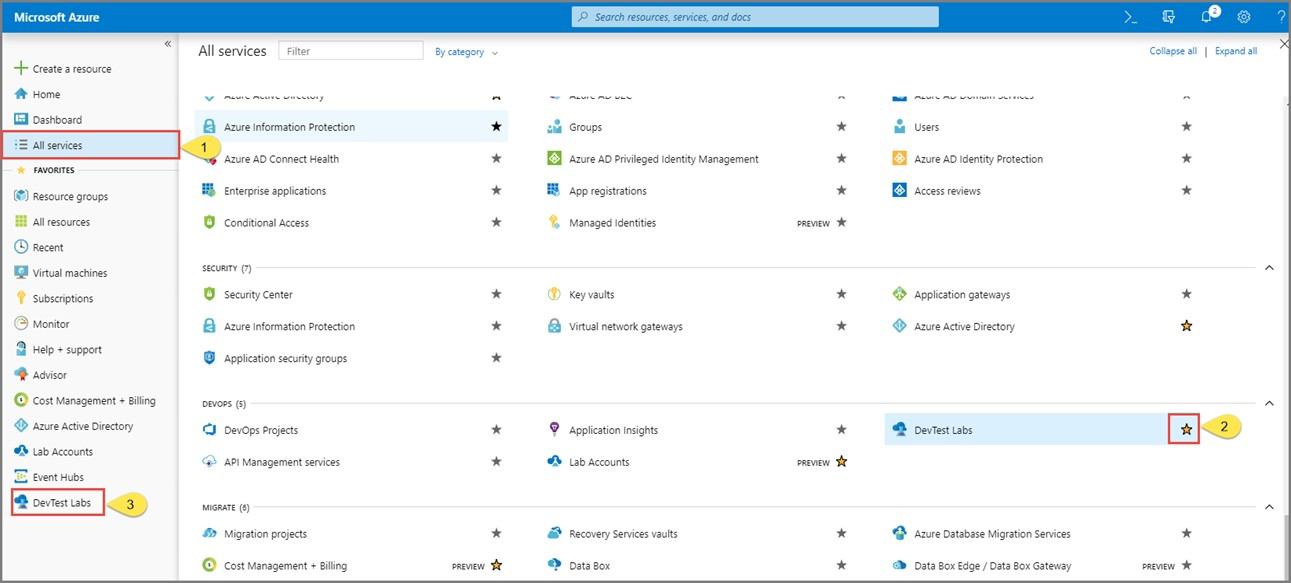
1. Open Microsoft Azure Portal
2. Select All Services, and then select DevTest Labs in the DEVOPS section.


3. From the list of labs, select the az400-9940427-dtl1 lab
4. On the home page for your lab, select + Add on the toolbar.
5. Select the Windows Server 2016 Datacenter base image for the VM.
6. Select automation options at the bottom of the page above the Submit button.
7. You see the Azure Resource Manager template for creating the virtual machine.
8. The JSON segment in the resources section has the definition for the image type you selected earlier.

Page 18 out of 49 Pages