Topic 4: Mix Questions Set
You have a project in Azure DevOps named Project1 that references an Azure Artifacts feed named Feed1. You have a package named Package1 that has the versions shown in the following table.
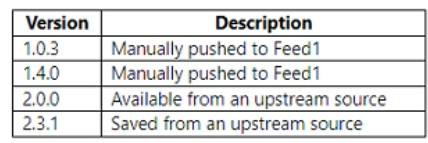
You need to perform a build of Project1. Which version of Package1 will be used?
A. 1.0.3
B. 1.4.0
C. 2.0.0
D. 2.3.1
You have a GitHub Enterprise account. You need to enable push protection for secret scanning of the account repositories. What should you do first?
A. Purchase Premium Plus support.
B. Enforce multi-factor authentication (MFA).
C. Purchase a GitHub Advanced Security license.
D. Create an access policy for secrets.
You use Azure Pipelines to build and test code projects.
You notice an increase in cycle times.
You need to identify whether agent pool exhaustion is causing the issue.
What are two possible ways to achieve this goal?
Each correct answer presents a
complete solution.
NOTE: Each correct selection is worth one point.
A. View the Pipeline duration report.
B. Query the PipelineRun/PipelineRuns endpoint.
C. View the pool consumption report at the organization level.
D. Query the TaskAgentPoolSizeSnapshots endpoint
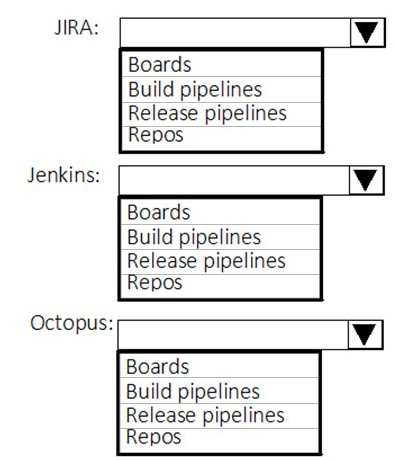
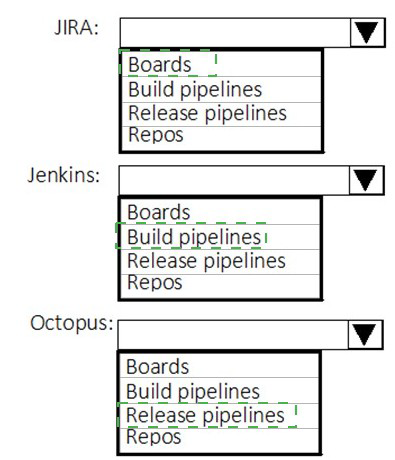
You currently use JIRA, Jenkins, and Octopus as part of your DevOps processes.
You plan to use Azure DevOps to replace these tools.
Which Azure DevOps service should you use to replace each tool? To answer, select the appropriate options in the answer area.
NOTE: Each correct selection is worth one point.
This question is part of a series of questions that present the same scenario. Each question
in the series contains a unique solution that might meet the stated goals. Some question
sets might have more than one correct solution, while others might not have a correct
solution.
After you answer a question in this section, you will NOT be able to return to it. As a result,
these questions will not appear in the review screen.
You have an Azure DevOps project.
Your build process creates several artifacts.
You need to deploy the artifacts to on-premises servers.
Solution: You deploy an Azure self-hosted agent to an on-premises server. You add a
Copy and Publish Build Artifacts task to the deployment pipeline.
Does this meet the goal?
A. Yes
B. No
Explanation:
To build your code or deploy your software using Azure Pipelines, you need at least one
agent.
If your on-premises environments do not have connectivity to a Microsoft-hosted agent pool
(which is typically the case due to intermediate firewalls), you'll need to manually configure
a self-hosted agent on on-premises computer(s). The agents must have connectivity to the
target on-premises environments, and access to the Internet to connect to Azure Pipelines
or Team Foundation Server.
You need to deploy a new project in Azure DevOps that has the following requirements:
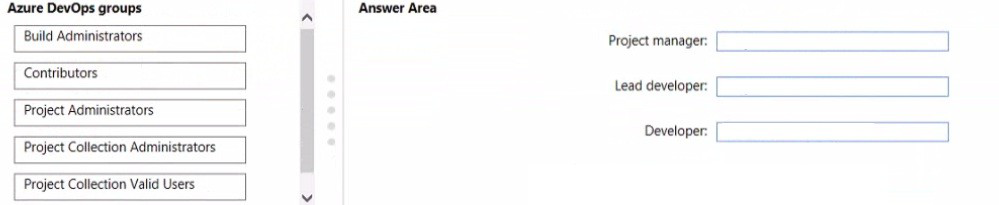
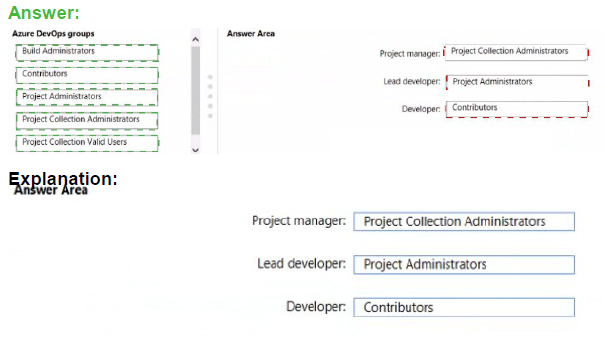
• The lead developer must be able to create repositories, manage permissions, manage policies, and contribute to the repository.
• Developers must be able to contribute to the repository and create branches, but NOT bypass policies when pushing builds.
• Project managers must only be able to view the repository.
• The principle of least privilege must be used.
You create a new Azure DevOps project team for each role.
To which Azure DevOps groups should you add each team? To answer, drag the appropriate groups to the correct teams. Each group may be used once, more than once, or not at all. You may need to drag the split bar between panes or scroll to view content.
NOTE: Each correct selection is worth one point.
Your company has a project in Azure DevOps. You need to ensure that when there are multiple builds pending deployment only the most recent build is deployed. What should you use?
A. deployment queue settings
B. deployment conditions
C. release gates
D. pull request triggers
You have a project in Azure DevOps that contains a Continuous Integration/Continuous Deployment (CI/CD) pipeline.
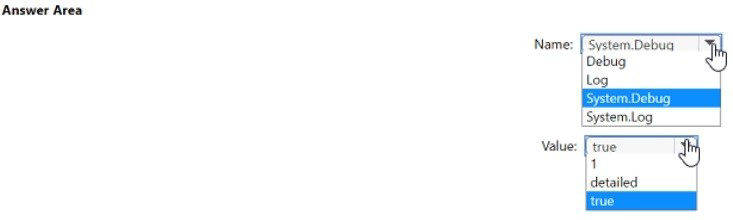
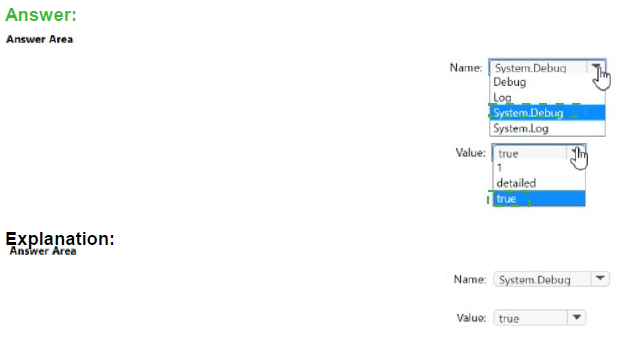
You need to enable detailed logging by defining a pipeline variable.
Mow should you configure the variable? To answer, select the appropriate options in the answer area.
NOTE: Each correct selection is worth one point.
You have a GitHub repository that contains multiple versions of an Azure Pipelines template. You plan to deploy multiple pipelines that will use a template stored in the repository. You need to ensure that you use a fixed version of the template. What should you use to reference which version of the template repository to use?
A. the runner
B. the branch
C. the SHA-based hashes
D. the serial
During a code review, you discover many quality issues. Many modules contain unused variables and empty catch Modes. You need to recommend a solution to improve the quality o' the code. What should you recommend?
A. In a Gradle build task, select Run Checkstyle.
B. In an Xcode build task, select Use xcpretty from Advanced
C. In a Grunt build task, select Enabled from Control Options.
D. In a Maven build task, select Run PMD.
Explanation:
PMD is a source code analyzer. It finds common programming flaws like unused variables,
empty catch blocks, unnecessary object creation, and so forth.
There is an Apache Maven PMD Plugin which allows you to automatically run the PMD
code analysis tool on your project's source code and generate a site report with its results.
| Page 16 out of 49 Pages |