Topic 4: Mix Questions Set
You are implementing a new project in Azure DevOps.
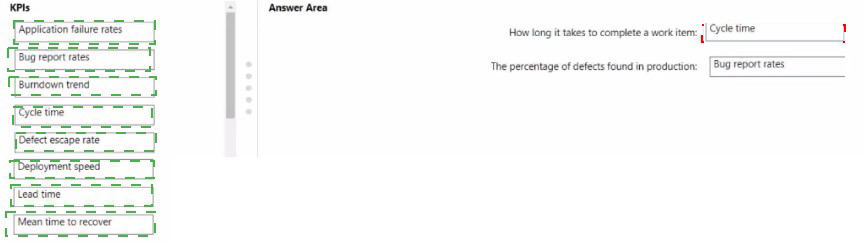
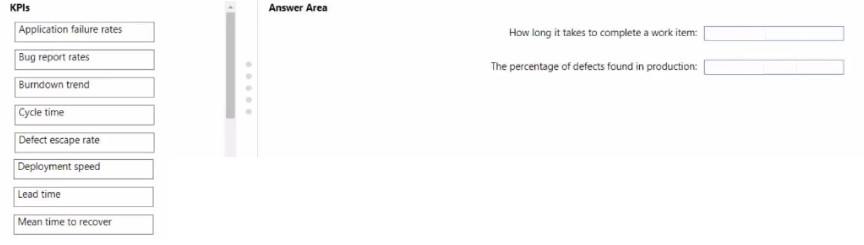
You need to assess the performance of the protect. The solution must identity the following metrics:
• How long it takes to complete a work item
* The percentage of defects found in production
Which DevOps KPI should you review for each metric? To answer drag the appropriate KPIs to the correct metric. Each KPI may be used once, more than once, or not at all. You may need to drag the spirt bar between panes or scroll to view content.
NOTE Each correct selection is worth one point.
Note: This question is part of a series of questions that present the same scenario. Each
question in the series contains a unique solution that might meet the stated goals. Some
question sets might have more than one correct solution, while others might not have a correct solution.
After you answer a question in this section, you will NOT be able to return to it. As a result,
these questions will not appear in the review screen.
You have an approval process that contains a condition. The condition requires that
releases be approved by a team leader before they are deployed.
You have a policy stating that approvals must occur within eight hours.
You discover that deployment fail if the approvals take longer than two hours.
You need to ensure that the deployments only fail if the approvals take longer than eight
hours.
Solution: From Post-deployment conditions, you modify the Timeout setting for postdeployment
approvals.
Does this meet the goal?
A. Yes
B. No
Explanation:
Use Pre-deployments conditions instead.
Use a gate instead of an approval instead.
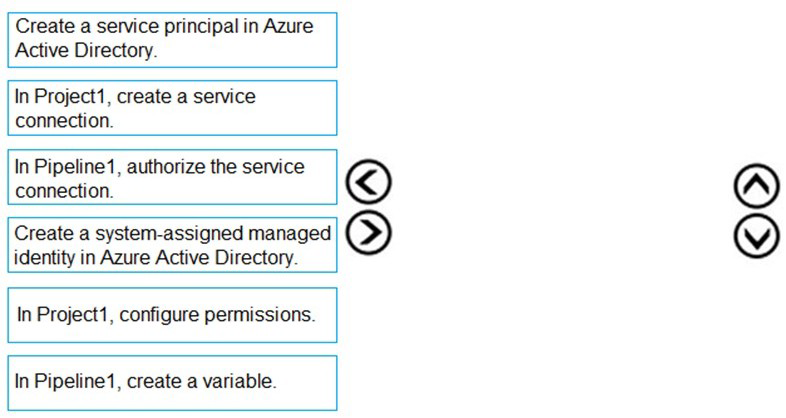
You have a project in Azure DevOps named Project1 that contains two Azure DevOps pipelines named Pipeline1 and Pipeline2.
You need to ensure that Pipeline1 can deploy code successfully to an Azure web app named webapp1. The solution must ensure that Pipeline2 does not have permission to webapp1.
Which three actions should you perform in sequence? To answer, move the appropriate actions from the list of actions to the answer area and arrange them in the correct order.
You plan to create a GitHub workflow that will use GitHub Actions. The actions will require a 256-KB secret. You need to recommend a solution to store and encrypt the secret. The secret value must be accessible only to the workflow. The solution must minimize administrative effort. What should you recommend?
A. Store the secret in the organization-level GitHub secrets.
B. Store the secret in the repository-level GitHub secrets
C. Encrypt the secret value and store the value in the repository. Store the decryption key in the repository-level GitHub secrets.
D. Encrypt the secret value and store the value in the repository. Store the decryption key in the organization-level GitHub secrets.
Explanation:
https://docs.github.com/en/actions/security-guides/encrypted-secrets
"To use
secrets that are larger than 48 KB, you can use a workaround to store encrypted secrets in
your repository and save the decryption passphrase as a secret on GitHub." Because it
requires less administrative privilege it's at repository level.
Note: This question is part of a series of questions that present the same scenario. Each
question in the series contains a unique solution that might meet the stated goals. Some
question sets might have more than one correct solution, while others might not have a
correct solution.
After you answer a question in this section, you will NOT be able to return to it. As a result,
these questions will not appear in the review screen.
You plan to update the Azure DevOps strategy of your company.
You need to identify the following issues as they occur during the company’s development
process:
- Licensing violations
- Prohibited libraries
Does this meet the goal?
A. Yes
B. No
Explanation:
Instead use implement continuous integration.
Note: WhiteSource is the leader in continuous open source software security and
compliance management. WhiteSource integrates into your build process, irrespective of
your programming languages, build tools, or development environments. It works
automatically, continuously, and silently in the background, checking the security, licensing,
and quality of your open source components against WhiteSource constantly-updated denitive database of open source repositories.
You are monitoring the health and performance of an Azure web app by using Azure Application Insights. You need to ensure that an alert is sent when the web app has a sudden rise in performance issues and failures. What should you use?
A. Application Insights Profiler
B. Continuous export
C. Smart Detection
D. custom events
E. usage analysis
Explanation: Smart Detection automatically warns you of potential performance problems and failure anomalies in your web application. It performs proactive analysis of the telemetry that your app sends to Application Insights. If there is a sudden rise in failure rates, or abnormal patterns in client or server performance, you get an alert.
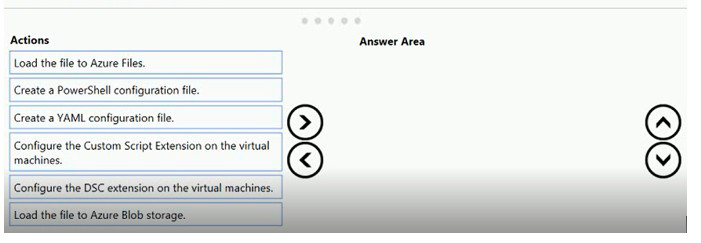
You are deploying a new application that uses Azure virtual machines.
You plan to use the Desired State Configuration (DSC) extension on the virtual machines.
You need to ensure that the virtual machines always have the same Windows features installed.
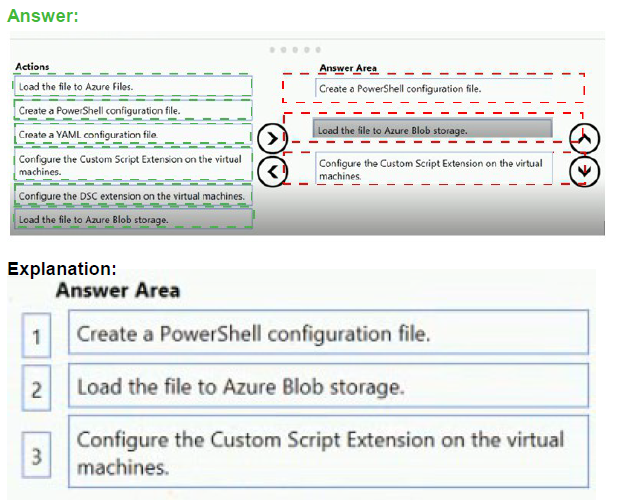
Which three actions should you perform in sequence? To answer, move the appropriate actions from the list of actions to the answer area and arrange them in the correct order.

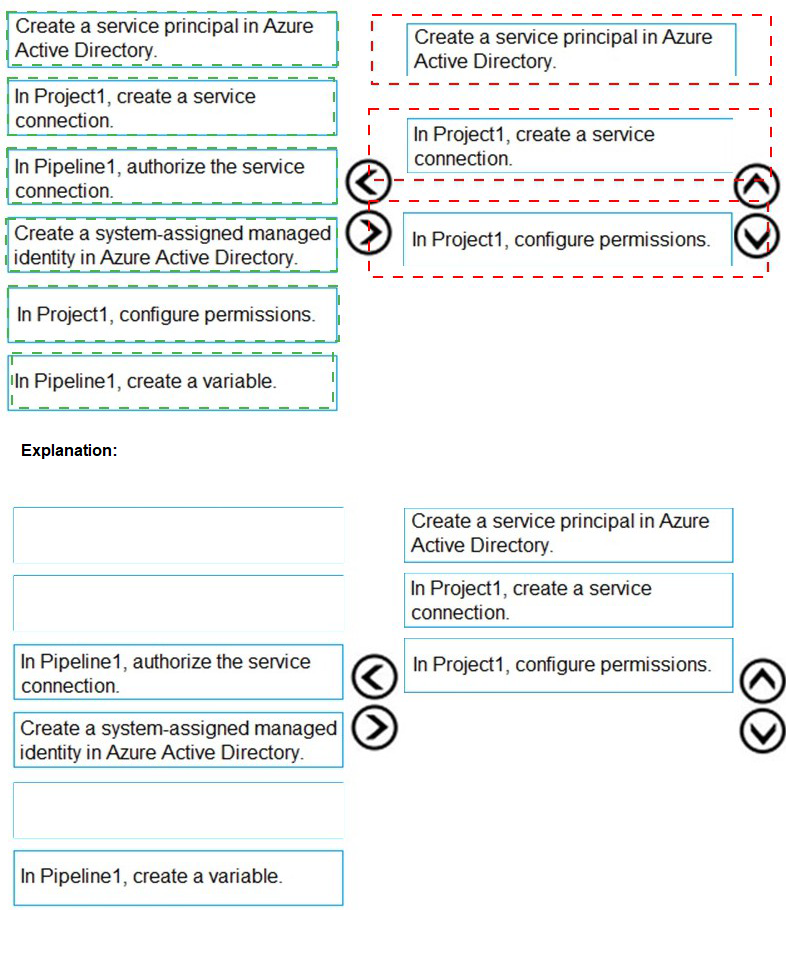
Step 1: Create a PowerShell configuration file
You create a simple PowerShell DSC configuration file.
Step 2: Load the file to Azure Blob storage
Package and publish the module to a publically accessible blob container URL
Step 3: Configure the Custom Script Extension on the virtual machines.
The Custom Script Extension downloads and executes scripts on Azure virtual machines.
Note: This question is part of a series of questions that present the same scenario. Each
question in the series contains a unique solution that might meet the stated goals. Some
question sets might have more than one correct solution, while others might not have a
correct solution.
After you answer a question in this section, you will NOT be able to return to it As a result, these questions will not appear in the review screen.
You need to recommend an integration strategy for the build process of a Java application.
The solution must meet the following requirements:
- The builds must access an on-premises dependency management system.
- The build outputs must be stored as Server artifacts m Azure DevOps.
- The source code must be stored in a get repository in Azure DevOps.
Does this meet the goal?
A. Yes
B. No
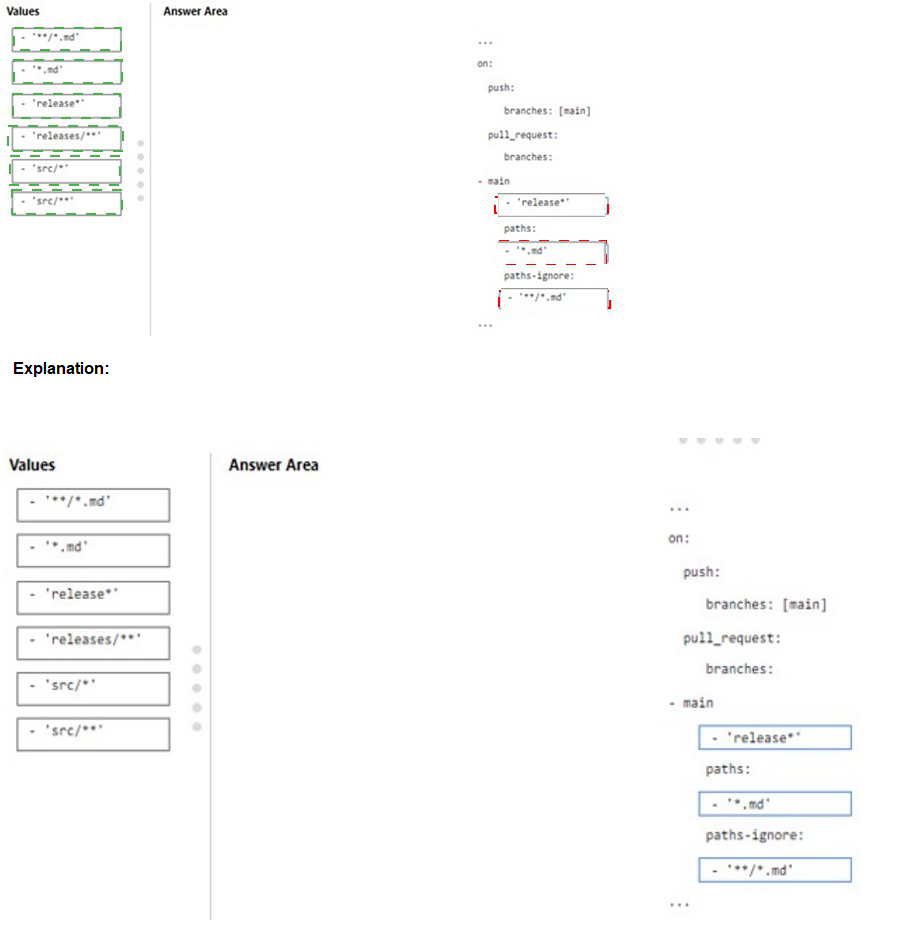
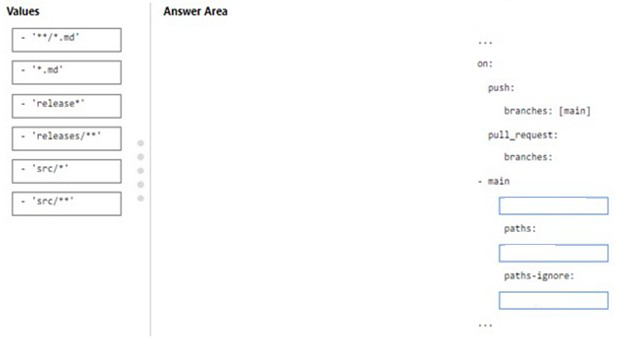
You have GitHub repository named repo1 that stores the code of named App1.
You need deploy workflow for repo1 by using GitHub Actions. The solution must meet the following requirements:
Scan on pushes to the main branch.
Scan on pull requests to the main branch.
Scan on pull requests to any branch that has a prefix of releases/.
Scan all the files in subdirectories of the scan directory.
Exclude scanning of markdown files
Your company uses the following resources:
- Windows Server 2019 container images hosted in an Azure Container Registry
- Azure virtual machines that run the latest version of Ubuntu An Azure
- Log Analytics workspace Azure Active Directory (Azure AD)
- An Azure key vault
A. the Azure Log Analytics workspace
B. the Azure key vault
C. the Azure virtual machines that run the latest version of Ubuntu
D. Azure Active Directory (Azure AD)
E. the Windows Server 2019 container images hosted in the Azure Container Registry
| Page 15 out of 49 Pages |