Topic 5, Labs & Tasks

You have an Azure subscription that contains the resources shown in the following table.
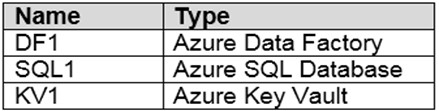


You plan to create a linked service in DF1. The linked service will connect to SQL1 by using Microsoft SQL Server authentication. The password for the SQL Server login will be stored in KV1.
You need to configure DF1 to retrieve the password when the data factory connects to SQL1. The solution must use the principle of least privilege.
How should you configure DF1? To answer, select the appropriate options in the answer area.
NOTE: Each correct selection is worth one point.
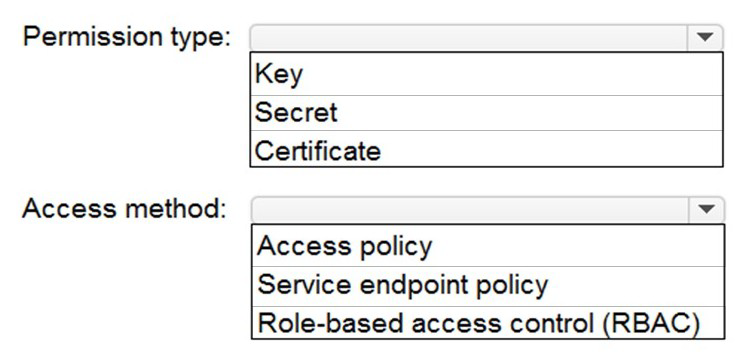


Explanation:
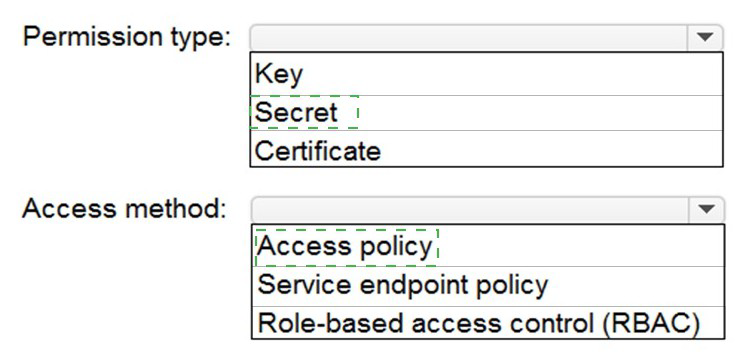
Box 1: Secret
Store credential in Azure Key Vault by reference secret stored in key vault.
To reference a credential stored in Azure Key Vault, you need to:
Retrieve data factory managed identity
Grant the managed identity access to your Azure Key Vault. In your key vault ->
Access policies -> Add Access Policy, search this managed identity to grant Get
permission in Secret permissions dropdown. It allows this designated factory to
access secret in key vault.
Create a linked service pointing to your Azure Key Vault.
Create data store linked service, inside which reference the corresponding secret stored in key vault.
Box 2: Access policy

Your company develops an app for OS. All users of the app have devices that are members of a private distribution group in Microsoft Visual Studio App Center. You plan to distribute a new release of the app. You need to identify which certificate file you require to distribute the new release from App Center. Which file type should you upload to App Center?

A. .cer

B. .pvk

C. .pfx

D. .p12

D.   .p12

Explanation:
A successful IOS device build will produce an ipa file. In order to install the build on a device, it needs to be signed with a valid provisioning profile and certificate. To sign the builds produced from a branch, enable code signing in the configuration pane and upload a provisioning profile (.mobileprovision) and a valid certificate (.p12) , along with the password for the certificate.

Note: This question is part of a series of questions that present the same scenario. Each question in the series contains a unique solution that might meet the stated goals. Some question sets might have more than one correct solution, while others might not have a correct solution. After you answer a question in this section, you will NOT be able to return to it. As a result, these questions will not appear in the review screen. You need to recommend an integration strategy for the build process of a Java application.
The solution must meet the following requirements:

  • The builds must access an on-premises dependency management system.
  • The build outputs must be stored as Server artifacts in Azure DevOps.
  • The source code must be stored in a Git repository in Azure DevOps.
Solution: Install and configure a self-hosted build agent on an on-premises machine. Configure the build pipeline to use the Default agent pool. Include the Java Tool Installer task in the build pipeline.
Does this meet the goal?

A. Yes

B. No

B.   No

You have an Azure Pipeline.
You need to store configuration values as variables.
At which four scopes can the variables be defined, and what is the precedence of the variables from the highest precedence to lowest precedence? To answer, move the appropriate scope from the list of scopes to the answer area and arrange them in the correct order.


You have a free tier of an Azure DevOps organization named Contoso. Contoso contains 10 private projects. Each project has multiple jobs with no dependencies. You frequently run the jobs on five self-hosted agents but experience long build times and frequently queued builds. You need to minimize the number of queued builds and the time it takes to run the builds. What should you do?

A. Purchase self-hosted parallel jobs

B. Register additional self-hosted agents.

C. Purchase Microsoft-hosted parallel jobs

D. Configure the pipelines to use the Microsoft-hosted agents.

B.   Register additional self-hosted agents.

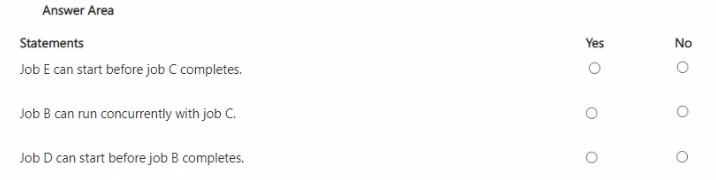
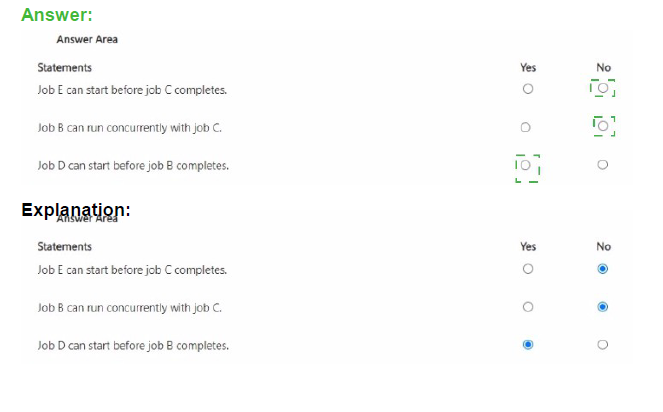
You have an Azure Pipelines pipeline that has the following definition.
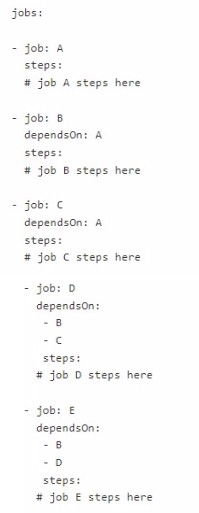


For each of the following statements, select Yes if the statement is true. Otherwise, select No.
NOTE: Each correct selection is worth one point.
Your team uses Azure Pipelines to deploy applications.
You need to ensure that when a failure occurs during the build or release process, all the
team members are notified by using Microsoft Teams. The solution must minimize
development effort.
What should you do?

A. Install the Azure Boards app for Teams and configure a subscription to receive notifications in a channel.

B. Use Azure Automation to connect to the Azure DevOps REST API and notify the team members.

C. Use an Azure function to connect to the Azure DevOps REST API and notify the team members.

D. Install the Azure Pipelines app for Teams and configure a subscription to receive notifications in a channel.

D.   Install the Azure Pipelines app for Teams and configure a subscription to receive notifications in a channel.

You use Git for source control. You enable GitHub code scanning. You raise a pull request from a non-default branch. In the code scanning output you receive the following error message: "Analysis not found." You need to ensure that the code scanning completes successfully for the pull request. Which two actions should you perform?
Each correct answer presents part of the solution.
NOTE: Each correct selection is worth one point.

A. Add a new workflow for code scanning

B. Add the name of the non-default branch to the on: push specification in the code scanning workflow.

C. Update the code in the pull request.

D. Add the name of the default branch to the on: push specification in the code scanning workflow.

E. Delete the pull request, and then raise the request again from the default branch.

C.   Update the code in the pull request.
D.   Add the name of the default branch to the on: push specification in the code scanning workflow.

You have an Azure DevOps organization named Contoso and an Azure subscription. The subscription contains an Azure virtual machine scale set named VMSS1 and an Azure Standard Load Balancer named LB1. LB1 distributes incoming requests across VMSS1 instances. You use Azure DevOps to build a web app named Appl and deploy App1 to VMSS1. App1 is accessible via HTTPS only and configured to require mutual authentication by using a client certificate.
You need to recommend a solution for implementing a health check of App1. The solution must meet the following requirements:

  • Identify whether individual instances of VMSSl are eligible for an upgrade operation.
  • Minimize administrative effort.
What should you include in the recommendation?

A. the Custom Script Extension

B. the Application Health extension

C. Azure Monitor autoscale

D. an Azure Load Balancer health probe

B.   the Application Health extension

You use GitHub for source control and Azure Boards for project management. GitHub and Azure Boards are integrated. You plan to create a pull request in GitHub. You need to automatically link the request to an existing Azure Boards work item by using the text of AB#.
To which two elements can you add the text?
Each correct answer presents a complete solution.
NOTE: Each correct selection is worth one point.

A. milestone

B. comment

C. title

D. description

E. label

C.   title
D.   description

Explanation: You can add the text "AB#" to the title or description of the pull request in GitHub, which will automatically link the request to an existing Azure Boards work item with that number.

Page 12 out of 49 Pages