Topic 5: Misc. Questions
How should the migrated databases DB1 and DB2 be implemented in Azure?
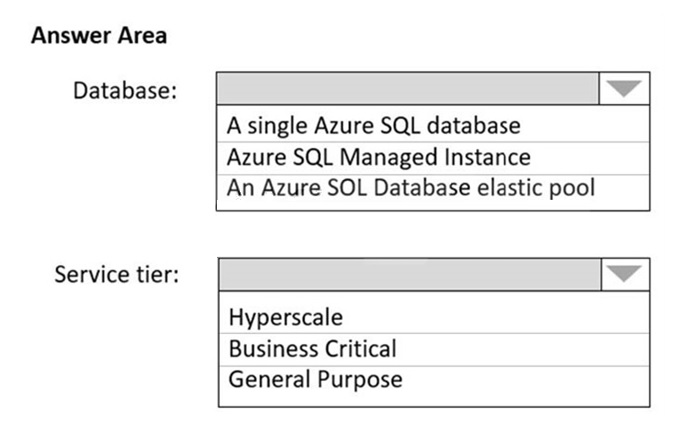
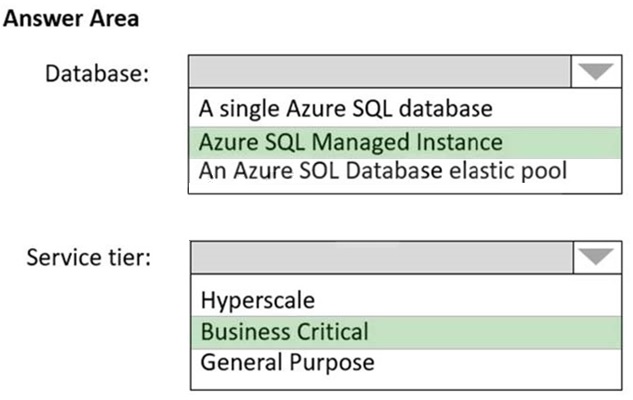
I notice that the image content you've provided describes the available Azure SQL deployment options and service tiers, but it does not include the specific requirements or context for databases DB1 and DB2. To answer the question "How should the migrated databases DB1 and DB2 be implemented in Azure?" I need the details of the scenario.
Please provide the full question, which typically includes:
The specific technical and business requirements for each database (e.g., "requires a 99.995% SLA," "must support in-place transparent data encryption," "has unpredictable usage patterns").
Any constraints, such as the need for minimal administrative overhead, specific networking features, or compatibility with a certain SQL Server version.
The differences between DB1 and DB2 that would justify choosing different configurations.
Once you provide the complete question text, I will be able to give you a detailed answer following your requested format.
For now, I can offer a general explanation of the choices presented in your image:
Database Options:
Single Database:
A standalone, fully managed database in Azure.
Elastic Pool:
A collection of single databases with a shared set of resources (e.g., CPU, memory), ideal for multi-tenant applications or databases with unpredictable usage to optimize cost.
Managed Instance:
A fully managed instance of SQL Server with near-100% feature parity with on-premises SQL Server, best for lift-and-shift migrations requiring instance-level features.
Service Tiers:
General Purpose:
A budget-oriented tier that separates compute and storage, suitable for most business workloads.
Business Critical:
A high-performance tier that uses local SSD storage for low-latency and high resilience, often used for applications requiring high IO and fail-fast recovery.
Hyperscale:
A tier for very large databases (up to 100 TB) that scales compute and storage independently, designed for rapid scaling and fast backups/restores.
Please share the full question, and I will provide the specific, targeted analysis you need.
You have an Azure subscription named Sub1 that is linked to an Azure AD tenant named contoso.com.
You plan to implement two ASP.NET Core apps named App1 and App2 that will be deployed to 100 virtual machines in Sub1. Users will sign in to App1 and App2 by using their contoso.com credentials.
App1 requires read permissions to access the calendar of the signed-m user. App2 requires write permissions to access the calendar of the signed-in user.
You need to recommend an authentication and authorization solution for the apps. The solution must meet the following requirements:
• Use the principle of least privilege.
• Minimize administrative effort
What should you include in the recommendation? To answer, select the appropriate options in the answer area.
NOTE: Each correct selection is worth one pent.


Summary:
The scenario describes two apps (App1 and App2) that need to access the signed-in user's calendar with different permission levels (Read vs. Write). The key requirements are using the least privilege and minimizing administrative effort. Since the apps run on Azure VMs and need to act on behalf of the user, the optimal solution is to use a managed identity for secure, credential-free authentication to Azure AD. For authorization, since the apps need to access user data (their calendar) and not manage Azure resources, Microsoft Graph API permissions (Delegated) should be used. This allows the apps to request only the specific permissions they need for the user's data.
Correct Options:
Authentication: A user-assigned managed identity
A user-assigned managed identity can be created as a standalone Azure resource and then assigned to multiple Azure resources, like all 100 VMs. This is far more efficient for minimizing administrative effort than using a system-assigned identity (which is unique to each VM) or an app registration secret (which requires manual credential management). It provides a secure, automated identity without storing any secrets in the app code.
Authorization: Delegated permissions
Delegated permissions are used when an app acts on behalf of a signed-in user. The app can only perform actions that the user themselves has permission to do. This perfectly aligns with the least privilege principle: App1 can be granted Calendars.Read and App2 Calendars.ReadWrite, and a user who only has read access to their own calendar cannot grant App2 write access. This is more secure for user-data scenarios than application permissions, which are highly privileged and grant the app access to all calendars in the tenant, regardless of the user.
Incorrect Options
Authentication: Application registration in Azure AD
While an app registration is necessary to define the app's identity and permissions, using it directly for authentication (e.g., with a client secret) is less secure and requires more administrative effort. You would have to manage and securely rotate these secrets across all 100 application instances, which violates the "minimize administrative effort" requirement.
Authentication: A system-assigned managed identity
A system-assigned managed identity is enabled directly on an individual Azure resource (like a single VM). Using it for 100 VMs would result in 100 separate identities. This creates significant administrative overhead to configure and assign permissions for each one, contradicting the goal to minimize effort.
Authorization: Azure role-based access control (Azure RBAC)
Azure RBAC is used to control access to manage Azure resources (like VMs, storage accounts, or subscriptions). It is not used to grant permissions to access data within a user's Microsoft 365 calendar. For data-plane operations in Microsoft Graph, API permissions (Delegated or Application) are the correct mechanism.
Authorization: Application permissions
Application permissions grant the app itself the rights to access calendars, without a signed-in user. This would allow the app to access any calendar in the tenant, which is a massive privilege escalation far beyond the "read/write to the signed-in user's calendar" requirement. This blatantly violates the principle of least privilege.
Reference:
Microsoft Learn, "Managed identities for Azure resources": https://learn.microsoft.com/en-us/azure/active-directory/managed-identities-azure-resources/overview
Microsoft Learn, "Permissions and consent in the Microsoft identity platform": https://learn.microsoft.com/en-us/azure/active-directory/develop/v2-permissions-and-consent
A company has an existing web application that runs on virtual machines (VMs) in Azure.
You need to ensure that the application is protected from SQL injection attempts and uses a layer-7 load balancer. The solution must minimize disruption to the code for the existing web application.
What should you recommend? To answer, drag the appropriate values to the correct items.
Each value may be used once, more than once, or not at all. You may need to drag the split bar between panes or scroll to view content.
NOTE: Each correct selection is worth one point.


Summary
The requirement is to protect from SQL injection (a web attack) and use a Layer-7 load balancer with minimal code disruption. Azure Application Gateway is a web traffic load balancer that operates at OSI Layer 7 (HTTP/HTTPS). It has an integrated, pre-configured Web Application Firewall (WAF) SKU that protects web applications from common vulnerabilities like SQL injection without requiring any changes to the application code itself. Deploying it in front of the VMs fulfills both core requirements seamlessly.
Correct Option Justification
Azure service: Azure Application Gateway
Azure Application Gateway is a Layer-7 load balancer. It is the only service listed that natively provides both advanced HTTP/S routing (like URL-based routing) and an integrated Web Application Firewall (WAF) in a single product. Deploying it in front of the existing VMs acts as a secure entry point, inspecting all incoming web traffic for threats like SQL injection before it reaches the application, thus meeting both security and load balancing requirements without code changes.
Feature: Web Application Firewall (WAF)
Web Application Firewall (WAF) is a feature of Application Gateway (WAF_v2 SKU) that provides centralized, platform-level protection for your web applications from common exploits and vulnerabilities. It uses rule sets from the OWASP core rule set to automatically defend against attacks like SQL injection and cross-site scripting. Enabling WAF on the Application Gateway is the direct method to fulfill the requirement to "protect the application from SQL injection attempts."
Incorrect Option Explanations
Azure Load Balancer:
This is a Layer-4 (TCP/UDP) load balancer. It is excellent for distributing non-HTTP traffic or for high-performance forwarding but lacks the ability to inspect HTTP content for SQL injection attacks. It does not have a WAF feature.
Azure Traffic Manager:
This is a DNS-based traffic load balancer that works at the DNS level. It directs users to the closest or healthiest endpoint globally but does not terminate the connection or inspect the HTTP traffic for attacks. It is ineffective for protecting against SQL injection.
SSL offloading:
This is a feature of Application Gateway, not a service. While Application Gateway can perform SSL offloading, the primary requirement is protection from SQL injection, which is achieved by the WAF feature.
URL-based content routing: This is another feature of Application Gateway. It allows routing traffic to different backend pools based on the URL path. While useful, it is not the feature that provides security against SQL injection.
Reference
Microsoft Learn, "Web Application Firewall on Azure Application Gateway": https://learn.microsoft.com/en-us/azure/web-application-firewall/ag/ag-overview
Microsoft Learn, "Azure Application Gateway overview": https://learn.microsoft.com/en-us/azure/application-gateway/overview
| Page 9 out of 36 Pages |