Topic 5: Misc. Questions
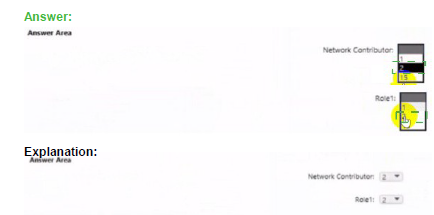
You need to implement the Azure RBAC role assignment. The solution must meet the authentication and authorization requirements.
How many assignment should you configure for the Network Contributor role for Role1? To answer, select appropriate in the answer area.

You have an Azure App Service web app named Webapp1 that connects to an Azure SQL database named DB1. Webapp1 and DB1 are deployed to the East US Azure region.
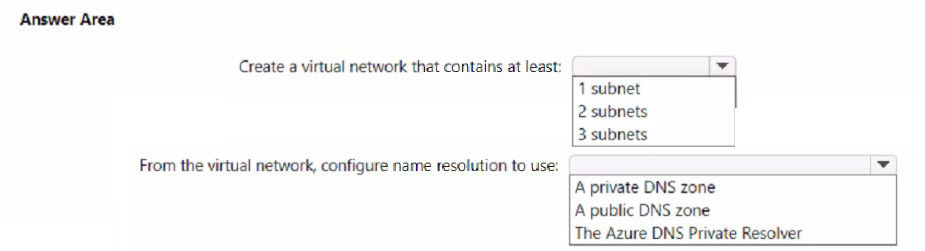
You need to ensure that all the traffic between Weoapp1 and DB1 is sent via a private connection.
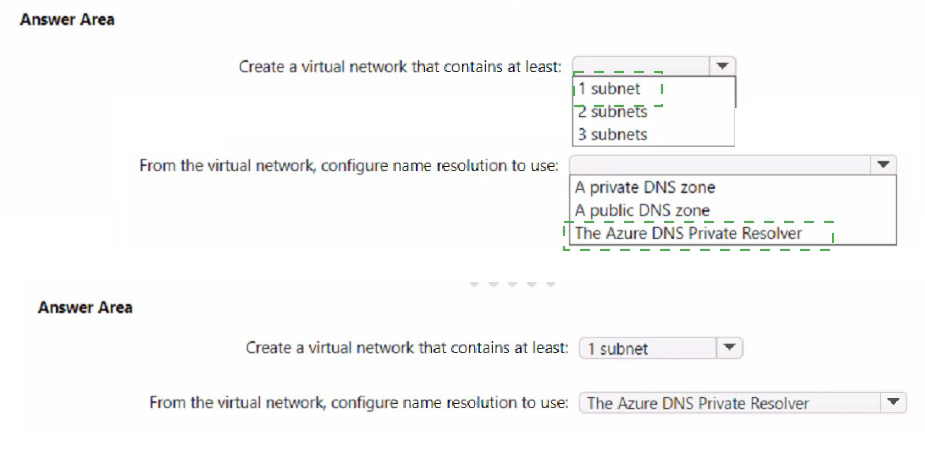
What should you do? To answer, select the appropriate options in the answer area.
NOTE: Each correct selection is worth one point.
Explanation:
To ensure all traffic between Webapp1 (App Service) and DB1 (SQL Database) is private and stays on the Azure backbone network, you must isolate them from the public internet. This is achieved by deploying them inside an Azure Virtual Network (VNet) and using Private Endpoints. A Private Endpoint provides a private IP address from your VNet to the Azure service (SQL DB), making it accessible as if it were a local resource within the network.
Correct Options:
Create a virtual network that contains at least: 2 subnets
You need one subnet for the App Service to integrate into (using VNet Integration) and a separate, dedicated subnet to deploy the Private Endpoint for the SQL Database. Placing the Private Endpoint in its own subnet is a security and management best practice.
From the virtual network, configure name resolution to use: A private DNS zone
When you create a Private Endpoint for Azure SQL Database, it creates a Fully Qualified Domain Name (FQDN) like db1.database.windows.net. To ensure this name resolves to the private IP address of the Private Endpoint (instead of the public IP), you must link a dedicated Azure Private DNS zone (privatelink.database.windows.net) to your VNet.
Incorrect Options:
1 subnet / 3 subnets:
One subnet is insufficient for the recommended two-tier architecture. Three subnets are not required for this core scenario, though they could be used for other reasons.
A public DNS zone:
This would resolve names to public IP addresses, defeating the purpose of the private connection.
The Azure DNS Private Resolver:
While the Private Resolver is used for hybrid DNS resolution (e.g., to resolve on-premises names from Azure), it is not the correct service for resolving the private FQDN of an Azure PaaS service's Private Endpoint. That is the specific role of an Azure Private DNS zone.
Reference:
Microsoft Learn: What is Azure Private Endpoint?
Microsoft Learn: Integrate your app with an Azure virtual network
Microsoft Learn: Azure Private Endpoint DNS configuration - Specifically covers the required use of Private DNS zones.
You are designing a data analytics solution that will use Azure Synapse and Azure Data Lake Storage Gen2. You need to recommend Azure Synapse pools to meet the following requirements:
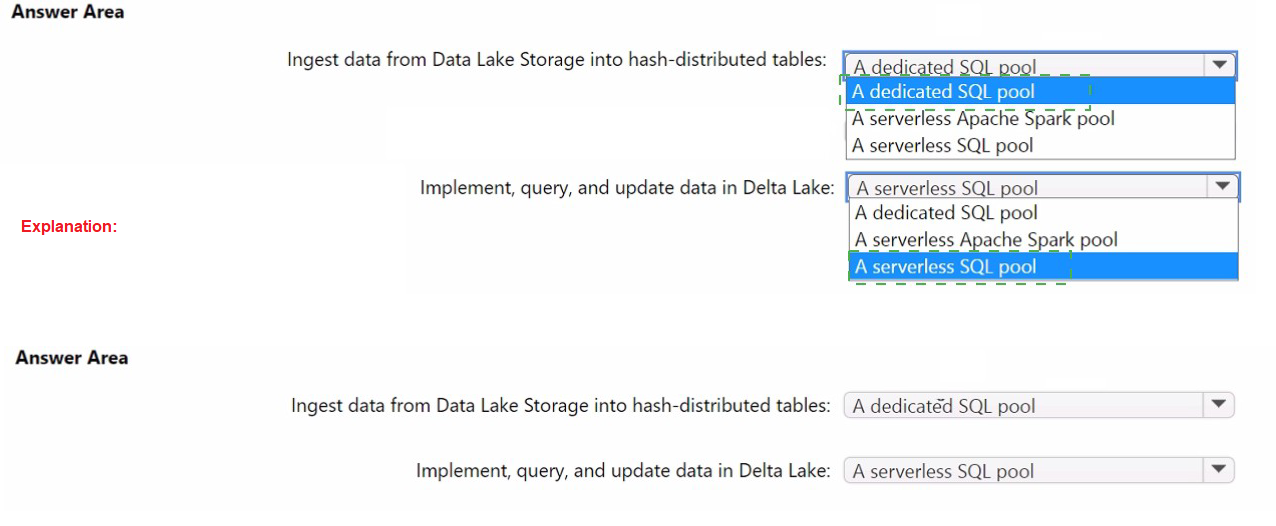
• Ingest data from Data Lake Storage into hash-distributed tables.
• Implement, query, and update data in Delta Lake.
What should you recommend for each requirement? To answer, select the appropriate options in the answer area. NOTE: Each correct selection is worth one point.

Explanation:
The two requirements map to distinct Synapse pools based on their optimized workloads.
Hash-distributed tables are a core feature of dedicated SQL pools (formerly SQL DW), designed for large-scale, structured data warehousing with high-performance queries using Massively Parallel Processing (MPP).
Delta Lake operations (CREATE, UPDATE, MERGE) require the transactional engine that writes to the Delta transaction log. In Synapse, this is natively provided by Spark pools, as Delta Lake is inherently part of the Apache Spark ecosystem.
Correct Options:
Ingest data from Data Lake Storage into hash-distributed tables:
A dedicated SQL pool
Hash-distributed tables are a defining feature of dedicated SQL pools (the data warehouse). The CREATE TABLE ... WITH (DISTRIBUTION = HASH) syntax and the PolyBase or COPY INTO commands used to ingest from Data Lake Storage are executed within this MPP engine.
Implement, query, and update data in Delta Lake:
A serverless Apache Spark pool
While you can query Delta Lake tables with both serverless SQL pools and Spark pools, the requirement to implement and update (i.e., perform DML operations like INSERT, UPDATE, MERGE) requires the Apache Spark engine. Spark pools provide the native transactional support for writing to Delta Lake tables.
Why the Other Options are Incorrect:
For Ingestion into Hash-Distributed Tables:
Serverless SQL pool / Spark pool:
These cannot create or manage permanent hash-distributed tables. Serverless SQL is for ad-hoc querying; Spark pools use Spark DataFrames/RDDs, not Synapse hash distribution.
For Implementing & Updating Delta Lake:
Dedicated SQL pool:
It can query external Delta tables via CETAS but has very limited support for performing UPDATE/MERGE operations on Delta Lake files. It is not the primary engine for Delta Lake DML.
Serverless SQL pool:
It is excellent for querying Delta Lake tables (T-SQL over Delta). However, it is read-only for Delta Lake; you cannot perform INSERT, UPDATE, or MERGE operations on Delta tables using serverless SQL pools.
Reference (Conceptual Alignment with AZ-305 Skills Outline):
This tests the "Design a data analytics solution" objective, specifically knowledge of the different Azure Synapse Analytics compute pools (Dedicated SQL, Serverless SQL, Spark) and their appropriate use cases for data transformation, warehousing, and lakehouse patterns.
| Page 10 out of 36 Pages |