Topic 5: Describe features of conversational AI workloads on Azure

Select the answer that correctly completes the sentence.




Explanation
The scenario describes ensuring a system behaves correctly when input data is incomplete or anomalous. This directly relates to building robust, dependable AI systems that perform safely even in unexpected or edge‑case conditions—the core aim of the reliability and safety principle. Handling missing or unusual values prevents the system from making erroneous or harmful predictions, thereby maintaining its operational integrity and safety.

Correct Option

Reliability and safety:
This responsible AI principle focuses on ensuring AI systems operate consistently, safely, and as intended across a wide range of conditions, including when input data is imperfect. Properly managing missing or unusual data is a fundamental engineering practice within this principle to avoid unreliable or unsafe outputs.

Incorrect Options

Inclusiveness:
This principle aims to address bias and ensure AI systems benefit all people equitably, regardless of background or ability. It does not specifically address data‑quality handling.

Privacy and security:
This principle concerns protecting data from unauthorized access and ensuring user privacy. While important, it is not about managing data anomalies for system reliability.

Transparency:
This principle focuses on making AI systems understandable and their decisions explainable to users. It does not directly deal with the technical handling of missing or unusual input values.

Reference
Microsoft’s Responsible AI principles document defines reliability and safety as requiring that AI systems behave reliably and safely under all conditions, including when processing imperfect or unexpected data. Techniques like data validation and robust error handling are implementations of this principle.

What is the maximum image size that can be processed by using the prebuilt receipt model in Azure Al Document Intelligence?

A. 5 MB

B. 10MB

C. 50 MB

D. 100 MB

D.   100 MB

Explanation
The question asks for the specific maximum file size limit for images processed by the prebuilt receipt model in Azure AI Document Intelligence (formerly Form Recognizer). These service limits are set to ensure processing performance and stability. For all prebuilt models (including Receipt, Invoice, ID, etc.), the documented maximum supported file size is 100 MB.

Correct Option

D. 100 MB:
This is the documented global maximum file size for documents (including images and PDFs) submitted for synchronous analysis to Azure AI Document Intelligence prebuilt models. Files larger than this limit will be rejected by the service.

Incorrect Options

A. 5 MB:
This is too low. While acceptable for many small images, it is not the maximum limit set by the service.

B. 10 MB:
This is also below the actual service limit. It may be a common size for typical receipts but is not the maximum.

C. 50 MB:
Although a large size, it is still below the officially documented maximum capacity of the service.

Reference
The official Microsoft Learn documentation for Azure AI Document Intelligence service limits states: "Maximum file size for synchronous (non‑async) requests: 100 MB for paid (S0) tiers." This applies to all prebuilt models, including the Receipt model.

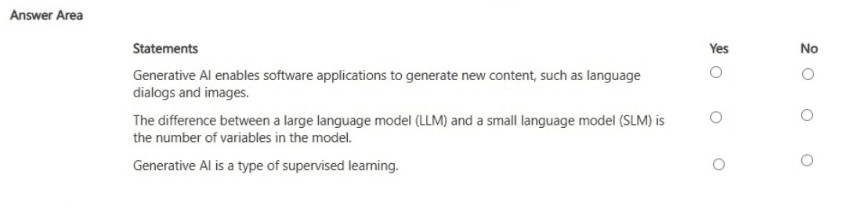
For each of the following statements, select Yes if the statement is true. Otherwise, select No.

NOTE: Each correct selection is worth one point.


Explanation
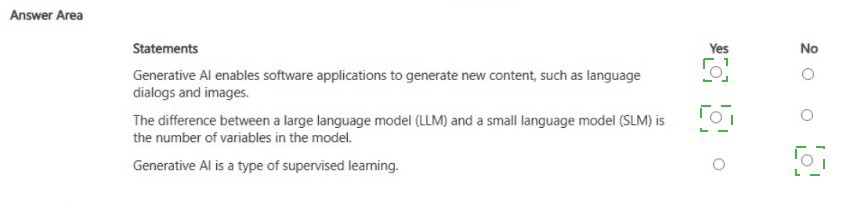
This set of statements tests fundamental knowledge of generative AI and language models. The answers depend on the core definitions: generative AI creates new content; LLMs are characterized by their vast parameter scale; and generative AI is not exclusively supervised learning—it often uses self‑supervised or unsupervised pre‑training.

Correct Options

Row 1 – Yes:
Generative AI is defined by its ability to create original content—such as text, images, code, or audio—that did not exist before, rather than just analyzing existing data. This is its primary distinction from discriminative AI.

Row 2 – Yes:
The primary distinction between a Large Language Model (LLM) and a Small Language Model (SLM) is the number of parameters (variables). LLMs have billions or trillions of parameters, enabling broad knowledge and complex reasoning, while SLMs have significantly fewer, making them faster and cheaper but with more limited capabilities.

Row 3 – No:
Generative AI is not exclusively a type of supervised learning. While some generative tasks can use supervised fine‑tuning, the foundational training of models like GPT or DALL‑E is typically self‑supervised (predicting the next token in a large corpus) or unsupervised, not reliant on labeled input‑output pairs in the traditional supervised sense.

Incorrect Options

Row 1 – No:
Incorrect. The defining capability of generative AI is novel content generation, not just analysis or classification.

Row 2 – No:
Incorrect. Parameter count is the key differentiating factor, not just training data size or use case.

Row 3 – Yes:
Incorrect. Labeling all generative AI as supervised learning misrepresents its core training methodologies.

Reference
Microsoft Learn AI‑900 materials define generative AI as systems that generate new content. The module on foundation models explains that LLMs are characterized by their massive scale of parameters, and that generative models are often pre‑trained in a self‑supervised manner on vast unlabeled datasets.

You need to predict the population size of a specific species of animal in an area.

Which Azure Machine Learning type should you use?

A. clustering

B. regression

C. classification

B.   regression

Explanation
The problem is to predict a continuous numeric value—the population size of a species. In machine learning, predicting a numeric quantity is a regression task. Regression models learn the relationship between input features (like habitat size, climate data, food sources) and a continuous target variable (population count) to make numeric predictions.

Correct Option

B. Regression:
This is the appropriate machine learning task type when the goal is to forecast a continuous numeric outcome, such as a count, price, temperature, or—in this case—animal population size. Azure Machine Learning's regression algorithms would be used to train a model for this purpose.

Incorrect Options

A. Clustering:
This is an unsupervised learning technique used to group similar data points together based on their features, not to predict a specific numeric value. It could be used to segment areas into different habitat types, but not to predict a population count.

C. Classification:
This task predicts a category or class label from a discrete set of possibilities (e.g., "endangered," "stable," "thriving"). While you could classify the population trend, the question explicitly asks to predict the size (a number), which requires regression.

Reference
Microsoft Learn AI‑900 documentation on "Machine Learning tasks" defines regression as used to predict a continuous numeric value, while classification predicts categories, and clustering groups data without pre‑defined labels.

Select the answer that correctly completes the sentence.




Explanation
The sentence describes using a random subset of data from a dataset to assess something about the model. In machine learning workflow, a randomly extracted subset of the full dataset is typically held back as a validation (or test) set. This independent subset is not used during training but is used to evaluate the model's performance, check for overfitting, and tune hyperparameters.

Correct Option

Validation:
A validation set is a randomly selected portion of the original dataset that is used to provide an unbiased evaluation of a model fit during the training phase. It is essential for assessing how well the model generalizes to new, unseen data.

Incorrect Options

Algorithms:
These are the mathematical procedures or models (like linear regression, decision trees) used for training. A data subset is not used "for algorithms."

Features:
These are the input variables or attributes used by the model to make predictions. A data subset contains features, but the subset itself is not "for features."

Labels:
These are the target outputs or true values the model is trying to predict in supervised learning. While a validation subset includes labels, the purpose of the subset is not "for labels" but for evaluation.

Reference
Microsoft Learn documentation on "Split data into training and testing sets" explains that data is typically divided into training, validation, and test sets. The validation set is used to tune model parameters and evaluate performance during development to prevent overfitting.

What is a form of unsupervised machine learning?

A. multiclass classification

B. clustering

C. binary classification

D. regression

B.   clustering

Explanation
This question tests the understanding of unsupervised machine learning, which is a type of learning where the model finds patterns and structures in data without using pre-labeled outcomes. Among the listed options, only clustering fits this definition, as it groups data points based on similarities without prior knowledge of categories.

Correct Option

B. Clustering:
This is a classic unsupervised learning technique. It involves grouping a set of data points so that items in the same cluster are more similar to each other than to those in other clusters. Common algorithms include K-Means and hierarchical clustering. It does not require labeled data.

Incorrect Options

A. Multiclass classification:
This is a supervised learning task where the model predicts one label from three or more possible categories (e.g., classifying an image as a cat, dog, or bird). It requires labeled training data.

C. Binary classification:
This is also a supervised learning task where the model predicts one of two possible classes (e.g., yes/no, spam/not spam). It requires labeled data.

D. Regression:
This is a supervised learning task used to predict a continuous numeric value (e.g., price, temperature). It requires labeled data with known target values.

Reference
Microsoft Learn AI‑900 materials categorize machine learning into supervised (using labeled data for classification and regression) and unsupervised (finding patterns without labels, such as clustering and association). The module explicitly lists clustering as a primary example of unsupervised learning.

What should you use to identify similar faces in a set of images?

A. Azure Al Vision

B. Azure Al Custom Vision

C. Azure Al Language

D. Azure OpenAI Service

A.   Azure Al Vision

Explanation
The task is to identify similar faces across a set of images. This is a specific computer vision capability known as face recognition, which involves detecting faces, analyzing their features, and comparing them for similarity. In the Azure AI stack, this functionality is provided by the Face service, which is part of the broader Azure AI Vision offering.

Correct Option

A. Azure AI Vision:
This service includes the Face API, which provides pre‑trained models for face detection, verification (matching two faces), identification (matching against a known group), and grouping similar faces. It is the direct, purpose‑built tool for this task.

Incorrect Options

B. Azure AI Custom Vision:
This service is for building custom image classification and object detection models by training on your own labeled images. It is not designed for out‑of‑the‑box face recognition or similarity grouping.

C. Azure AI Language:
This service is for text and natural language processing (sentiment analysis, entity recognition, etc.), not for analyzing visual content like faces.

D. Azure OpenAI Service:
This provides access to large language and generative AI models (like GPT) for text and code generation, and DALL‑E for image generation. It does not include specialized face recognition capabilities.

Reference
Microsoft Learn documentation for Azure AI Vision – Face service describes its ability to detect, recognize, and analyze human faces in images, including the Find Similar operation that retrieves a list of faces that are visually similar to a given query face from a face list or large face list.

What is an example of a regression model in machine learning?

A. dividing the student data in a dataset based on the age of the students and their educational achievements

B. identifying subtypes of spam email by examining a large collection of emails that were flagged by users

C. predicting the sale price of a house based on historical data, the size of the house, and the number of bedrooms in the house

D. identifying population counts of endangered animals by analyzing images

C.   predicting the sale price of a house based on historical data, the size of the house, and the number of bedrooms in the house

Explanation
The question asks for an example of a regression model. In machine learning, regression is a supervised learning technique used to predict a continuous numeric value (like price, temperature, or quantity) based on input features. The correct example must involve forecasting such a numeric outcome.

Correct Option

C. Predicting the sale price of a house based on historical data, the size of the house, and the number of bedrooms in the house.
This is a classic regression problem. The target variable (sale price) is a continuous number, and the model learns the relationship between input features (size, bedroom count, location, etc.) and that price to make numeric predictions.

Incorrect Options

A. Dividing student data based on age and educational achievements.
This describes clustering (an unsupervised learning task), where data is grouped by similarity without a predefined target. No continuous numeric value is being predicted.

B. Identifying subtypes of spam email by examining emails flagged by users.
This is a classification task (a type of supervised learning). The goal is to assign each email to a discrete category (subtype), not to predict a numeric value.

D. Identifying population counts of endangered animals by analyzing images.
While the output (population count) is numeric, this description emphasizes identifying/counting objects in images, which is typically a computer vision object detection or counting task. If framed as "predicting population size from environmental features," it could be regression, but as written, the primary method is image analysis, not a direct regression model.

Reference
Microsoft Learn AI‑900 materials define regression as a machine learning task used to predict a continuous value, with forecasting house prices given as a standard example. Classification is for predicting categories, and clustering is for grouping unlabeled data.

You need to identify street names based on street signs in photographs.

Which type of computer vision should you use?

A. object detection

B. optical character recognition (OCR)

C. image classification

D. facial recognition

A.   object detection

Explanation
This question asks which computer vision capability is best for identifying street names from street signs in photographs. While reading the text on the sign is an OCR task, the initial step of locating the sign itself within the photograph is essential. The most comprehensive solution here is a model that can both find the sign (object detection) and then read its text (OCR). Since the question focuses on identifying street names from signs, which inherently requires first detecting the sign object, and object detection models can be trained to recognize "street sign" as an object class, the primary required capability is object detection.

Correct Option

A. Object detection:
This is the most accurate choice. Object detection can identify and locate specific objects—like street signs—within an image by drawing bounding boxes around them. A specialized model could be trained to detect "street sign" as an object class. Once the sign is located, the cropped region can be passed to an OCR service to extract the text. The question's core task ("identify street names... in photographs") is fundamentally enabled by first detecting the sign object.

Incorrect Options

B. Optical character recognition (OCR):
While OCR is crucial for reading the text on the sign, it works best on a pre‑cropped image of the text. In a full photograph, OCR alone may fail because it must first find the text region. A pipeline would use object detection first to find the sign, then OCR to read it.

C. Image classification:
This assigns a single label to the entire image (e.g., "street scene"), but does not locate or identify specific objects like individual signs within the image.

D. Facial recognition:
This is a specialized technology for identifying or verifying human faces, completely unrelated to reading street signs.

Reference
Microsoft Learn documentation on computer vision tasks describes object detection as identifying and locating objects within an image. For scenarios like extracting information from signs or documents in photos, a common pattern is to combine object detection (to find regions of interest) with OCR (to extract text). The AI‑900 learning path reinforces that object detection is for locating multiple objects within an image.

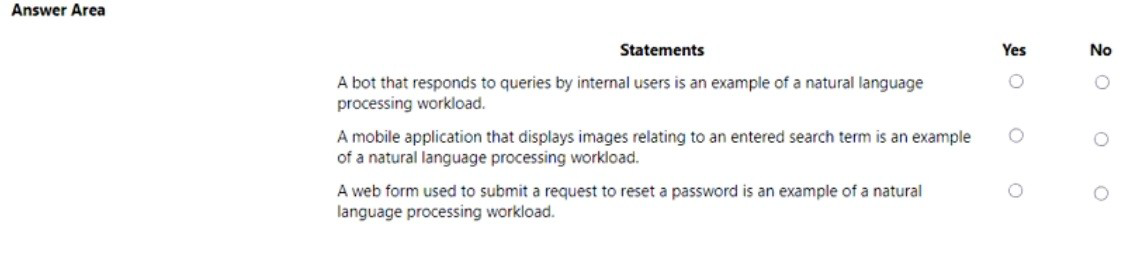
For each of the following statements, select Yes if the statement is true. Otherwise, select No. NOTE: Each correct selection is worth one point.


Explanation
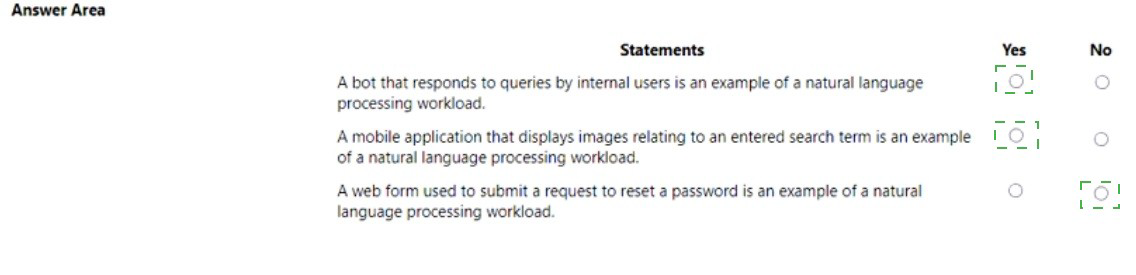
This set tests understanding of what constitutes a natural language processing (NLP) workload. An NLP workload involves AI systems that process, understand, or generate human language. If a system interacts with users using natural language (text or speech), it is an NLP workload. Simple graphical interfaces or image-based tasks without language understanding are not NLP.

Correct Options

Row 1 – Yes:
A bot that responds to user queries must understand the natural language in the query and generate a language‑based response. This is a core example of an NLP workload (often using services like Azure AI Language or the Bot Service with QnA).

Row 2 – Yes:
A mobile app that takes a search term (a text query in natural language) and returns relevant images involves understanding the user's intent and the semantics of the search query – an NLP task. The image retrieval itself is a separate step, but the query processing is NLP.

Row 3 – No:
A standard web form for password reset is a graphical user interface (GUI) form. The user fills out fields manually; there is no AI interpreting natural language. This is a traditional software form, not an NLP workload.

Incorrect Options

Row 1 – No:
Incorrect. Any conversational bot that processes user text or speech is definitively an NLP application.

Row 2 – No:
Incorrect. Processing a textual search query to understand user intent is a fundamental NLP task, even if the output is non‑textual (images).

Row 3 – Yes:
Incorrect. A static web form does not use AI to understand language; it is a simple data‑entry mechanism.

Reference:
Microsoft Learn AI‑900 content defines natural language processing as the AI capability that enables applications to understand, interpret, and respond to human language. Examples given include chatbots, search query understanding, translation, and sentiment analysis—all of which involve processing natural language input.

Page 3 out of 33 Pages