Topic 2: Describe fundamental principles of machine learning on Azure
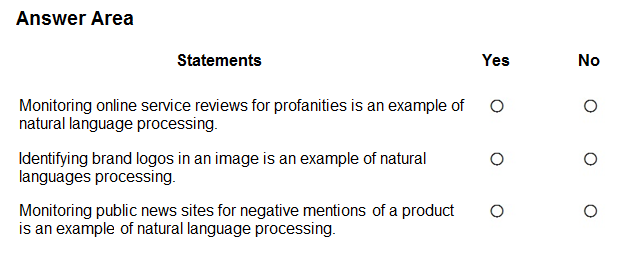
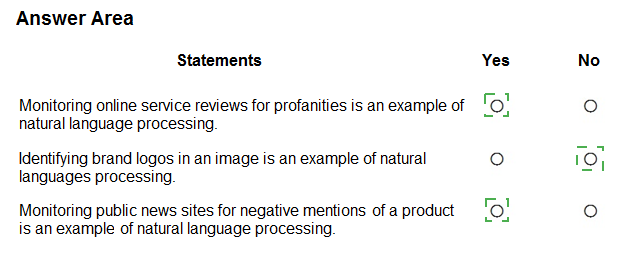
For each of the following statements, select Yes if the statement is true. Otherwise, select No.
NOTE: Each correct selection is worth one point.
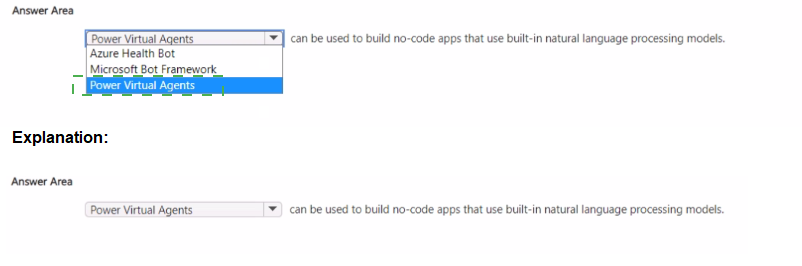
Select the answer that correctly completes the sentence.
You plan to apply Text Analytics API features to a technical support ticketing system.
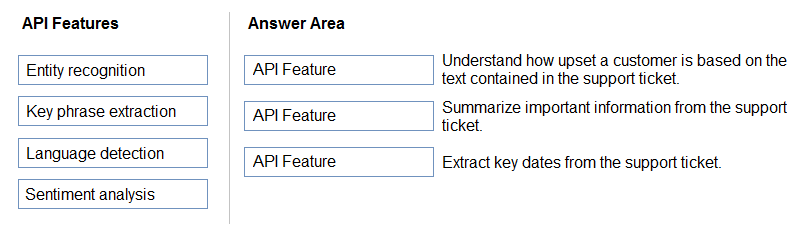
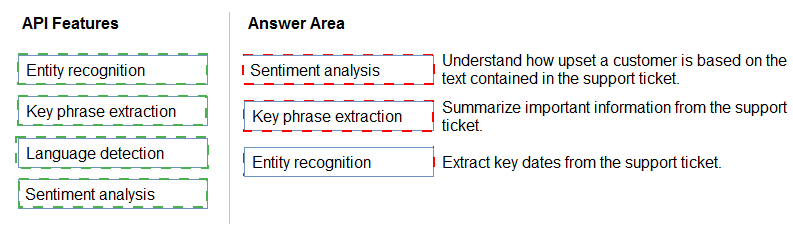
Match the Text Analytics API features to the appropriate natural language processing scenarios.
To answer, drag the appropriate feature from the column on the left to its scenario on the right. Each feature may be used once, more than once, or not at all.
NOTE: Each correct selection is worth one point.
Explanation:
Box1: Sentiment analysis
Sentiment Analysis is the process of determining whether a piece of writing is positive, negative or neutral.
Box 2: Broad entity extraction
Broad entity extraction: Identify important concepts in text, including key
Key phrase extraction/ Broad entity extraction: Identify important concepts in text, including key phrases and named entities such as people, places, and organizations.
Box 3: Entity Recognition
Named Entity Recognition: Identify and categorize entities in your text as people, places, organizations, date/time, quantities, percentages, currencies, and more. Well-known entities are also recognized and linked to more information on the web.
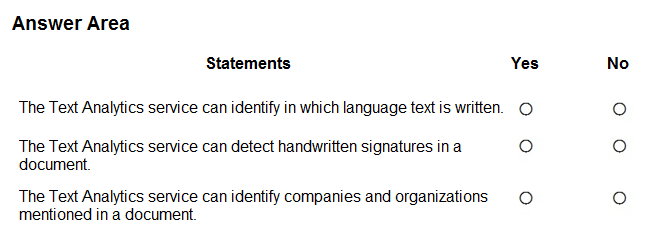
For each of the following statements, select Yes if the statement is true. Otherwise, select No.
NOTE: Each correct selection is worth one point.
Explanation:
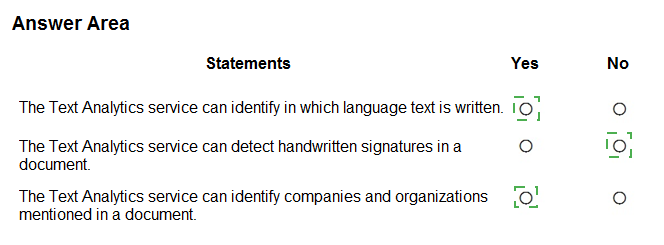
The Text Analytics API is a cloud-based service that provides advanced natural language processing over raw text, and includes four main functions: sentiment analysis, key phrase extraction, named entity recognition, and language detection.
Box 1: Yes
You can detect which language the input text is written in and report a single language code for every document submitted on the request in a wide range of languages, variants, dialects, and some regional/cultural languages. The language code is paired with a score indicating the strength of the score.
Box 2: No
Box 3: Yes
Named Entity Recognition: Identify and categorize entities in your text as people, places, organizations, date/time, quantities, percentages, currencies, and more. Well-known entities are also recognized and linked to more information on the web.
| Page 11 out of 33 Pages |