Topic 2: CoHo Vineyard and Winery Case Study


This is a case study. Case studies are not timed separately. You can use as much exam
time as you would like to complete each case. However, there may be additional case
studies and sections on this exam. You must manage your time to ensure that you are able
to complete all questions included on this exam in the time
provided.
To answer the questions included in a case study, you will need to reference information
that is provided in the case study. Case studies might contain exhibits and other resources.

that provide more information about the scenario that is described in the case study. Each
question is independent of the other questions in this case study.
At the end of this case study, a review screen will appear. This screen allows you to review
your answers and to make changes before you move to the next section of the exam. After
you begin a new section, you cannot return to this section.
To start the case study
To display the first question in this case study, dick the Next button. Use the buttons in the
left pane to explore the content of the case study before you answer the questions. Clicking
these buttons displays information such as business requirements, existing environment,
and problem statements. If the case study has an All Information tab, note that the
information displayed is identical to the information displayed on the subsequent tabs.
When you are ready to answer a question, dick the Question button to return to the
question.
Overview
CoHo Vineyard and Winery is based in the United States. The company has a single
vineyard. The company distributes full pallets of wine worldwide and sometimes sells wine
by using a private label. Grape growing and wine production operations are owned and
operated by a third-party company. The company uses bottles, accessories, and other
disposables from a company in China.
CoHo Vineyard and Winery opens a second location. This location manages inventory for
Wine Club members and includes a wine tasting room. The location also includes a
warehouse and distribution center.
The wine club currently has 200 members. The company hopes to increase this number.
The company holds events for club members in the tasting room and ships both full cases
and individual bottles to members. The tasting room is not treated as a retail store. All sales
to club members only and purchases must be made on-account.
Company structure
The following graphic shows the company structure:

Current environment
Coho Vineyard and Winery currently uses manual processes for most of its operations. The
company stores names and phone numbers for club members and prospective club
members in a Microsoft Excel workbook. The sales team currently tracks club membership
in a separate system. Sales team stock awards are granted on a three-year basis. The
solution for the sales Team cannot be replaced for three years.
• The types of wine, such as cabernet sauvignon and red blends are tracked as separate
items. Each item will have a year associated with it such as Red Blend 2017, 2018, 2019,
etc. The items are updated for the year association annually.
• Peak times for order entry could be in the hundreds. This typically happens when first and
second shift workers overlap and all users are on the system, as well as orders imported in.
• Packaging materials, bottles, and accessories are received in the warehouse FOB
Destination from the manufacturer in China.
• Each retailer has individual item numbers, barcode placement descriptions and other
additions such as pictures and details of the wine year and flavor notes.
CoHo Vineyard and Winery has outgrown their legacy ERP system and plans to implement
Dynamics 365 Finance. CoHo wants to use out-of-the-box tools which are linked to the
system where possible and not create new tools.
Licensing and organization
• Only the President/CEO, CFO, COO, Controller and VP Operations users must be able to
access finance and warehouse features.
• Warehouse users must only have access to warehouse function. All other users must
have access to finance functions.
• The distribution center must have mobile scanners for the warehouse. The tasting room
will not have mobile scanners.
• The inventory cost must be tracked separately by distribution center or tasting room.
Club membership events
• You must ensure the members created in their existing system are also customers in
Dynamics 365 Finance and that the customers do not exist in both systems under multiple
record numbers.
• When tasting events are planned, text notifications must be sent out to the club members.
• text notifications must sent out to non-club members to encourage the non-members to
join the club.
• During tasting events. CoHo will need access to place orders during the event but will not
have the need for cash registers.
Warehouse and shipping
• The system must be able to track inventory throughout the whole warehouse process.
• A Certificate of Origin must accompany each shipment.
• Private label items that are shipped to retailers must be stored and costed as a single
item number at CoHo.

• The system must be able to compare year-to-year performance of a single wine type.
Implementation
• Business processes must be documented as step-by-step processes and must align with
the process flows in a visual format
• Data will be migrated and is a requirement for order entry.
• Data migration must be completed prior to testing.
• You must track each step of process validation so that the users have ownership for their
individual functional areas. The tracking system used should be integrated with the system
where possible.
Issues
• Users are struggling to understand the new system's processes.
• CoHo is concerned that the go-live will may not go smoothly.

A company is implementing Dynamics 365 Supply Chain Management for multiple legal entities.

Each legal entity will be rolled out in a phased approach over a 24-month period. Some customizations will be required.

You need to define how to test Microsoft’s continuous updates throughout the implementation lifecycle.

What should you recommend?

A. Use the SysTest Framework in a build or test environment.

B. Use the Performance software development kit (Perf SDK) in a build or test environment.

C. Use the SysTest Framework in a production environment.

D. Use the Regression suite automation tool (RSAT) with DevOps in a build or test environment.

D.   Use the Regression suite automation tool (RSAT) with DevOps in a build or test environment.

Explanation:
This question assesses your knowledge of testing strategies for continuous updates in Dynamics 365 Supply Chain Management implementations. The scenario involves multiple legal entities rolling out over 24 months with customizations, requiring a robust approach to validate Microsoft's continuous updates throughout the implementation lifecycle without disrupting ongoing deployment activities.

Correct Option:

D. Use the Regression suite automation tool (RSAT) with DevOps in a build or test environment.
RSAT is specifically designed to test Microsoft's continuous updates by automating regression testing. When integrated with Azure DevOps, it allows teams to validate that customizations and configurations continue to work correctly after each Microsoft update. Running these tests in build or test environments ensures updates are validated before affecting production, providing confidence throughout the extended 24-month implementation.

Incorrect Option:

A. Use the SysTest Framework in a build or test environment.
While SysTest Framework is valuable for unit testing custom code during development, it is not designed for testing Microsoft's continuous updates. SysTest focuses on validating custom code logic at the method level, not on ensuring that the application behaves correctly after platform updates across multiple legal entities.

Incorrect Option:

B. Use the Performance software development kit (Perf SDK) in a build or test environment.
The Perf SDK is used for performance testing and benchmarking, not for validating functionality after Microsoft updates. While performance testing is important, it does not address the requirement of testing that customizations and configurations remain functional through continuous updates.

Incorrect Option:

C. Use the SysTest Framework in a production environment.
This option is incorrect for two reasons: SysTest Framework is not designed for testing Microsoft updates, and testing in production violates best practices. Production environments should never be used for validation testing, as it risks disrupting live operations and data integrity.

Reference:

Microsoft Learn: "Regression suite automation tool (RSAT) overview"

Microsoft Docs: "Testing strategy for Dynamics 365 implementations"

Microsoft Learn: "Continuous updates and regression testing in Dynamics 365"

A company plans to apply updates to a Dynamics 365 Finance environment. The environment has custom code.

You need to determine the impact of updates to the custom code. What is the impact?

A. Updates are runtime backward compatible only.

B. Updates are backward compatible from both a design time and runtime perspective.

C. Updates are design-time backward compatible only.

D. Updates are not backward compatible from either a design-time or runtime perspective.

B.   Updates are backward compatible from both a design time and runtime perspective.

Explanation:
This question tests your understanding of Microsoft's update compatibility policy for Dynamics 365 Finance, particularly concerning custom code. The scenario involves applying updates to an environment with customizations, requiring knowledge of how these updates affect existing custom code from both development and operational perspectives.

Correct Option:

B. Updates are backward compatible from both a design time and runtime perspective.
Microsoft ensures that all updates to Dynamics 365 Finance are backward compatible for both design-time (development) and runtime (execution) scenarios. This means custom code continues to compile in development environments and execute properly in production after updates. This commitment enables customers to apply updates confidently without breaking existing customizations, though regression testing is still recommended.

Incorrect Option:

A. Updates are runtime backward compatible only.
This option is incorrect because Microsoft maintains backward compatibility for both runtime execution and design-time development. If updates were only runtime compatible, developers could not recompile or modify custom code after updates without encountering breaking changes in the development environment.

Incorrect Option:

C. Updates are design-time backward compatible only.
This option is incorrect because runtime compatibility is equally important. Custom code must continue executing properly in production environments after updates. If updates were only design-time compatible, existing functionality would break when users attempt to run the application.

Incorrect Option:

D. Updates are not backward compatible from either a design-time or runtime perspective.
This option is completely incorrect as it contradicts Microsoft's fundamental update policy. Such an approach would make continuous updates impossible for customers with customizations, forcing them to choose between staying current with updates or maintaining custom functionality.

Reference:

Microsoft Learn: "Dynamics 365 Finance and Operations update policy"

Microsoft Docs: "Backward compatibility in Dynamics 365 updates"

Microsoft Learn: "Custom code and application lifecycle management"

You are designing a solution for a company. The solution will integrate with various data sources.
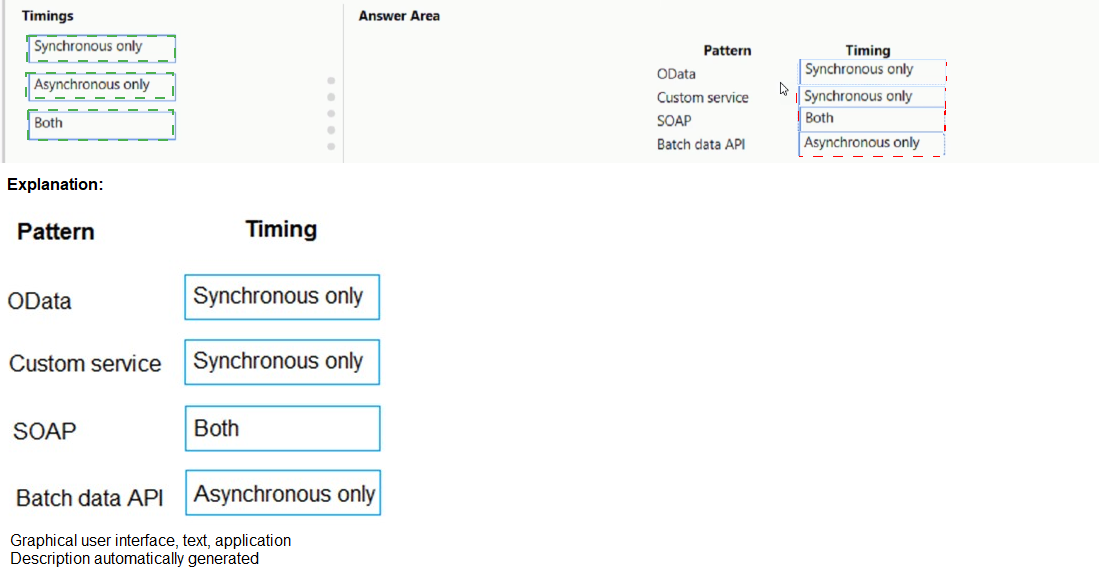
You need to recommend the correct timing for each integration pattern.
What should you recommend? To answer, drag the appropriate timings to the correct patterns. Each timing may be used once, more than once, or not at all. You may need to drag the split bar between panes or scroll to view content.
NOTE: Each correct selection is worth one point.



Explanation:
This question tests your knowledge of integration patterns and their appropriate timing mechanisms in Dynamics 365 Finance and Operations applications. Understanding whether each integration pattern supports synchronous, asynchronous, or both types of communication is essential for designing effective integration solutions that meet business requirements for real-time vs. background processing.

Correct Option Matching:

Pattern 1: OData

Timing: Both
OData (Open Data Protocol) is a RESTful API protocol that supports both synchronous and asynchronous operations. Synchronous requests are used for real-time data queries and small transactions, while asynchronous patterns can be implemented for longer-running operations or bulk data scenarios using deferred execution and callback mechanisms.

Pattern 2: Custom service

Timing: Both
Custom services in Dynamics 365 can be designed to support both synchronous and asynchronous timing depending on business requirements. Developers can implement custom service operations to execute synchronously for immediate responses or asynchronously for long-running processes by leveraging framework capabilities like batch processing and integration queues.

Pattern 3: SOAP

Timing: Both
SOAP (Simple Object Access Protocol) web services inherently support both synchronous and asynchronous communication patterns through WS-* specifications. While traditional SOAP implementations often use synchronous request-response, the protocol also supports asynchronous messaging through mechanisms like WS-Addressing and one-way operations.

Pattern 4: Batch data API

Timing: Asynchronous only
The Batch Data API in Dynamics 365 is specifically designed for asynchronous processing of large data volumes. It submits data for background processing through batch jobs and integration queues, providing status monitoring capabilities but not real-time responses. This pattern is optimized for high-volume data transfers where immediate feedback is not required.

Reference:
Microsoft Learn: "Integration patterns for Dynamics 365 Finance and Operations"

Microsoft Docs: "OData protocol implementation in Dynamics 365"

Microsoft Learn: "Custom service development and timing considerations"

Microsoft Docs: "SOAP services and asynchronous patterns"

Microsoft Learn: "Batch data API for high-volume integrations"

A company uses Dynamics 365 Finance and Dynamics 365 Supply Chain Management.
The company plans to continuously apply upgrades.
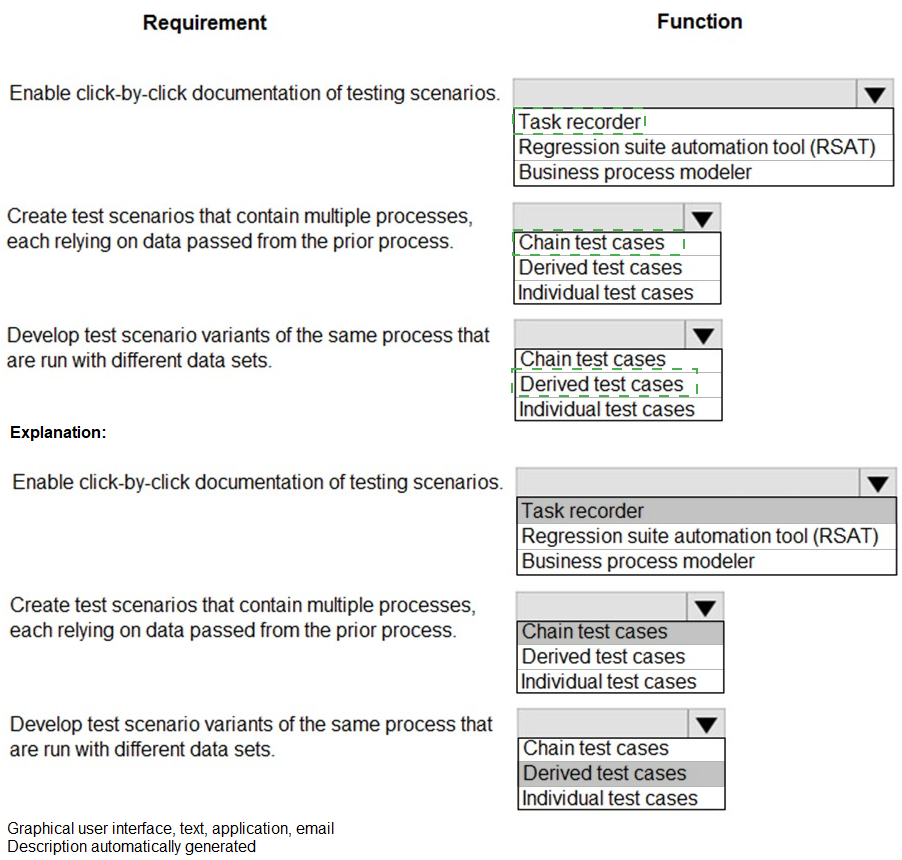
You need to determine which functions meet the requirements.
Which function meets each requirement? To answer, select the appropriate options in the answer area.
NOTE: Each correct selection is worth one point.



Explanation:
This question tests your knowledge of testing and documentation tools in Dynamics 365 Finance and Supply Chain Management. The scenario involves continuous upgrades, requiring proper test automation and documentation strategies. You need to match specific requirements with the appropriate functions from the available options.

Correct Option Matching:

Requirement 1: Enable click-by-click documentation of testing scenarios

Function: Task recorder
Task recorder captures every user interaction with the system, including clicks, data entry, and navigation, creating detailed step-by-step documentation. This is the primary tool for documenting business processes and testing scenarios in Dynamics 365, generating recordings that can be played back or used as training materials.

Requirement 2: Create test scenarios that contain multiple processes, each relying on data passed from the prior process

Function: Chain test cases
Chain test cases allow you to link multiple test cases together where the output or data from one test becomes the input for the next. This functionality is essential for testing end-to-end business processes that span multiple transactions and depend on data continuity.

Requirement 3: Develop test scenario variants of the same process that are run with different data sets

Function: Derived test cases
Derived test cases enable you to create multiple variations of a base test scenario, each configured with different data parameters. This allows testing the same business process under various conditions (different customers, products, quantities) without recreating the entire test logic.

Incorrect Options:

Regression suite automation tool (RSAT) - While RSAT is important for automating test execution, it does not provide click-by-click documentation functionality.

Business process modeler - This tool is used for designing and documenting business process flows, not for capturing detailed click-by-click testing steps.

Individual test cases - These are standalone tests without dependencies between them, not suitable for scenarios requiring data passed between processes.

Reference:

Microsoft Learn: "Task recorder in Finance and Operations apps"

Microsoft Docs: "Regression suite automation tool (RSAT) architecture"

Microsoft Learn: "Business process modeler (BPM) in Lifecycle Services"

Microsoft Learn: "Test case management and chaining strategies"

An organization is planning to migrate to Dynamics 365 Finance.
The organization reports that the legacy system has failed during peak sessions. You need to recommend an approach that will handle peak session volume.
Which two approaches should you recommend? Each correct answer presents part of the solution.
NOTE: Each correct selection is worth one point.

A. Use performance and load testing.

B. Configure a single box development environment.

C. Perform user integration testing.

D. Optimize server configuration.

A.   Use performance and load testing.
D.   Optimize server configuration.

Explanation:
This question assesses your knowledge of performance optimization strategies for Dynamics 365 Finance implementations, specifically addressing concerns about handling peak session volumes. The legacy system's failure during peak sessions indicates capacity and performance issues that must be addressed in the new solution through proper testing and configuration optimization.

Correct Option:

A. Use performance and load testing.
Performance and load testing is essential to validate that the Dynamics 365 Finance environment can handle expected peak session volumes. This testing simulates real-world user loads, identifies bottlenecks, and verifies system responsiveness under stress. It provides data-driven insights for capacity planning and ensures the solution meets performance requirements before go-live.

D. Optimize server configuration.
Server configuration optimization involves tuning various parameters including database settings, application server configurations, network components, and load balancing to maximize throughput during peak loads. This includes adjusting batch job schedules, optimizing connection pooling, and configuring proper resource allocation based on performance testing results.

Incorrect Option:

B. Configure a single box development environment.
A single-box development environment is intended for development and testing purposes only, not for handling production peak loads. It lacks the scalability, redundancy, and resources of a production environment. This recommendation does not address peak session volume requirements and would actually create a bottleneck.

Incorrect Option:

C. Perform user integration testing.
User integration testing (UAT) focuses on validating business processes and functionality, not on performance under peak loads. While UAT is critical for confirming that the system meets business requirements, it does not provide the load simulation or performance metrics needed to ensure the system can handle peak session volumes.

Reference:

Microsoft Learn: "Performance testing methodology for Dynamics 365"

Microsoft Docs: "Capacity planning and sizing for Finance and Operations"

Microsoft Learn: "Load testing strategies in Lifecycle Services"

Microsoft Docs: "Server configuration best practices for Dynamics 365"

You are an architect implementing Dynamics 365.

The Dynamics 365 administrator who manages deployments of components leaves the company. Microsoft Azure DevOps pipelines must be configured to automate deployments.

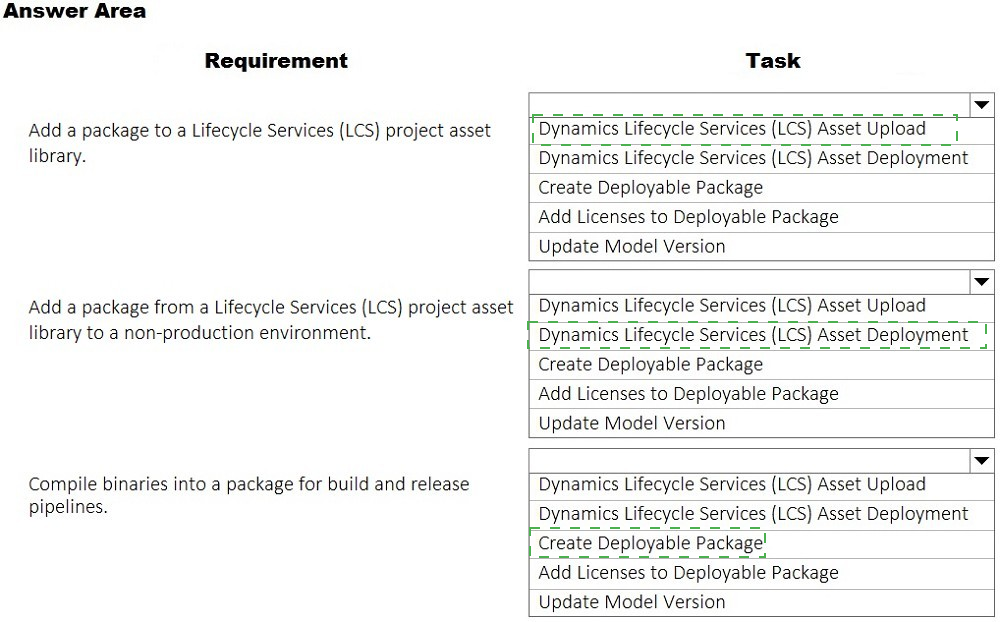
You need to recommend which Microsoft Azure DevOps pipeline tasks to use to meet the requirements. What should you recommend? To answer, select the appropriate options in the answer area.

NOTE: Each correct selection is worth one point.


Explanation:
This question tests your knowledge of Azure DevOps pipeline tasks for automating Dynamics 365 deployments. The scenario requires configuring DevOps pipelines after an administrator departure, focusing on package management tasks within Lifecycle Services (LCS) integration. You need to match specific deployment requirements with the appropriate Azure DevOps pipeline tasks.

Correct Option Matching:

Requirement 1: Add a package to a Lifecycle Services (LCS) project asset library.

Task: Dynamics Lifecycle Services (LCS) Asset Upload
This Azure DevOps pipeline task is specifically designed to upload deployable packages to the LCS project asset library. It automates the process of making packages available in LCS for subsequent deployment to environments, supporting continuous integration and delivery workflows.

Requirement 2: Add a package from a Lifecycle Services (LCS) project asset library to a non-production environment.

Task: Dynamics Lifecycle Services (LCS) Asset Deployment
This pipeline task handles the deployment of packages from the LCS asset library to target non-production environments (sandbox, UAT, build, or test environments). It automates the application of updates and customizations to environments through LCS integration.

Requirement 3: Compile binaries into a package for build and release pipelines.

Task: Create Deployable Package
This task compiles the source code and binaries into a deployable package format that can be uploaded to LCS. It is a critical step in build pipelines that transforms development artifacts into deployment-ready packages following Microsoft's packaging standards.

Incorrect Options:

Add Licenses to Deployable Package -
This task is not a standard Azure DevOps pipeline task for Dynamics 365 deployments. License management is typically handled separately through LCS or partner sources.

Update Model Version -
While model versioning is important in development, this is not a dedicated Azure DevOps pipeline task for the specified requirements. Version updates are usually managed through source control and build configuration.

Reference:

Microsoft Learn: "Azure DevOps tasks for Dynamics 365 Finance and Operations"

Microsoft Docs: "Lifecycle Services (LCS) integration with Azure DevOps"

Microsoft Learn: "Create and manage deployable packages in Dynamics 365"

Microsoft Docs: "Automate deployments using LCS Asset Deployment task"

An organization is implementing Dynamics 365 Finance.
The organization uses financial reports including detailed balance information in local currencies for all accounts. Reports must include general ledger account number and journal entry line description.
You need to recommend a report that meets the requirements.
Which report should you recommend?

A. Detailed Trial Balance

B. Summary Trial Balance

C. Balance Sheet

D. Cash Flow

A.   Detailed Trial Balance

Explanation:
This question tests your knowledge of financial reporting capabilities in Dynamics 365 Finance. The requirements specify detailed balance information in local currencies, including general ledger account numbers and journal entry line descriptions. Understanding the specific data elements available in each standard report is essential for meeting detailed financial reporting needs.

Correct Option:

A. Detailed Trial Balance
The Detailed Trial Balance report provides comprehensive account information including general ledger account numbers, journal entry details, and line descriptions. It displays opening balances, period activity, and closing balances at the transaction level, with support for local currency reporting. This report meets all requirements by showing detailed balance information with the specified account number and journal entry description fields.

Incorrect Option:

B. Summary Trial Balance
The Summary Trial Balance provides account balances aggregated at the account level without journal entry line details or descriptions. While it shows account numbers and balances in local currency, it does not include the required journal entry line descriptions, making it insufficient for the detailed reporting needs specified.

Incorrect Option:
C. Balance Sheet
The Balance Sheet is a standard financial statement that shows asset, liability, and equity account balances at a summary level. It presents ending balances but does not provide journal entry line descriptions or detailed transaction information. This report is designed for high-level financial position reporting, not detailed transaction analysis.

Incorrect Option:

D. Cash Flow
The Cash Flow statement reports on cash inflows and outflows from operating, investing, and financing activities. It does not provide general ledger account numbers or journal entry line descriptions, and it focuses specifically on cash-related transactions rather than detailed balance information for all accounts.

Reference:

Microsoft Learn: "Financial reporting in Dynamics 365 Finance"

Microsoft Docs: "Trial balance reports in Dynamics 365"

Microsoft Learn: "Detailed vs. summary trial balance reporting options"

Microsoft Docs: "Financial statement design and generation"

Note: This question is part of a series of questions that present the same scenario.

Each question in the series contains a unique solution that might meet the stated goals. Some question sets might have more than one correct solution, while others might not have a correct solution.

After you answer a question in this section, you will NOT be able to return to it. As a result, these questions will not appear in the review screen.

A company is planning to implement Dynamics 365 Supply Chain Management with three locations. Two locations must use United States currency (USD) as the default currency.

The third location must use Canadian currency (CAD).

One US facility and the Canadian facility must use advanced warehouse functionality. The other US facility must use basic warehousing.

You need to configure the legal entity, site, and warehouse architecture to meet the requirements.

Solution: Create two legal entities, one for advanced warehouse and one for basic warehouse.

Does the solution meet the goal?

A. Yes

B. No

B.   No

Explanation:
This question continues testing your knowledge of organizational architecture in Dynamics 365 Supply Chain Management. The scenario involves three facilities with specific currency and warehouse functionality requirements. The proposed solution suggests creating legal entities based on warehouse functionality level rather than currency requirements or facility locations.

Correct Option:

B. No
Creating legal entities based on warehouse functionality (advanced vs. basic) does not meet the currency requirements. One legal entity would contain both the advanced warehouse US facility and the basic warehouse US facility, which share USD currency - this part works. However, the Canadian facility requiring CAD would be in either legal entity, causing currency conflicts. The Canadian facility cannot share a legal entity with US facilities using USD as default currency.

Incorrect Option:

A. Yes
This option is incorrect because the solution fails to properly address the currency requirement. By organizing legal entities around warehouse functionality, the Canadian facility would be forced into a legal entity with USD as the default currency, or both legal entities would need to support multiple default currencies, which is not possible. The architecture must first address the currency requirement through separate legal entities for USD and CAD.

Reference:

Microsoft Learn: "Legal entity design considerations for multi-currency environments"

Microsoft Docs: "Warehouse management configuration across legal entities"

Microsoft Learn: "Organizational architecture best practices in Supply Chain Management"

A professional services company implements Dynamics 365 Finance using the FastTrack Success by Design framework.

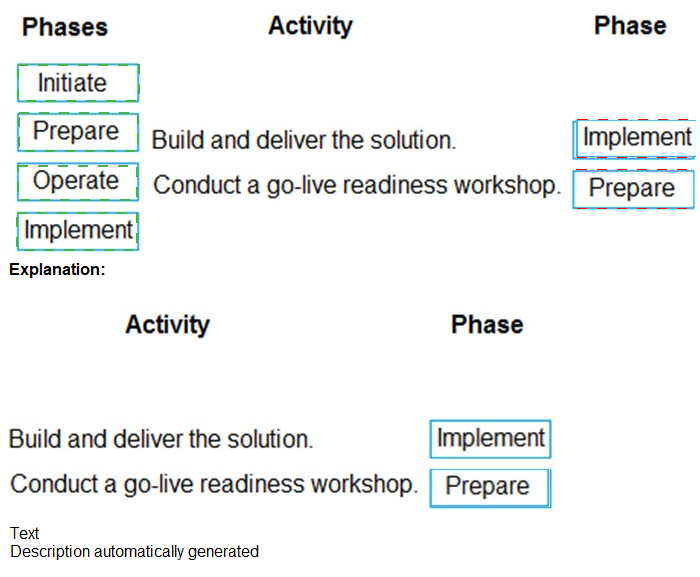
You need to describe the various phases of the implementation to company stakeholders.

In which phase is the activity performed? To answer, drag the appropriate phases to the correct activities. Each phase may be used once, more than once, or not at all. You may need to drag the split bar between panes or scroll to view content.

NOTE: Each correct selection is worth one point.


Explanation:
This question tests your knowledge of the FastTrack Success by Design implementation framework phases for Dynamics 365 Finance. The framework consists of four main phases: Initiate, Prepare, Implement, and Operate. Understanding which activities occur in each phase is essential for effectively communicating the implementation journey to stakeholders.

Correct Option Matching:

Activity 1: Build and deliver the solution

Phase: Implement
The Implement phase is where the actual solution development, configuration, and delivery occur. During this phase, the team builds the solution according to the design specifications, performs development and configuration work, conducts testing, and prepares the system for deployment. This is the core execution phase of the implementation.

Activity 2: Conduct a go-live readiness workshop

Phase: Implement
The go-live readiness workshop is a critical activity conducted during the Implement phase, typically just before production deployment. This workshop assesses the solution's readiness, validates that all prerequisites are met, reviews cutover plans, and ensures the organization is prepared for the transition to the new system.

Incorrect Options:

Initiate - This phase focuses on project kickoff, team formation, objective setting, and high-level planning. Build activities and go-live readiness occur later.

Prepare - This phase involves detailed requirements gathering, solution design, and environment provisioning. While planning for build occurs here, actual building happens in Implement.

Operate - This post-go-live phase focuses on production support, monitoring, optimization, and ongoing maintenance activities after the solution is live.

Reference:

Microsoft Learn: "FastTrack Success by Design framework for Dynamics 365"

Microsoft Docs: "Dynamics 365 implementation lifecycle phases"

Microsoft Learn: "Go-live readiness assessment in Success by Design"

You need to ensure that the customer records remain synchronized in both systems.

What should you recommend?

A. Write a Power Bl report

B. Integrate the third-party application into Dynamics 365 Finance

C. Replace the sales system with Dynamics 365 Sales

D. Use Microsoft Power Automate

B.   Integrate the third-party application into Dynamics 365 Finance

Explanation:
This question tests your understanding of integration strategies for synchronizing customer records between Dynamics 365 Finance and external systems. The requirement focuses on ensuring data consistency across platforms, which requires a robust integration approach rather than reporting tools or application replacement.

Correct Option:

B. Integrate the third-party application into Dynamics 365 Finance.
Integrating the third-party application directly with Dynamics 365 Finance establishes a bi-directional synchronization mechanism for customer records. This approach ensures that changes in either system are reflected in the other, maintaining data consistency. Integration can be achieved through various methods including OData endpoints, custom services, or middleware platforms, providing a sustainable long-term solution for data synchronization.

Incorrect Option:

A. Write a Power BI report.
Power BI is a reporting and analytics tool, not a data synchronization solution. While it can display data from multiple sources, it cannot write back to either system or keep records synchronized. This recommendation addresses data visualization but completely fails to meet the synchronization requirement.

Incorrect Option:

C. Replace the sales system with Dynamics 365 Sales.
Replacing the existing sales system is an extreme and unnecessary approach to solving a data synchronization problem. This would require significant time, cost, and business disruption when a simpler integration solution exists. The requirement is to synchronize data, not to replace functional systems.

Incorrect Option:

D. Use Microsoft Power Automate.
While Power Automate can facilitate some integration scenarios, it is not the optimal recommendation for enterprise-grade customer record synchronization. Power Automate is better suited for simple, event-driven workflows and may not handle complex data mapping, error handling, and high-volume synchronization requirements effectively compared to a proper integration solution.

Reference:

Microsoft Learn: "Integration patterns for Dynamics 365 Finance"

Microsoft Docs: "Data synchronization strategies between Dynamics 365 applications"

Microsoft Learn: "Third-party application integration with Dynamics 365"

Page 2 out of 11 Pages