Topic 3, Mix Questions

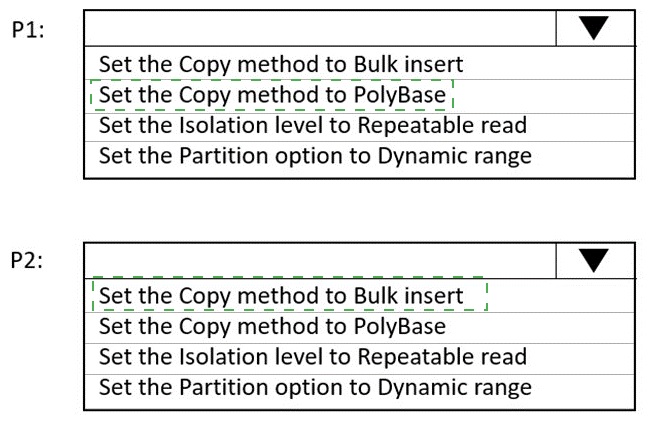
You have an Azure Data Factory instance named ADF1 and two Azure Synapse Analytics
workspaces named WS1 and WS2.
ADF1 contains the following pipelines:
P1: Uses a copy activity to copy data from a nonpartitioned table in a dedicated
SQL pool of WS1 to an Azure Data Lake Storage Gen2 account
P2: Uses a copy activity to copy data from text-delimited files in an Azure Data
Lake Storage Gen2 account to a nonpartitioned table in a dedicated SQL pool of
WS2
You need to configure P1 and P2 to maximize parallelism and performance.
Which dataset settings should you configure for the copy activity if each pipeline? To
answer, select the appropriate options in the answer area.
NOTE: Each correct selection is worth one point.

You have an Azure Data Factory instance that contains two pipelines named Pipeline1 and Pipeline2. Pipeline1 has the activities shown in the following exhibit.
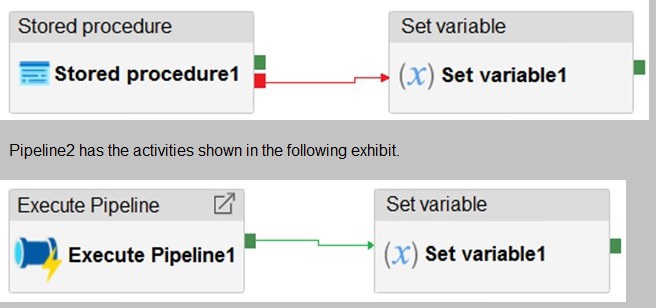
You execute Pipeline2, and Stored procedure1 in Pipeline1 fails.
What is the status of the pipeline runs?

A.

Pipeline1 and Pipeline2 succeeded.

B.

Pipeline1 and Pipeline2 failed.

C.

Pipeline1 succeeded and Pipeline2 failed.

D.

Pipeline1 failed and Pipeline2 succeeded

A.   

Pipeline1 and Pipeline2 succeeded.


Explanation:
Activities are linked together via dependencies. A dependency has a condition of one of the
following: Succeeded, Failed, Skipped, or Completed.
Consider Pipeline1:
If we have a pipeline with two activities where Activity2 has a failure dependency on
Activity1, the pipeline will not fail just because Activity1 failed. If Activity1 fails and Activity2
succeeds, the pipeline will succeed. This scenario is treated as a try-catch block by Data
Factory.
Waterfall chart
Description automatically generated with medium confidence
The failure dependency means this pipeline reports success.
Note:
If we have a pipeline containing Activity1 and Activity2, and Activity2 has a success
dependency on Activity1, it will only execute if Activity1 is successful. In this scenario, if
Activity1 fails, the pipeline will fail.
Reference:
https://datasavvy.me/category/azure-data-factory/

You plan to create an Azure Data Factory pipeline that will include a mapping data flow.
You have JSON data containing objects that have nested arrays.
You need to transform the JSON-formatted data into a tabular dataset. The dataset must
have one tow for each item in the arrays.
Which transformation method should you use in the mapping data flow?

A.

unpivot

B.

flatten

C.

new branch

D.

alter row

B.   

flatten


You need to design a solution that will process streaming data from an Azure Event Hub and output the data to Azure Data Lake Storage. The solution must ensure that analysts can interactively query the streaming data.
What should you use?

A.

event triggers in Azure Data Factory

B.

BAzure Stream Analytics and Azure Synapse notebooks

C.

Structured Streaming in Azure Databricks

D.

Azure Queue storage and read-access geo-redundant storage (RA-GRS)

B.   

BAzure Stream Analytics and Azure Synapse notebooks


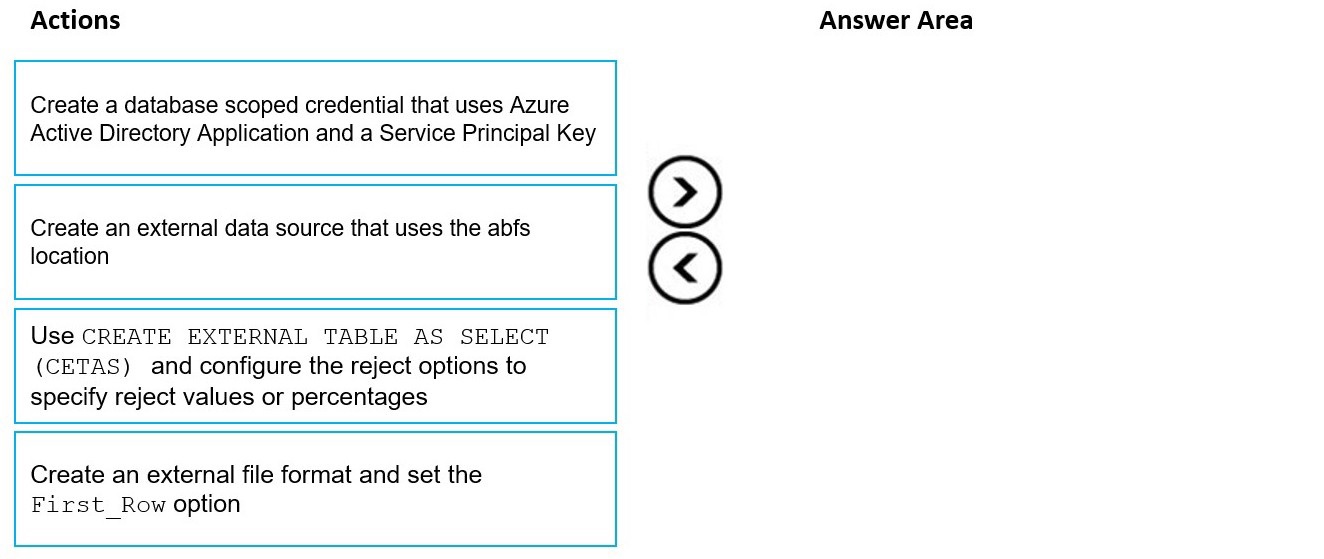
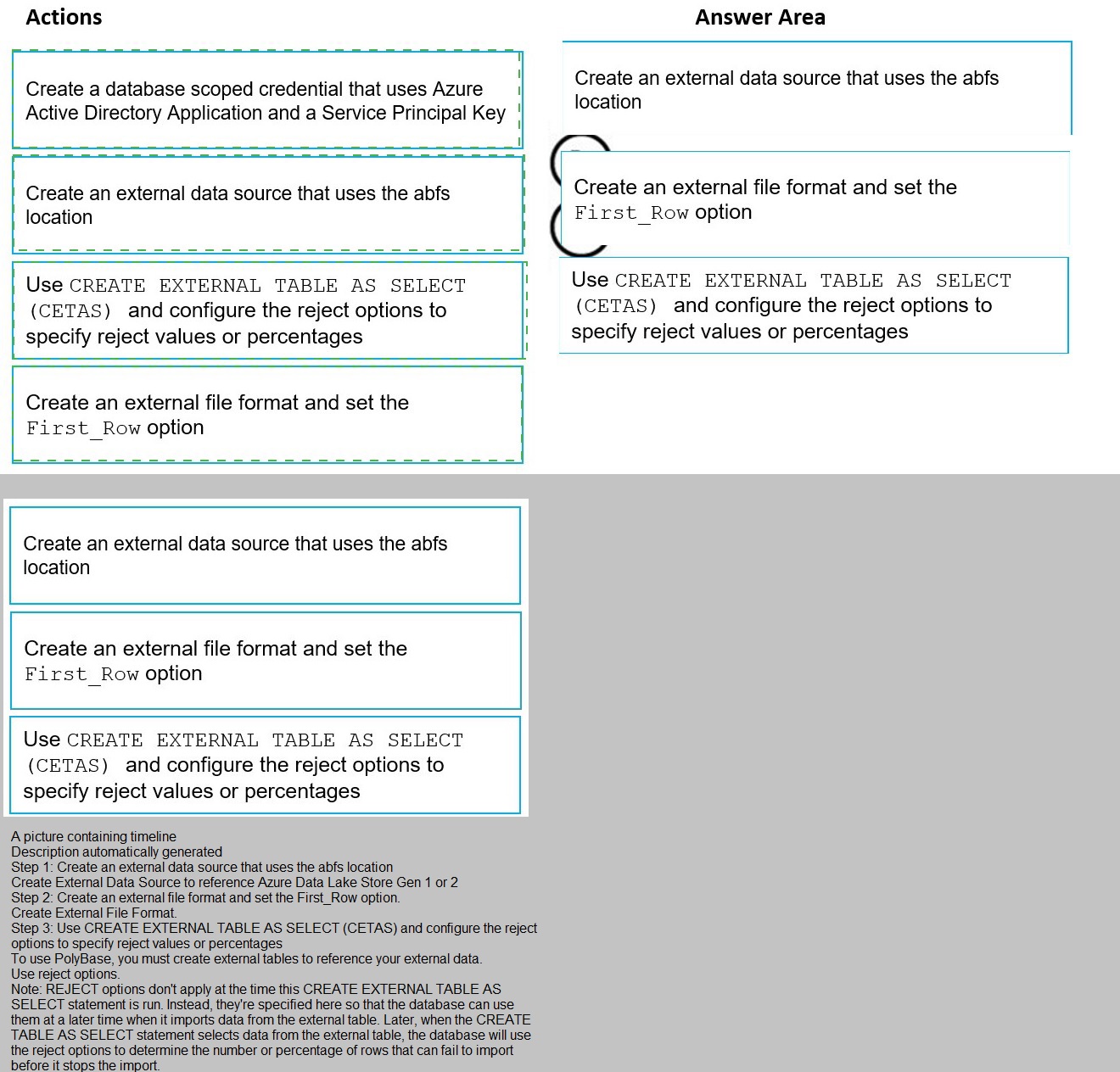
You have data stored in thousands of CSV files in Azure Data Lake Storage Gen2. Each
file has a header row followed by a properly formatted carriage return (/r) and line feed (/n).
You are implementing a pattern that batch loads the files daily into an enterprise data
warehouse in Azure Synapse Analytics by using PolyBase.
You need to skip the header row when you import the files into the data warehouse. Before
building the loading pattern, you need to prepare the required database objects in Azure Synapse Analytics.
Which three actions should you perform in sequence? To answer, move the appropriate
actions from the list of actions to the answer area and arrange them in the correct order.
NOTE: Each correct selection is worth one point
A company has a real-time data analysis solution that is hosted on Microsoft Azure. The
solution uses Azure Event Hub to ingest data and an Azure Stream Analytics cloud job to
analyze the data. The cloud job is configured to use 120 Streaming Units (SU).
You need to optimize performance for the Azure Stream Analytics job.
Which two actions should you perform? Each correct answer presents part of the solution.
NOTE: Each correct selection is worth one point.

A.

Implement event ordering.

B.

Implement Azure Stream Analytics user-defined functions (UDF).

C.

Implement query parallelization by partitioning the data output.

D.

Scale the SU count for the job up.

E.

Scale the SU count for the job down.

F.

Implement query parallelization by partitioning the data input

D.   

Scale the SU count for the job up.


F.   

Implement query parallelization by partitioning the data input


Reference:
https://docs.microsoft.com/en-us/azure/stream-analytics/stream-analytics-parallelization

You are monitoring an Azure Stream Analytics job.
You discover that the Backlogged Input Events metric is increasing slowly and is
consistently non-zero.
You need to ensure that the job can handle all the events.
What should you do?

A.

Change the compatibility level of the Stream Analytics job.

B.

Increase the number of streaming units (SUs).

C.

Remove any named consumer groups from the connection and use $default.

D.

Create an additional output stream for the existing input stream

B.   

Increase the number of streaming units (SUs).


Explanation:
Backlogged Input Events: Number of input events that are backlogged. A non-zero value
for this metric implies that your job isn't able to keep up with the number of incoming
events. If this value is slowly increasing or consistently non-zero, you should scale out your
job. You should increase the Streaming Units.
Note: Streaming Units (SUs) represents the computing resources that are allocated to
execute a Stream Analytics job. The higher the number of SUs, the more CPU and memory
resources are allocated for your job.
Reference:
https://docs.microsoft.com/bs-cyrl-ba/azure/stream-analytics/stream-analytics-monitoring

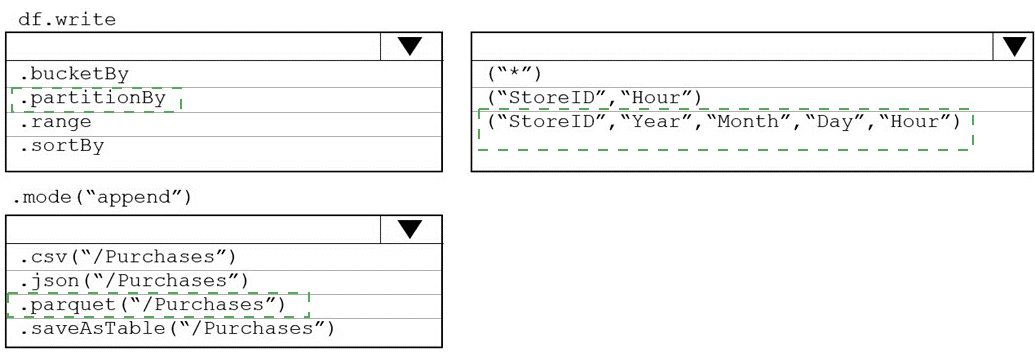
You plan to develop a dataset named Purchases by using Azure databricks Purchases will
contain the following columns:
• ProductID
• ItemPrice
• lineTotal
• Quantity
• StorelD
• Minute
• Month
• Hour
• Year
• Day
You need to store the data to support hourly incremental load pipelines that will vary for
each StoreID. the solution must minimize storage costs. How should you complete the
rode? To answer, select the appropriate options In the answer area.
NOTE: Each correct selection is worth one point.

You have an Azure Data Factory pipeline that performs an incremental load of source data
to an Azure Data Lake Storage Gen2 account.
Data to be loaded is identified by a column named LastUpdatedDate in the source table.
You plan to execute the pipeline every four hours.
You need to ensure that the pipeline execution meets the following requirements:
Automatically retries the execution when the pipeline run fails due to concurrency
or throttling limits.
Supports backfilling existing data in the table.
Which type of trigger should you use?

A.

event

B.

on-demand

C.

schedule

D.

tumbling window

D.   

tumbling window


Explanation:
In case of pipeline failures, tumbling window trigger can retry the execution of the
referenced pipeline automatically, using the same input parameters, without the user
intervention. This can be specified using the property "retryPolicy" in the trigger definition.
Reference:
https://docs.microsoft.com/en-us/azure/data-factory/how-to-create-tumbling-window-trigger

You have an Azure Synapse Analytics dedicated SQL pool.
You run PDW_SHOWSPACEUSED(dbo,FactInternetSales’); and get the results shown in the following table.
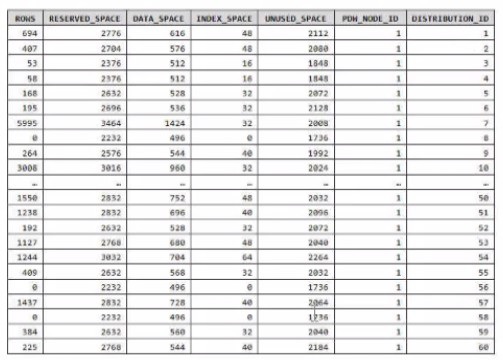
Which statement accurately describes the dbo,FactInternetSales table?

A.

The table contains less than 1,000 rows.

B.

All distribution contain data.

C.

The table is skewed.

D.

The table uses round-robin distribution.

C.   

The table is skewed.


Explanation:
Data skew means the data is not distributed evenly across the distributions.
Reference:
https://docs.microsoft.com/en-us/azure/synapse-analytics/sql-data-warehouse/sql-datawarehouse-
tables-distribute

Page 7 out of 21 Pages