Topic 3, Mix Questions
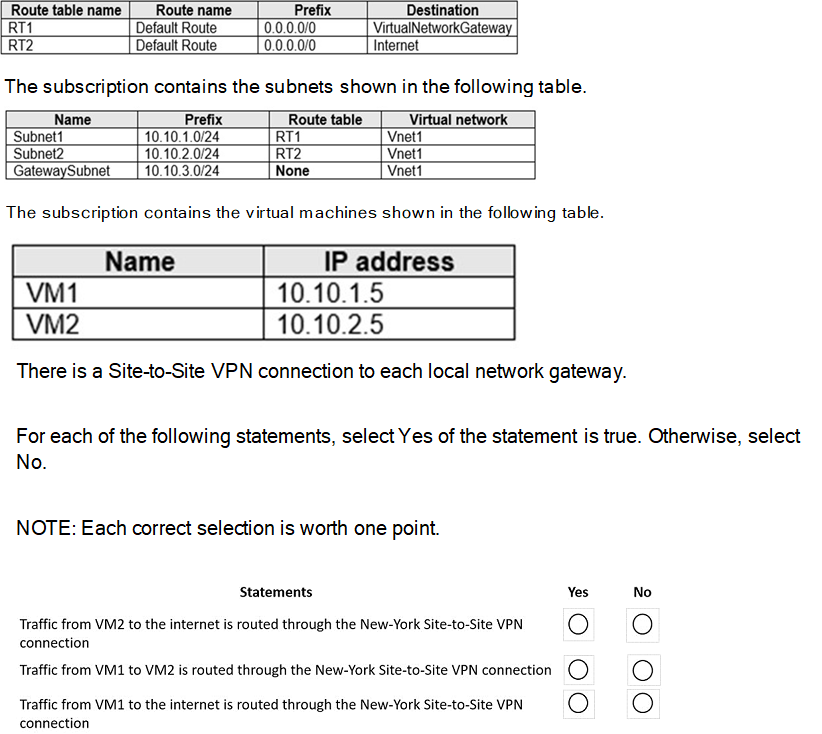
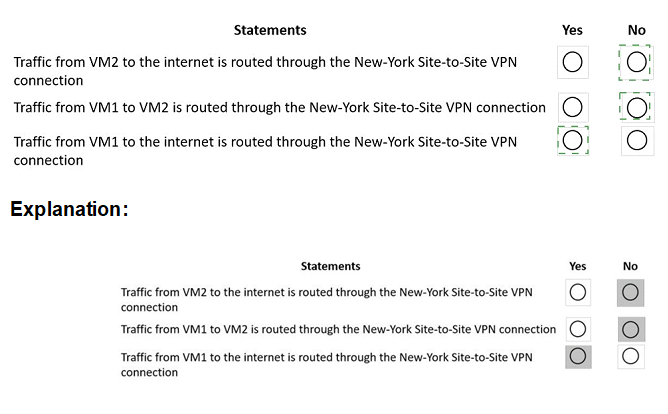
You have an Azure subscription that contains the route tables and routes shown in the following table.
Your company, named Contoso, Ltd, has an Azure subscription that contains the resources show in the following table.

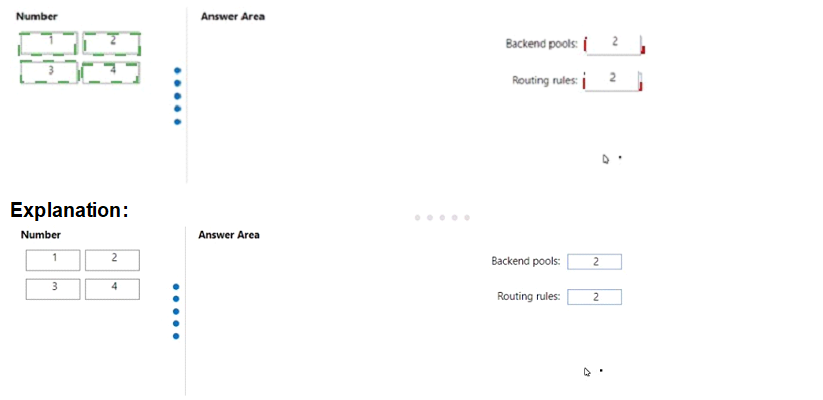
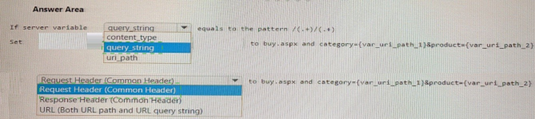
You have an Azure application gateway named AppGw1.
You need to create a rewrite rule for AppGw1. The solution must rewrite the URL of requests from https://www.contoso.com/fashion/shirts to ttps://www.contoso.com/buy.aspx?category-fashion&product=shirts.
How should you complete the rule? To answer NOTE: Each correct selection is worth one point appropriate options in the answer area.

You have two Azure virtual networks named Vnet1 and Vnet2.
You have a Windows 10 device named Client1 that connects to Vnet1 by using a Point-to- Site (P2S) IKEv2 VPN. You implement virtual network peering between Vnet1 and Vnet2. Vnet1 allows gateway transit Vnet2 can use the. You discover that Client1 cannot communicate with Vnet2.
You need to ensure that Client1 can communication with Vnet2. Solution: You resize the gateway of Vnet1 to a larger SKU. Does this meet the goal?
A.
Yes
B.
No
No
You have an Azure virtual network named Vnet1 and an on-premises network.
The on-premises network has policy-based VPN devices. In Vnet1, you deploy a virtual network gateway named GW1 that uses a SKU of VpnGw1 and is route-based.
You have a Site-to-Site VPN connection for GW1 as shown in the following exhibit.

You need to ensure that the on-premises network can connect to the route-based GW1. What should you do before you create the connection?
A.
Set Use Azure Private IP Address to Enabled
B.
Set IPsec / IKE policy to Custom.
C.
Set Connection Mode to ResponderOnly
D.
Set BGP to Enabled
Set Use Azure Private IP Address to Enabled
You have the Azure environment shown in the exhibit.

VM1 is a virtual machine that has an instance-level public IP address (ILPIP).
Basic Load Balancer uses a public IP address. VM1 and VM2 are in the backend pool. NAT Gateway uses a public IP address named IP3 that is associated to SubnetA.
VNet1 has a virtual network gateway that has a public IP address named IP4.
When initiating outbound traffic to the internet from VM1, which public address is used?
A.
IP1
B.
IP2
C.
IP3
D.
IP4
IP1
Note: This question is part of a series of questions that present the same scenario. Each question in the series contains a unique solution that might meet the stated goals. Some question sets might have more than one correct solution, while others might not have a correct solution.
After you answer a question in this section, you will NOT be able to return to it. As a result, these questions will not appear in the review screen.
You have two Azure virtual networks named Vnet1 and Vnet2.
You have a Windows 10 device named Client1 that connects to Vnet1 by using a Point-to- Site (P2S) IKEv2 VPN.
You implement virtual network peering between Vnet1 and Vnet2. Vnet1 allows gateway transit. Vnet2 can use the remote gateway.
You discover that Client1 cannot communicate with Vnet2. You need to ensure that Client1 can communicate with Vnet2.
Solution: You download and reinstall the VPN client configuration. Does this meet the goal?
A.
Yes
B.
No
Yes
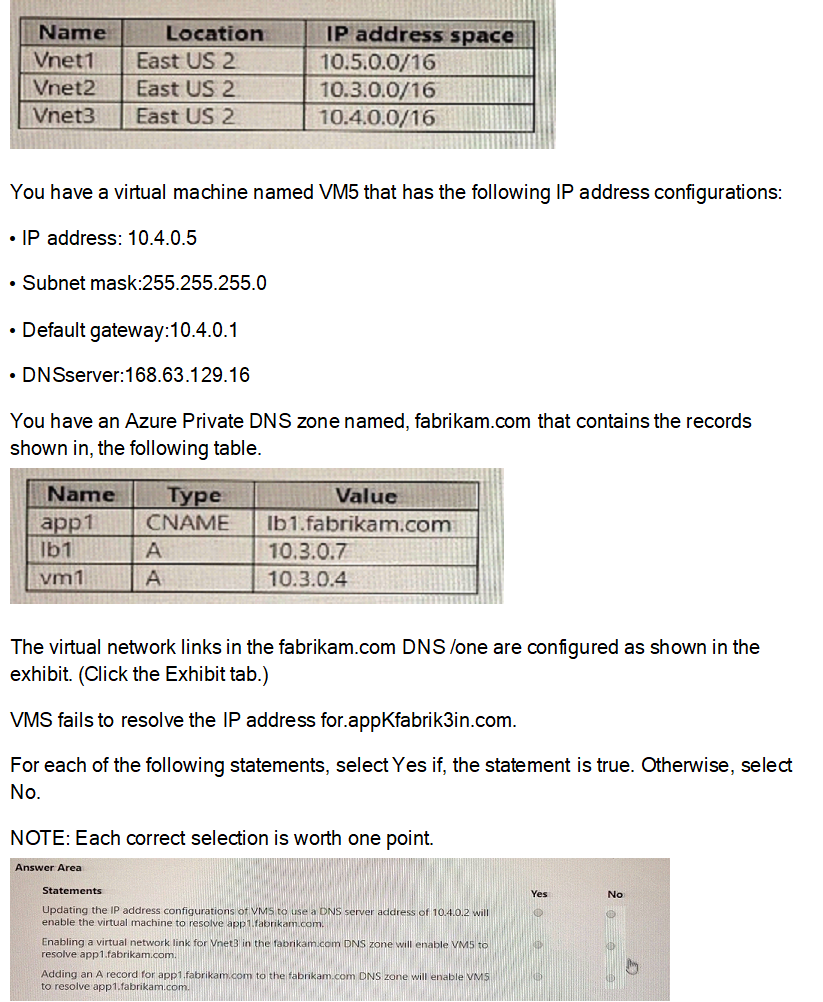
You have an Azure subscription that contains the virtual networks.shown in the following table.

You need to use Traffic Analytics to monitor the usage of applications deployed to Azure virtual machines.
Which Azure Network Watcher feature should you implement first?
A.
Connection monitor
B.
Connection monitor
C.
NSG flow logs
D.
IP flow verify
NSG flow logs
Note: This question is part of a series of questions that present the same scenario. Each question in the series contains a unique solution that might meet the stated goals. Some question sets might have more than one correct solution, while others might not have a correct solution. After you answer a question in this section, you will NOT be able to return to it as a result, these questions will not appear in the review screen.
You have an Azure subscription that contains an Azure Front Door Premium profile named AFD1 and an Azure Web Application Firewall (WAF) policy named WAF1. AFD1 is associated with WAF1.
You need to configure a rate limit for incoming requests to AFD1. Solution: You modify the policy settings of WAF1.
Does this meet the goal?
A.
Yes
B.
No
No
| Page 6 out of 19 Pages |