Topic 4: Mix Questions

You have an Azure subscription that contains an Azure web app named Appl.
You plan to configure a Conditional Access policy for Appl. The solution must meet the following requirements:

• Only allow access to App1 from Windows devices.
• Only allow devices that are marked as compliant to access Appl.

Which Conditional Access policy settings should you configure? To answer, drag the appropriate settings to the correct requirements. Each setting may be used once, more than once, or not at all. You may need to drag the split bar between panes or scroll to view content.
NOTE: Each correct selection is worth one point.


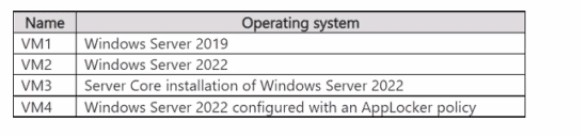
You have an Azure subscription that contains the virtual machines shown in the following table.


You are configuring Microsoft Defender for Servers.
You plan to enable adaptive application controls to create an allowlist of known-safe apps on the virtual machines. Which virtual machines support the use of adaptive application controls?

A. VM1 and VM2 only

B. VM2 and VM4 only

C. VM2 and VM3 only

D. VM1, VM2, VM3, and VM4

D.   VM1, VM2, VM3, and VM4

You have an Azure subscription named Sub1. Sub1 contains a virtual network named VNet1 that contains one subnet named Subnet1.
You create a service endpoint for Subnet1.
Subnet1 contains an Azure virtual machine named VM1 that runs Ubuntu Server 18.04.
You need to deploy Docker containers to VM1. The containers must be able to access Azure Storage resources and Azure SQL databases by using the service endpoint.

A. Create an application security group and a network security group (NSG).

B. Edit the docker-compose.yml file.

C. Install the container network interface (CNI) plug-in.

C.   Install the container network interface (CNI) plug-in.

You have an Azure subscription name Sub1 that contains an Azure Policy definition named Policy1. Policy1 has the following settings:

Definition location: Tenant Root Group
Category: Monitoring

You need to ensure that resources that are noncompliant with Policy1 are listed in the Azure Security Center dashboard.
What should you do first?

A. Change the Category of Policy1 to Security Center.

B. Add Policy1 to a custom initiative.

C. Change the Definition location of Policy1 to Sub1.

D. Assign Policy1 to Sub1.

D.   Assign Policy1 to Sub1.

You have an Azure subscription.
You create an Azure web app named Contoso1812 that uses an S1 App service plan.
You create a DNS record for www.contoso.com that points to the IP address of Contoso1812.
You need to ensure that users can access Contoso1812 by using the https://www.contoso.com URL.
Which two actions should you perform? Each correct answer presents part of the solution.
NOTE: Each correct selection is worth one point.

A. Turn on the system-assigned managed identity for Contoso1812.

B. Add a hostname to Contoso1812.

C. Scale out the App Service plan of Contoso1812.

D. Add a deployment slot to Contoso1812.

E. Scale up the App Service plan of Contoso1812.

F. Upload a PFX file to Contoso1812

B.   Add a hostname to Contoso1812.
F.   Upload a PFX file to Contoso1812

Note: This question is part of a series of questions that present the same scenario.
Each question in the series contains a unique solution that might meet the stated goals. Some question sets might have more than one correct solution, while others might not have a correct solution.
After you answer a question in this section, you will NOT be able to return to it. As a result, these questions will not appear in the review screen.
You use Azure Security Center for the centralized policy management of three Azure subscriptions.
You use several policy definitions to manage the security of the subscriptions.
You need to deploy the policy definitions as a group to all three subscriptions.
Solution: You create an initiative and an assignment that is scoped to the Tenant Root Group management group.
Does this meet the goal?

A. Yes

B. No

A.   Yes

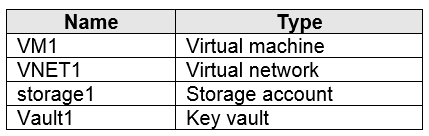
You have an Azure subscription that contains the resources shown in the following table.


You plan to enable Azure Defender for the subscription.
Which resources can be protected by using Azure Defender?

A. VM1, VNET1, storage1, and Vault1

B. VM1, VNET1, and storage1 only

C. VM1, storage1, and Vault1 only

D. VM1 and VNET1 only

E. VM1 and storage1 only

A.   VM1, VNET1, storage1, and Vault1

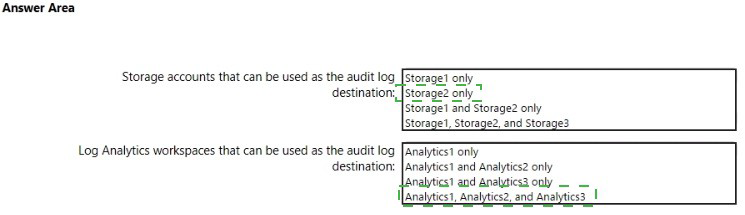
You have an Azure subscription that contains the resources shown in the following table.
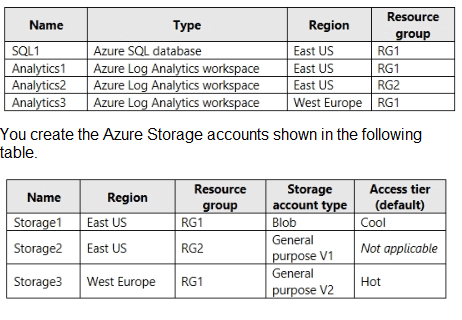


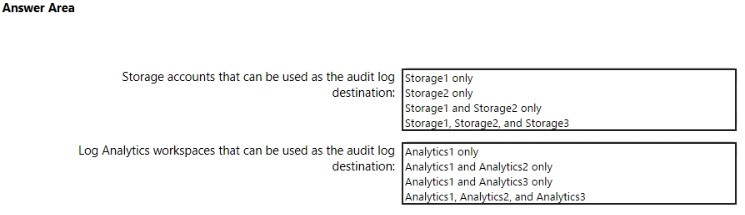
You need to configure auditing for SQL1.
Which storage accounts and Log Analytics workspaces can you use as the audit log destination? To answer, select the appropriate options in the answer area.
NOTE: Each correct selection is worth one point.
You have Azure virtual machines that have Update Management enabled. The virtual machines are configured as shown in the following table.
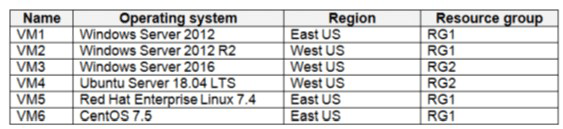


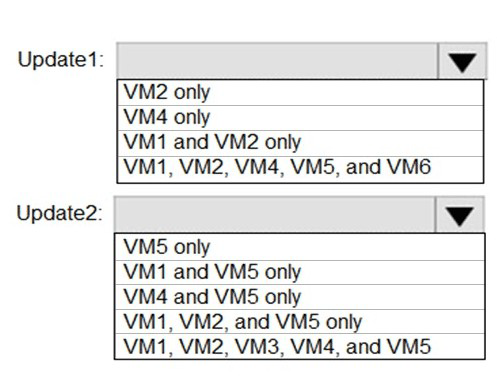
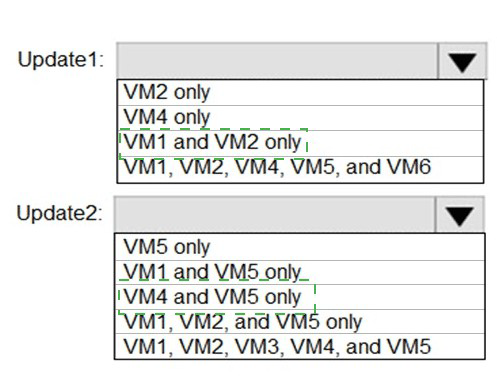
You schedule two update deployments named Update1 and Update2. Update1 updates VM3. Update2 updates VM6.
Which additional virtual machines can be updated by using Update1 and Update2? To answer, select the appropriate options in the answer area.
NOTE: Each correct selection is worth one point.
Note: This question is part of a series of questions that present the same scenario. Each question in the series contains a unique solution that might meet the stated goals. Some question sets might have more than one correct solution, while others might not have a correct solution.
After you answer a question in this section, you will NOT be able to return to it. As a result, these questions will not appear in the review screen.
You have an Azure Subscription. The subscription contains 50 virtual machines that run Windows Server 2012 R2 or Windows Server 2016.
You need to deploy Microsoft Antimalware to the virtual machines.
Solution: You connect to each virtual machine and add a Windows feature.
Does this meet the goal?

A. Yes

B. No

B.   No

Page 8 out of 50 Pages