Topic 4: Mix Questions

You have an Azure AD tenant that contains the users shown in the following table.
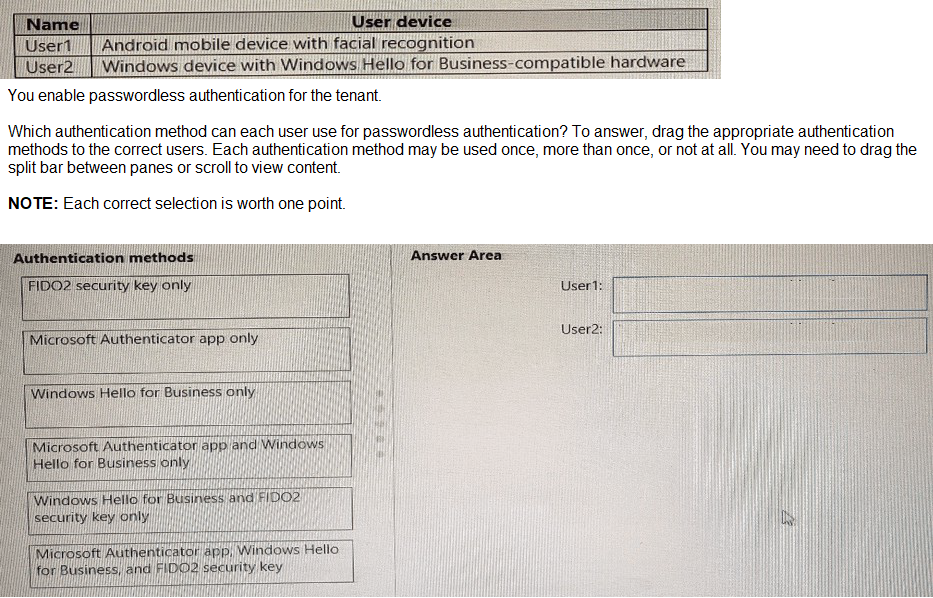

You have an Azure subscription. You configure the subscription to use a different Azure Active Directory (Azure AD) tenant. What are two possible effects of the change? Each correct answer presents a complete solution.
NOTE: Each correct selection is worth one point.

A. Role assignments at the subscription level are lost.

B. Virtual machine managed identities are lost.

C. Virtual machine disk snapshots are lost.

D. Existing Azure resources are deleted

A.   Role assignments at the subscription level are lost.
B.   Virtual machine managed identities are lost.

You have three on-premises servers named Server1, Server2, and Server3 that run Windows Server1 and Server2 and located on the Internal network. Server3 is located on the premises network. All servers have access to Azure. From Azure Sentinel, you install a Windows firewall data connector. You need to collect Microsoft Defender Firewall data from the servers for Azure Sentinel. What should you do?

A. Create an event subscription from Server1, Server2 and Server3

B. Install the On-premises data gateway on each server.

C. Install the Microsoft Agent on each server.

D. Install the Microsoft Agent on Server1 and Server2 install the on-premises data gateway on Server3.

C.   Install the Microsoft Agent on each server.

You have been tasked with applying conditional access policies for your company’s current Azure Active Directory (Azure AD). The process involves assessing the risk events and risk levels. Which of the following is the risk level that should be configured for users that have leaked credentials?

A. None

B. Low

C. Medium

D. High

D.   High

You have an Azure subscription named Sub1 that contains the virtual machines shown in the following table.
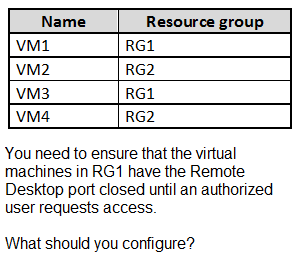
A. Azure Active Directory (Azure AD) Privileged Identity Management (PIM)

B. an application security group

C. Azure Active Directory (Azure AD) conditional access

D. just in time (JIT) VM access

D.   just in time (JIT) VM access

Your on-premises network contains the servers shown in the following table.
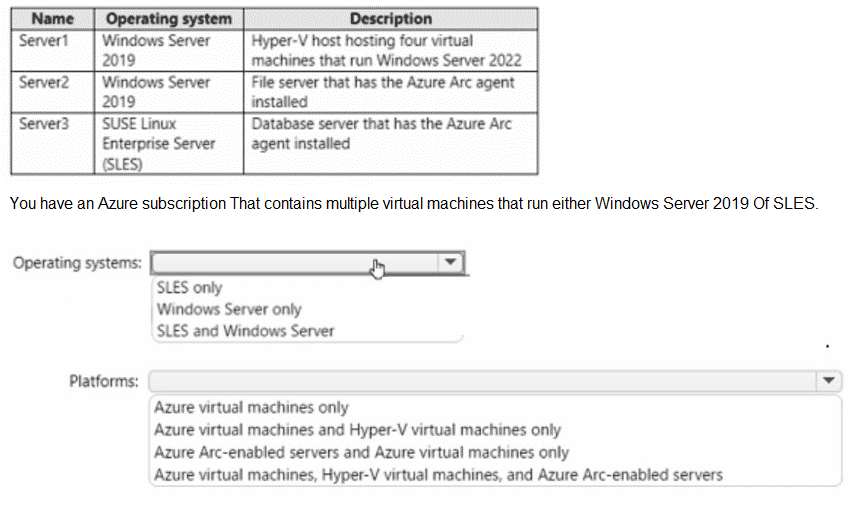

You have an Azure subscription that contains the virtual machines shown in the following table.
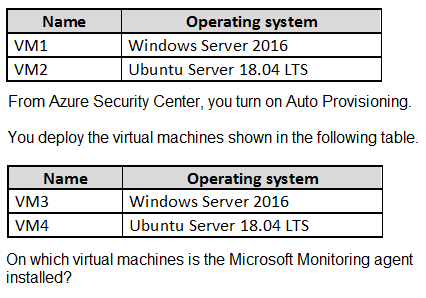
A. VM3 only

B. VM1 and VM3 only

C. VM3 and VM4 only

D. VM1, VM2, VM3, and VM4

D.   VM1, VM2, VM3, and VM4

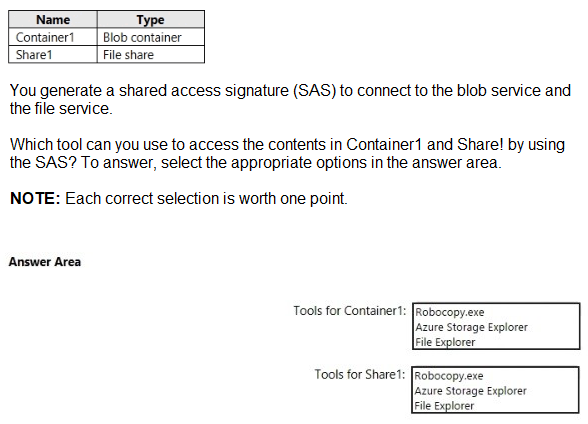
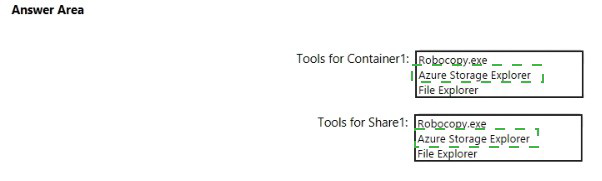
You have an Azure subscription named Sub1. Sub1 has an Azure Storage account named Storage1 that contains the resources shown in the following table.
You have an Azure subscription that contains an Azure Data Lake Storage account named sa1.
You plan to deploy an app named App1 that will access sa1 and perform operations, including Read. List, Create Directory, and Delete Directory.
You need to ensure that App1 can connect securely to sa1 by using a private endpoint What is the minimum number of private endpoints required for sa1?

A. 1

B. 2

C. 3

D. 4

E. 5

A.   1

You have an Azure subscription that contains a virtual network named VNet1 VNet1 contains a single subnet. The subscription contains a virtual machine named VM1 that is connected to VNet1.
You plan to deploy an Azure SQL managed instance named SQL1.
You need to ensure that VM1 can access SQL1.
Which three components should you create? Each correct answer presents pan of the solution.
NOTE: Each correct selection is worth one point.

A. a virtual network gateway

B. a network security group (NSG)

C. a route table

D. a subnet

E. a network security perimeter

B.   a network security group (NSG)
C.   a route table
D.   a subnet

Page 17 out of 50 Pages