Topic 4, Misc. Questions
You are developing an Azure Function App that processes images that are uploaded to an
Azure Blob container.
Images must be processed as quickly as possible after they are uploaded, and the solution
must minimize latency. You create code to process images when the Function App is
triggered.
You need to configure the Function App.
What should you do?
A.
Use an App Service plan. Configure the Function App to use an Azure Blob Storage input trigger.
B.
Use a Consumption plan. Configure the Function App to use an Azure Blob Storage trigger.
C.
Use a Consumption plan. Configure the Function App to use a Timer trigger.
D.
Use an App Service plan. Configure the Function App to use an Azure Blob Storage trigger.
E.
Use a Consumption plan. Configure the Function App to use an Azure Blob Storage input trigger.
Use a Consumption plan. Configure the Function App to use an Azure Blob Storage trigger.
Explanation:
The Blob storage trigger starts a function when a new or updated blob is detected. The
blob contents are provided as input to the function.
The Consumption plan limits a function app on one virtual machine (VM) to 1.5 GB of
memory.
Reference:
https://docs.microsoft.com/en-us/azure/azure-functions/functions-bindings-storage-blobtrigger
An organization hosts web apps in Azure. The organization uses Azure Monitor You discover that configuration changes were made to some of the web apps. You need to identify the configuration changes. Which Azure Monitor log should you review?
A.
AppServiceEnvironmentPlatformLogs
B.
AppServiceApplogs
C.
AppServiceAuditLogs
D.
AppServiceConsoteLogs
AppServiceAuditLogs
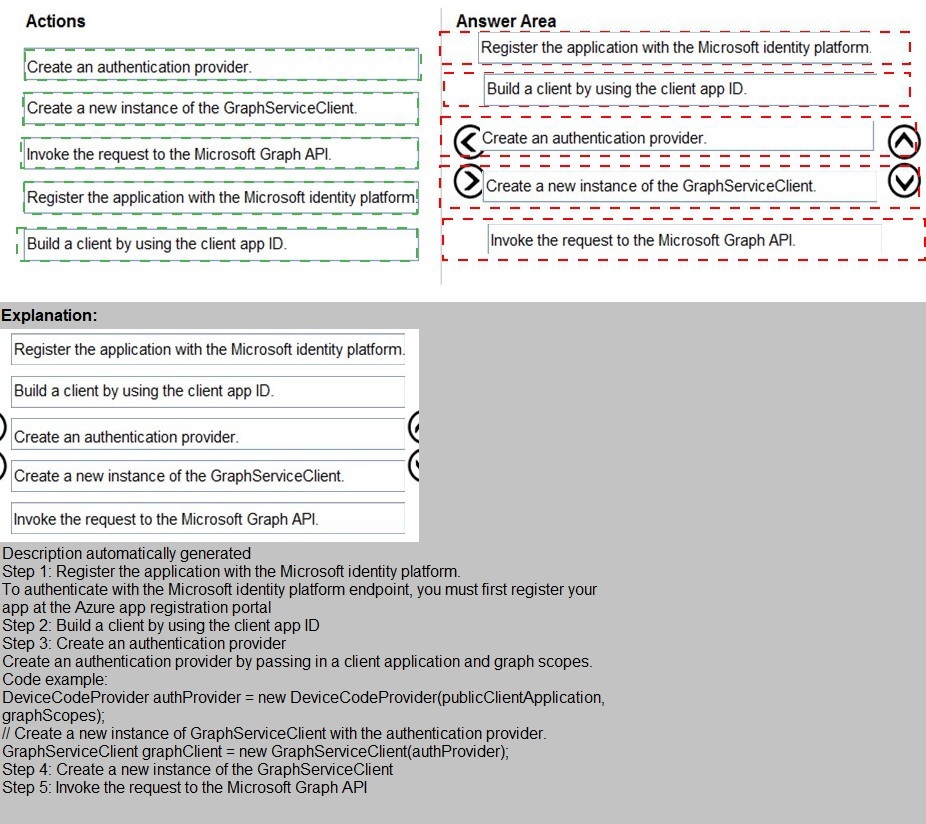
You are developing an application to retrieve user profile information. The application will
use the Microsoft Graph SDK.
The app must retrieve user profile information by using a Microsoft Graph API call.
You need to call the Microsoft Graph API from the application.
In which order should you perform the actions? To answer, move all actions from the list of
actions to the answer area and arrange them in the correct order.
You develop and deploy an Azure App Service -- app. The web app accesses data in an
Azure SQL database
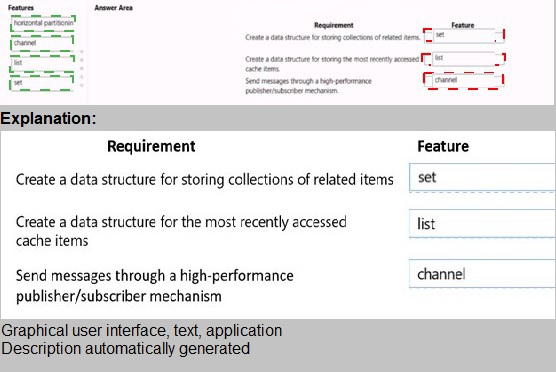
You must update the web app to store frequently used data m a new Azure Cache for
Redis Premium instance.
You need to implement the Azure Cache for Redis features.
Which feature should you implement? To answer, drag the appropriate feature to the
correct requirements Each feature may be used once, more than once, or not at all You
may need to ------ between panes or scroll to view content.
NOTE Each correct selection is worth one point

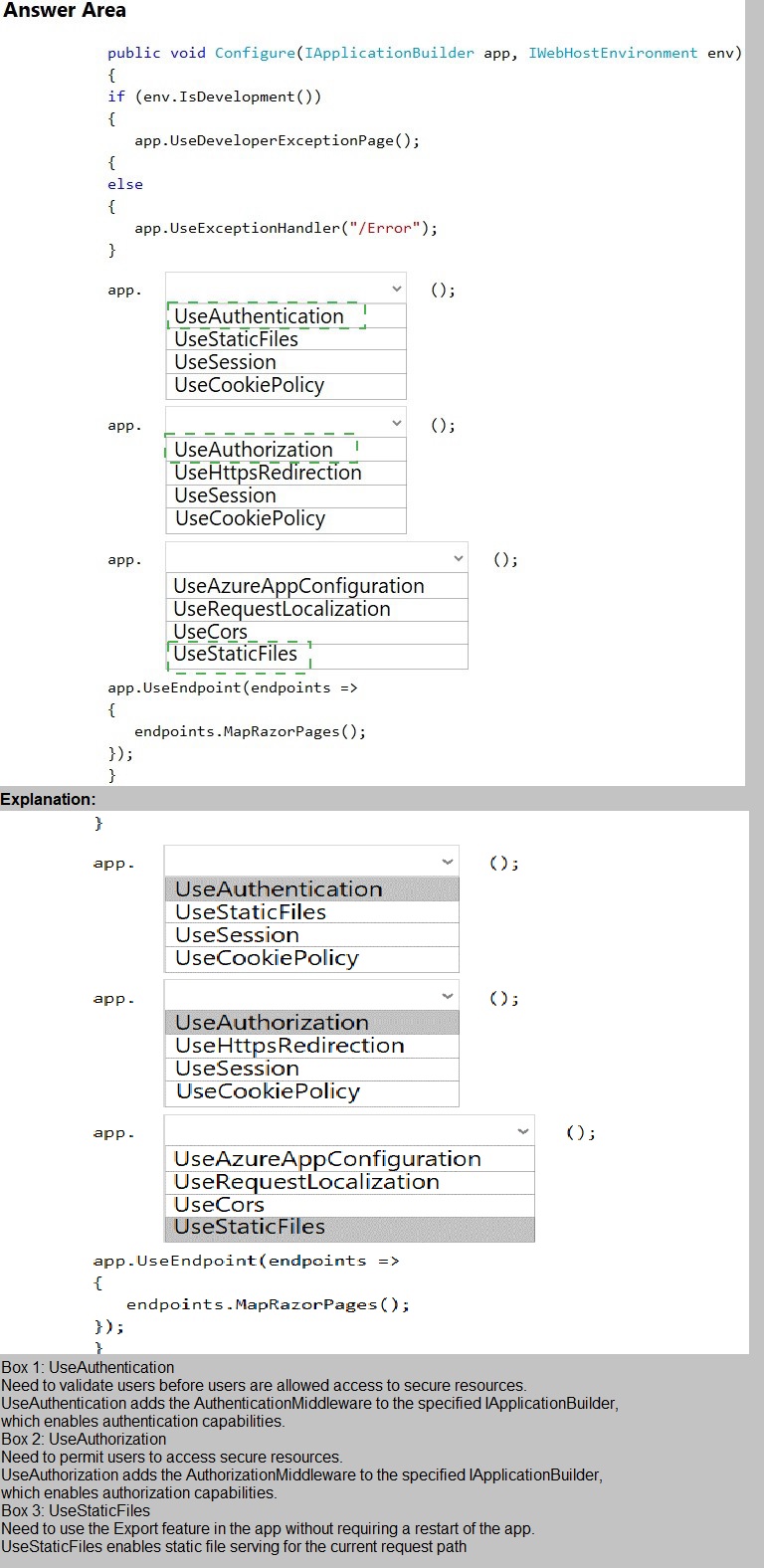
You are developing an ASP.NET Core app that includes feature flags which are managed
by Azure App Configuration. You create an Azure App Configuration store named
AppFeatureFlagStore that contains a feature flag named Export.
You need to update the app to meet the following requirements:
Use the Export feature in the app without requiring a restart of the app.
Validate users before users are allowed access to secure resources.
Permit users to access secure resources.
How should you complete the code segment? To answer, select the appropriate options in
the answer area.
NOTE: Each correct selection is worth one point.
You develop and deploy an Azure App Service web app. The app is deployed to multiple regions and uses Azure Traffic Manager. Application Insights is enabled for the app.You need to analyze app uptime for each month.
Which two solutions win achieve the goal? Each correct answer presents a complete solution NOTE: Each correct selection is worth one point
A.
Application Insights alerts
B.
Application Insights web tests
C.
Azure Monitor logs
D.
Azure Monitor metrics
Application Insights alerts
C.
Azure Monitor logs
Reference:
https://azure.microsoft.com/en-us/blog/creating-a-web-test-alert-programmatically-withapplication-
insights/
A development team is creating a new REST API. The API will store data in Azure Blob
storage. You plan to deploy the API to Azure App Service.
Developers must access the Azure Blob storage account to develop the API for the next
two months. The Azure Blob storage account must not be accessible by the developers
after the two-month time period.
You need to grant developers access to the Azure Blob storage account.
What should you do?
A.
Generate a shared access signature (SAS) for the Azure Blob storage account and provide the SAS to all developers.
B.
Create and apply a new lifecycle management policy to include a last accessed date value. Apply the policy to the Azure Blob storage account.
C.
Provide all developers with the access key for the Azure Blob storage account. Update the API to include the Coordinated Universal Time (UTC) timestamp for the request header.
D.
Grant all developers access to the Azure Blob storage account by assigning role-based
Generate a shared access signature (SAS) for the Azure Blob storage account and provide the SAS to all developers.
Reference:
https://docs.microsoft.com/en-us/azure/storage/common/storage-sas-overview
You are developing an Azure messaging solution.
You need to ensure that the solution that meets the following requirements:
• Provide transactional support
• Provide duplicate detection.
• Store the messages for an unlimited period of time
Which two technologies will meet the requirements? Each correct answer presents a complete solution NOTE Each correct selection is worth one point.
A.
Azure Service Bus Queue
B.
Azure Storage Queue
C.
Azure Service Bus Topic
D.
Azure Event Hub
Azure Service Bus Queue
C.
Azure Service Bus Topic
Explanation:
The Azure Service Bus Queue and Topic has duplicate detection.
Enabling duplicate detection helps keep track of the application-controlled MessageId of all
messages sent into a queue or topic during a specified time window.
Reference:
https://docs.microsoft.com/en-us/azure/service-bus-messaging/duplicate-detection
You develop and deploy a web application to Azure App Service. The application accesses
data stored in an Azure Storage account. The account contains several containers with
several blobs with large amounts of data. You deploy all Azure resources to a single
region.
You need to move the Azure Storage account to the new region. You must copy all data to
the new region.
What should you do first?
A.
Export the Azure Storage account Azure Resource Manager template
B.
Initiate a storage account failover
C.
Configure object replication for all blobs
D.
Use the AzCopy command line tool
E.
Create a new Azure Storage account in the current region
F.
Create a new subscription in the current region
Export the Azure Storage account Azure Resource Manager template
Explanation:
To move a storage account, create a copy of your storage account in another region. Then,
move your data to that account by using AzCopy, or another tool of your choice and finally,
delete the resources in the source region.
To get started, export, and then modify a Resource Manager template.
Reference:
https://docs.microsoft.com/en-us/azure/storage/common/storage-accountmove?
tabs=azure-portal
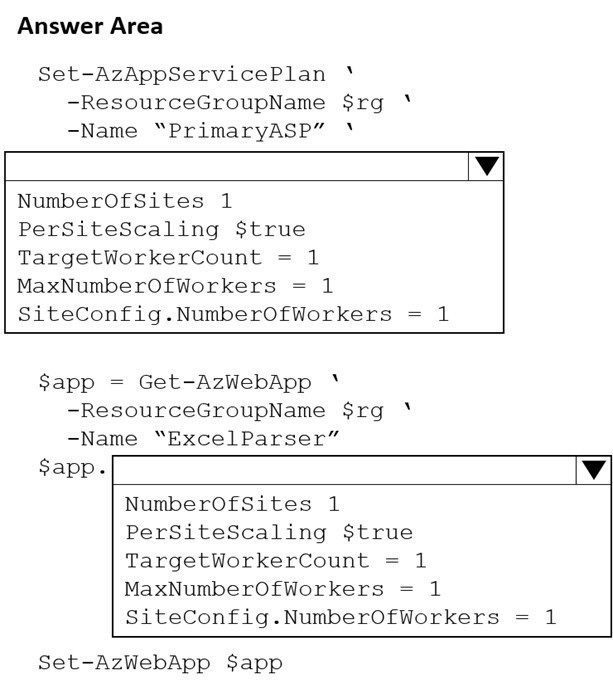
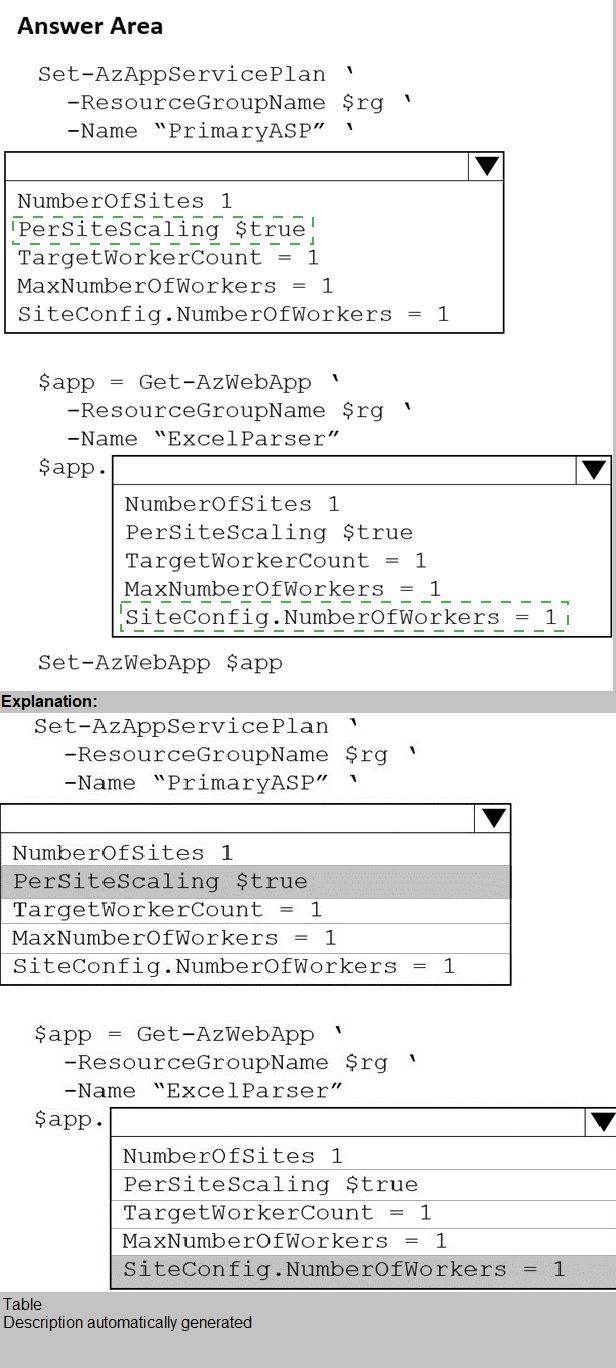
A software as a service (SaaS) company provides document management services. The
company has a service that consists of several Azure web apps. All Azure web apps run in
an Azure App Service Plan named PrimaryASP.
You are developing a new web service by using a web app named ExcelParser. The web
app contains a third-party library for processing Microsoft Excel files. The license for the
third-party library stipulates that you can only run a single instance of the library.
You need to configure the service.
How should you complete the script? To answer, select the appropriate options in the
answer area. NOTE: Each correct selection is worth one point.
| Page 6 out of 28 Pages |