Topic 2: Misc. Questions
You plan to deploy an SAP environment on Azure.
You plan to store all SAP connection strings securely in Azure Key Vault without storing credentials on the
Azure virtual machines that host SAP.
What should you configure to allow the virtual machines to access the key vault?
A.
Azure Active Directory (Azure AD) Privilege Identity Manager (PIM)
B.
role-based access control (RBAC)
C.
a Managed Service Identity (MSI)
D.
the Custom Script Extension
a Managed Service Identity (MSI)
Explanation:
To reference a credential stored in Azure Key Vault, you need to:
- Retrieve data factory managed identity
- Grant the managed identity access to your Azure Key Vault
- Create a linked service pointing to your Azure Key
- Create data store linked service, inside which reference the corresponding secret stored in key vault.
References:
https://docs.microsoft.com/bs-latn-ba/azure/data-factory/store-credentials-in-key-vault
You have an SAP environment on Azure.
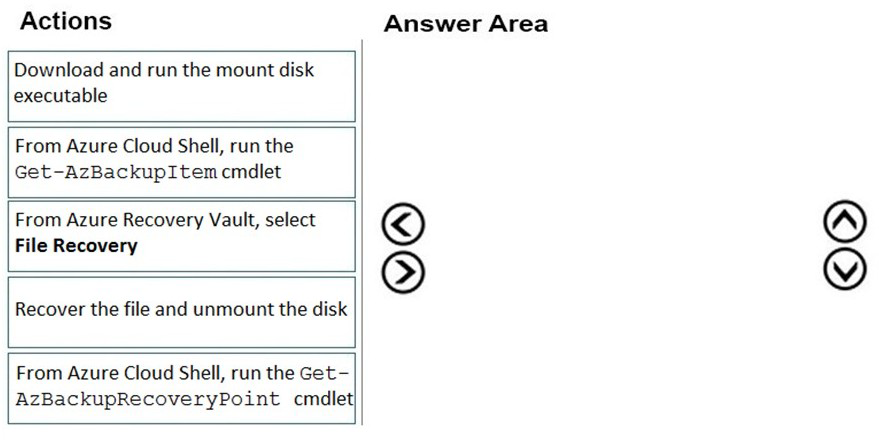
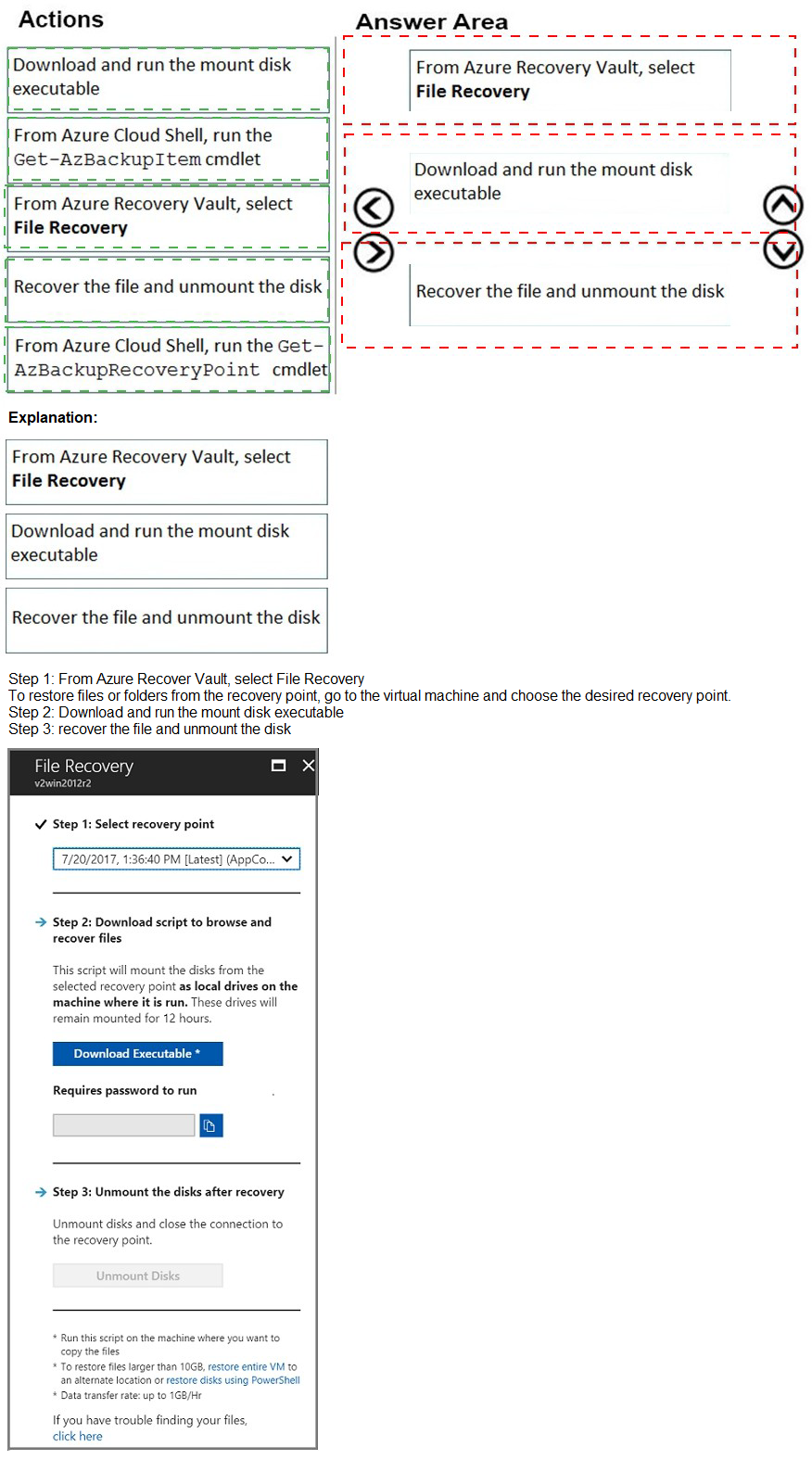
You use Azure Recovery Services to back up an SAP application server. You need to test the restoration process of a file on the server.
Which three actions should you perform in sequence? To answer, move the appropriate actions from the list of actions to the answer area and arrange them in the correct order.
You plan to migrate an SAP ERP Central Component (SAP ECC) production system to Azure.
You are reviewing the SAP EarlyWatch Alert report for the system.
You need to recommend sizes for the Azure virtual machines that will host the system.
Which two sections of the report should you review? Each correct answer presents a complete solution.
NOTE: Each correct selection is worth one point.
A.
Hardware Capacity
B.
Patch Levels under SAP Software Configuration
C.
Hardware Configuration under Landscape
D.
Database and ABAP Load Optimization
E.
Data Volume Management
Hardware Capacity
D.
Database and ABAP Load Optimization
You plan to migrate an SAP environment to Azure.
You need to create a design to facilitate end-user access to SAP applications over the Internet, while restricting user access to the virtual machines of the SAP application servers. What should you include in the design?
A.
Configure a public IP address for each SAP application server
B.
Deploy an internal Azure Standard Load Balancer for incoming connections
C.
Use an SAP Web Dispatcher to route all incoming connections
D.
Configure point-to-site VPN connections for each user
Use an SAP Web Dispatcher to route all incoming connections
Explanation:
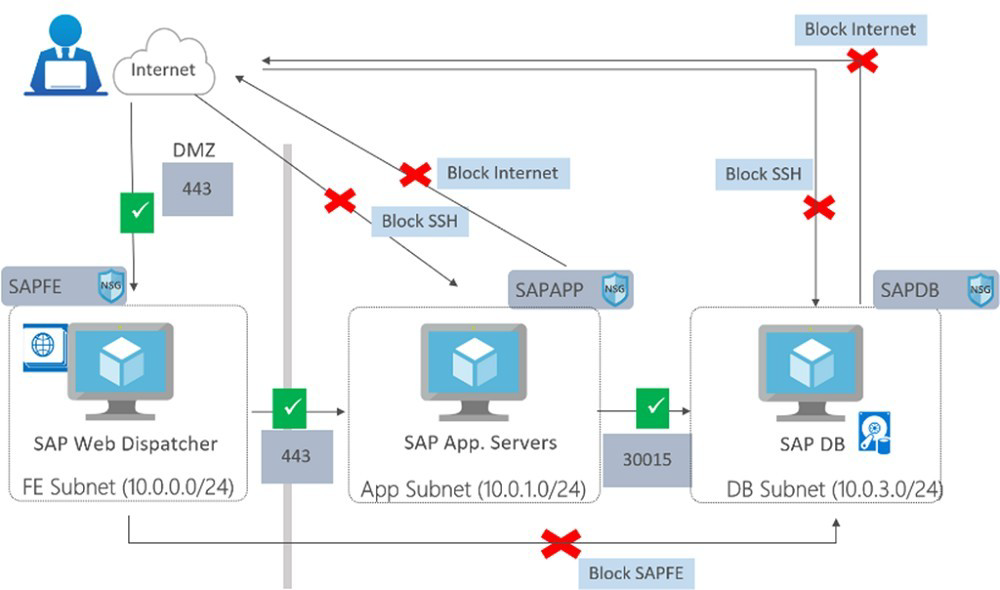
A public internet user can reach the SAP Web-Dispatcher over port 443
The SAP Web-Dispatcher can reach the SAP Application server over port 443 The App Subnet accepts traffic on port 443 from 10.0.0.0/24
The SAP Application server sends traffic on port 30015 to the SAP DB server The DB subnet accepts traffic on port 30015 from 10.0.1.0/24.
Public Internet Access is blocked on both App Subnet and DB Subnet.
You have an on-premises SAP environment that uses AIX servers and IBM DB2 as the database platform.
You plan to migrate SAP to Azure. In Azure, the SAP workloads will use Windows Server and Microsoft SQL
Server as the database platform.
What should you use to export from DB2 and import the data to SQL Server?
A.
R3load
B.
Azure SQL Data Warehouse
C.
SQL Server Management Studio (SSMS)
D.
R3trans
R3load
Explanation:
Both R3load and SSMA can be used to migrate from DB2 to SQL Server. In the options there is not SSMA, but SSMS, the SSMS cannot be use to migrate DB2 to SQL Server. please refer to:
https://techcommunity.microsoft.com/t5/running-sap-applications-on- the/sap-os-db-migration-to-sql-server-faq/ba-p/366986
https://sapnwnewbie.blogspot.com/2013/07/osdb-migration-cmd-str-toc-ext-r3load.html
https://docs.microsoft.com/en-us/sql/ssma/sql-server-migration-assistant?view=sql-server- ver15
https://docs.microsoft.com/en-us/sql/ssms/sql-server-management-studio-ssms?view=sql- server-ver15
You migrate an on-premises instance of SAP NANA that runs SUSE Linux Enterprise Server (SLES) to an Azure virtual machine.
You project that in two years, you will replace the virtual machine with a larger virtual machine within the same flexibility group.
You need to recommend solutions to minimize HANA deployment costs during the next three years. The solutions must not affect the availability SLAs.
Which two solutions should you recommend? Each correct answer presents a complete solution
NOTE: Each correct selection is worth one point.
A.
a three-year reservation that has instance size flexibility
B.
a one-year reservation that has instance size flexibility
C.
a one-year reservation that has capacity priority
D.
Azure Hybrid Benefit
E.
Azure Spot instance
a three-year reservation that has instance size flexibility
D.
Azure Hybrid Benefit
You have an on-premises SAP environment.
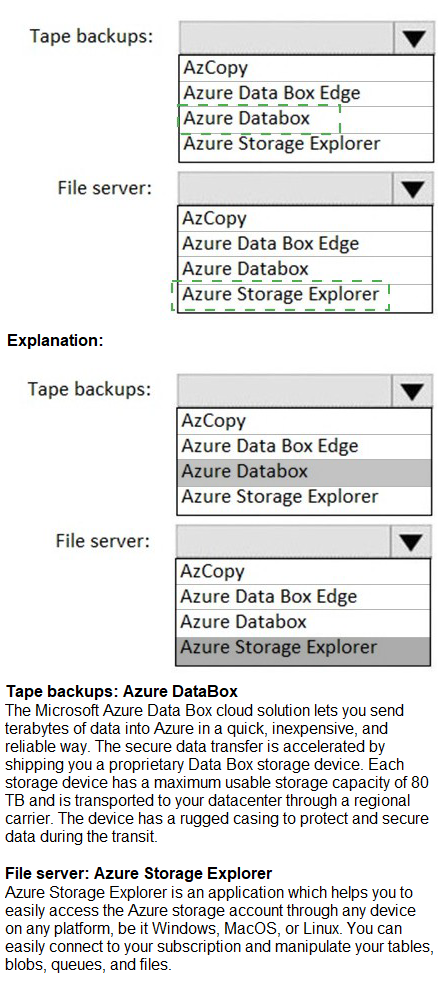
Backups are performed by using tape backups. There are 50 TB of backups.
A Windows file server has BMP images of checks used by SAP Finance. There are 9 TB of images.
You need to recommend a method to migrate the images and the tape backups to Azure. The solution must maintain continuous replication of the images.
What should you include in the recommendation? To answer, select the appropriate options in the answer area.
NOTE: Each correct selection is worth one point.

Your on-premises network contains the following:
- A 1-Gbps internet connection
- An SAP HANA 1.0 instance that has a 4-TB database
- An SAP landscape that uses SUSE Linux Enterprise (SLES) 12
You have an Azure subscription that contains a virtual machine. The virtual machine is of the M64s SKU and runs SLES 15 and HANA 2.0.
You need to migrate the database to the virtual machine and upgrade the database to HANA 2.0. The solution must meet the following requirements:
- The migration must be performed during a weekend
- The database can be offline during the migration
Which migration method should you use?
A.
Azure Data Box
B.
HANA database backup and log shipping
C.
Azure Migrate
D.
HANA database export and import
You have an on-premises deployment of SAP on DB2.
You plan to migrate the deployment to Azure and Microsoft SQL Server 2017.
What should you use to migrate the deployment?
A.
SQL Server Migration Assistant (SSMA)
B.
Azure SQL Data Sync
C.
db2haicu
D.
DSN1COPY
SQL Server Migration Assistant (SSMA)
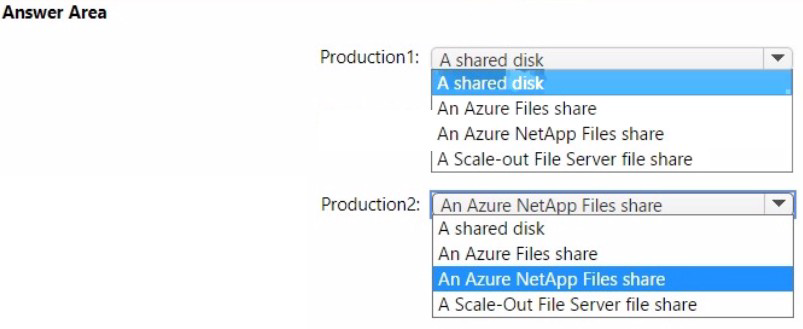
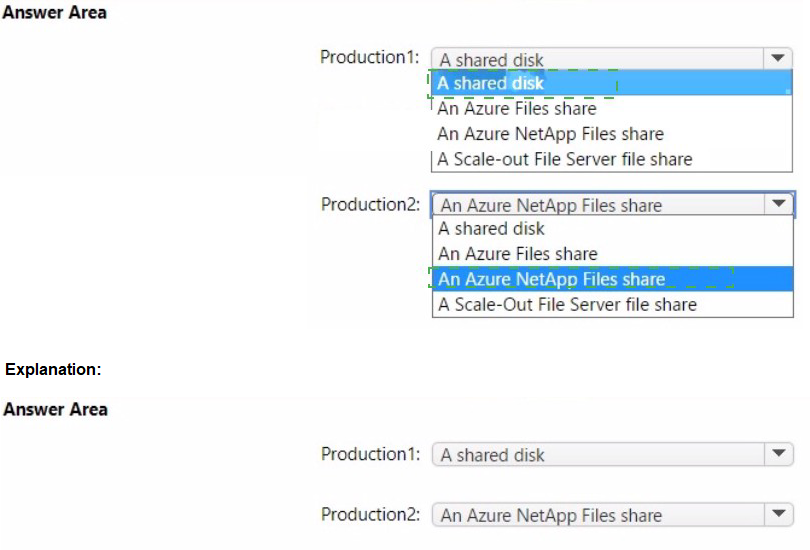
You plan to deploy two SAP NetWeaver landscapes named Production1 and Production2 to Azure. Production! will contain an SAP NetWeaver central services (ASCS/SCS) instance hosted on a Windows failover cluster. Production2 will contain an SAP ASCS/SCS instance hosted on a Linux Pacemaker cluster.
You need to recommend a shared storage solution for each landscape. The solutions must meet the following requirements:
- Minimize administrative
- Minimize
What should you include in the recommend? To answer, select the appropriate options in the answer area. NOTE: Each correct selection is worth one point.
| Page 6 out of 22 Pages |